

How to Reduce Streaming CDN Costs: A Pricing Guide
Streaming CDN costs are easy to underestimate because providers do not all sell the same unit. Some charge per gigabyte, some charge per delivered minute, and others bundle delivery with encoding, storage, security, or committed capacity. A headline rate is useful only after you make those differences explicit.
This guide compares current published pricing from AWS CloudFront, Cloudflare Stream, and ZeroBuffer.io. It uses one declared workload and shows the arithmetic, so every figure below can be recalculated from each provider's own public rate card.
Ownership and commercial disclosure: ZeroBuffer and Apexnova are operated by the same company, Apexnova Private Limited. ZeroBuffer is not an independent supplier we selected after a competitive evaluation — we built it, and Apexnova uses it for part of its video delivery infrastructure. Treat this article as a costing method with a worked example, not as a neutral recommendation, and price ZeroBuffer against at least two specialist video CDNs we do not own before deciding anything. The ZeroBuffer figures used below are the public list rates any buyer can sign up for, not the internal rate Apexnova pays.
The short answer: how can you reduce streaming CDN costs?
To reduce streaming CDN costs, measure delivered bytes and viewing minutes, normalize every quote to the same traffic and geography, then test the lowest credible options with real playback data. Rate changes matter, but so do bitrate, cache behavior, request fees, storage, transcoding, contractual commitments, and failover capacity.
For a high-volume workload, a specialist video CDN can be materially cheaper than general-purpose pay-as-you-go delivery. Both sides of that comparison move with volume: general-purpose CDNs step down through published tiers, and so do specialist ones. Across the bands Apexnova has priced, specialist volume delivery has stayed below the general-purpose alternatives — but the margin against other specialist video CDNs is far narrower, so quote two or three of them before deciding.
Streaming CDN pricing compared on one workload
The example below assumes 500 TB per month = 500,000 GB, using decimal units. It models delivery only unless the row says otherwise. Taxes, negotiated discounts, HTTP request charges, origin costs, storage, DRM, logs, and support are excluded.
| Provider and product | Published or disclosed basis | Illustrative delivery cost at 500 TB | What the number does not prove |
|---|---|---|---|
| ZeroBuffer | Published flat rate, all regions: $0.0049/GB to 200 TB, then $0.0045/GB; steps down further above 500 TB | $2,330 | Operated by the same company as this site — see the disclosure above. Confirm included capacity, support, storage, and processing in writing. |
| AWS CloudFront pay as you go | US/Canada tiered data transfer, first 1 TB free | $23,965 | This is delivery in one pricing region. Requests and optional services are additional; private contracts may be lower. |
| Cloudflare Stream | $1 per 1,000 delivered minutes | $13,333 at a 5 Mbps average bitrate | This is a bitrate conversion, not a native per-GB price. Storage is $5 per 1,000 stored minutes; encoding and bandwidth are included. |
The formulas are deliberately simple:
- ZeroBuffer: 200,000 GB × $0.0049 + 300,000 GB × $0.0045 = $2,330.
- CloudFront US/Canada: 1 TB free + 9 TB × $0.085 + 40 TB × $0.080 + 100 TB × $0.060 + 350 TB × $0.040 = $23,965.
- Cloudflare Stream: a 5 Mbps stream transfers 37.5 MB per minute, so 500 TB represents about 13.33 million delivered minutes; at $1 per 1,000 minutes, delivery is $13,333.
Cloudflare's result changes with bitrate. At 8 Mbps, the same 500 TB represents fewer viewing minutes and would cost about $8,333. That is why per-minute and per-GB products should not be ranked from one converted figure.
What the public prices actually show
The comparison supports two narrower conclusions—not a universal winner.
First, CloudFront's on-demand delivery can be much more expensive than video-focused volume delivery for a large, cacheable US/Canada workload. AWS also publishes discounts for traffic commitments, so a real evaluation must include the account's private offer rather than assume list price.
Second, a single 500 TB snapshot does not transfer to other volumes, because both curves move. CloudFront's published tiers fall as traffic rises, and so do ZeroBuffer's. The gap is widest in the middle of the range: below about 3 TB a month CloudFront's free first terabyte closes most of it, and above about 500 TB CloudFront's volume tiers deepen faster than ZeroBuffer's. Note also what this table does not contain: other specialist video CDNs publish volume rates in the same order of magnitude, so the large gap shown here is against general-purpose delivery, not against the specialist category as a whole.
CDN price is only one part of video infrastructure cost
A per-GB rate does not tell you whether the service replaces other components in the video path. Before comparing totals, map responsibility for five layers:
- Ingest: how live feeds and source files enter the system.
- Encoding and transcoding: which codecs, resolutions, frame rates, and adaptive bitrate renditions are produced.
- Packaging and storage: where HLS or DASH assets, manifests, subtitles, and originals are retained.
- Delivery: how content reaches viewers by geography and device.
- Protection and operations: signed URLs, DRM integration, logs, analytics, support, SLA remedies, and failover.
Cloudflare Stream includes encoding and bandwidth in its delivered-minute model, while storage is billed by stored duration. CloudFront is a general-purpose CDN; the origin, media processing, storage, and associated services remain separate architectural choices. Specialist video CDNs differ widely here—some bundle standard transcoding and a player, then bill storage, replication, premium encoding, or DRM separately.
In Apexnova's deployment, ZeroBuffer spans CDN delivery plus encoding, transcoding, storage infrastructure, and video up to 4K. Buyers should still price those components separately in the evaluation sheet. A low egress rate does not mean every adjacent service is included at no additional charge.
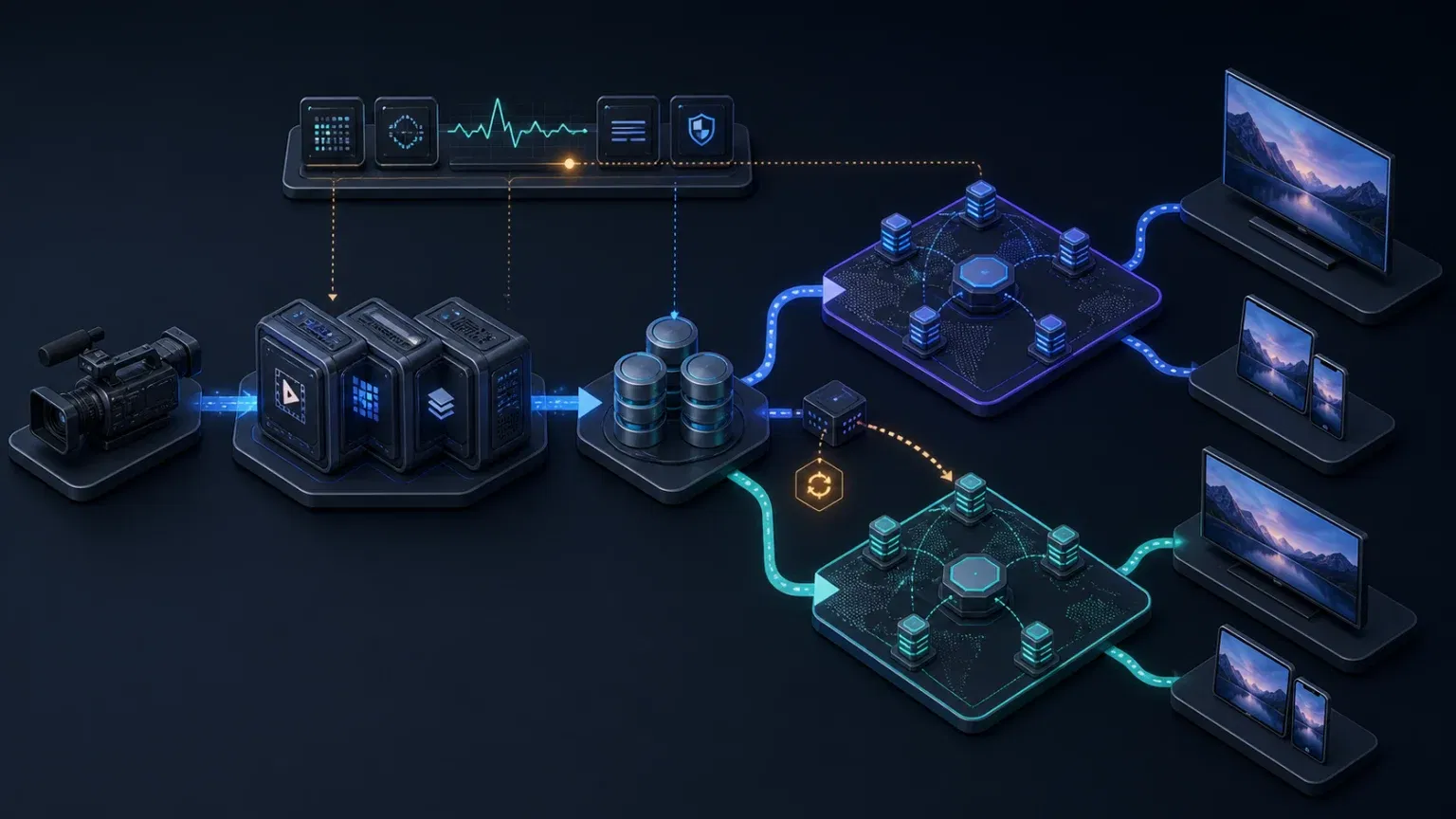
Four engineering levers that reduce streaming CDN costs
1. Right-size the adaptive bitrate ladder
Every unnecessary bit becomes delivery traffic. Start with viewing minutes by rendition, device class, content type, and country. Then test whether the highest rungs create a visible quality benefit on the screens that actually request them.
Do not solve this by simply lowering quality. Use content-aware or per-title encoding where it is justified, preserve a suitable 4K path for devices and titles that benefit, and set quality gates using objective measures plus real-device review. The goal is fewer wasted bits at equivalent viewer experience.
2. Separate manifests from immutable media segments
Live manifests change frequently; completed video segments generally do not. Applying one short time-to-live to both can force avoidable origin fetches. Use distinct cache rules for manifests, live segments, VOD segments, subtitles, thumbnails, and authorization responses.
Track both request and byte cache-hit ratios. A high request hit rate can conceal expensive misses on large video objects, while an authorization or cache-key error can fragment the cache even when the content itself is identical.
3. Protect the origin
An origin shield or equivalent mid-tier cache can collapse concurrent misses before they reach storage or a live packager. This can reduce origin load and help during a cold-cache event, but it does not make origin cost disappear. AWS notes that transfer from an AWS origin to CloudFront is free for ordinary CloudFront origin fetches, while other traffic patterns and services can be billed differently.
Test a cold cache, a popular-title launch, and a regional failover. The origin must tolerate the failure mode, not just average traffic.
4. Route by health, geography, and total cost
A second CDN can improve resilience, but idle failover capacity and duplicated minimum commitments may increase cost. Define when traffic moves, which telemetry triggers the decision, how quickly DNS or application routing reacts, and how sessions recover.
For more detail, see Apexnova's multi-CDN video delivery architecture. The useful policy is not “always choose the cheapest CDN”; it is “choose the lowest-cost healthy path that meets playback and contractual requirements.”
How to evaluate a lower-cost CDN without risking playback
Use a controlled pilot rather than a full cutover based on a spreadsheet.
Establish the baseline
Collect at least one representative billing and playback period. Record:
- delivered GB and viewing minutes by country;
- average bitrate and rendition mix;
- request count and average segment size;
- byte cache-hit ratio and origin traffic;
- video start time, rebuffering ratio, playback failures, and exit-before-start;
- storage, encoding, logging, support, and commitment costs.
Normalize every vendor quote
Give each provider the same traffic matrix. Ask whether a “global” rate has excluded regions, fair-use provisions, traffic-shape conditions, or minimum commitments. Confirm whether terabytes are decimal or binary and whether tiers are progressive, retroactive, or contract-specific.
For ZeroBuffer, the rates above are published list prices with no commitment or minimum attached, which makes them easy to verify but does not make them right for your traffic mix. Request a written quote at your own projected volume and geography from every provider on your list, including this one.
Pilot representative traffic
Route a limited audience slice that includes important geographies, devices, live/VOD formats, and both popular and long-tail content. Keep the incumbent path available for rollback. A pilot that covers only one city or a small set of popular VOD titles will overstate cache performance and hide regional weaknesses.
Set pass/fail gates before the test
Define acceptable changes in startup time, rebuffering, errors, cache efficiency, and total monthly cost. Review support response and incident communication as part of the test. “High availability” should resolve into a written SLA, exclusions, service credits, published maintenance process, and demonstrated failover behavior.
Questions to ask any video CDN provider
- Is the quoted rate public, negotiated, or conditional on a monthly commitment?
- At what volumes does the rate step down, and are those tiers progressive or retroactive?
- Does the same price apply in India, Asia-Pacific, the Middle East, Africa, and South America?
- Are encoding, transcoding, packaging, storage, requests, logs, DRM, and support included?
- Which 4K codecs, profiles, frame rates, HDR formats, and player targets are supported?
- How are cache purge, signed URLs, token validation, and origin shielding billed?
- What are the SLA measurement method, exclusions, remedies, and support response targets?
- Can traffic be exported or failed over without additional origin-egress penalties?
- Will the provider run a measured pilot against the incumbent using the same workload?
Frequently asked questions
What is a reasonable CDN price per GB for video streaming?
There is no universal market rate. Specialist video CDNs publish volume rates in the region of half a cent per GB, while general-purpose pay-as-you-go delivery can be an order of magnitude higher in some regions. Contract size, geography, included services, and commitments all change the effective rate, so compare quotes at your own volume rather than against a headline figure.
Does the ZeroBuffer rate get cheaper at higher volume?
Yes. The published rate is $0.0049/GB to 200 TB, $0.0045/GB to 500 TB, and steps down again above that. General-purpose CDNs also tier down as traffic grows, so the honest comparison is between two curves at your own projected volume, not between two points at someone else's.
Does ZeroBuffer support 4K video and transcoding?
In Apexnova's own deployment, ZeroBuffer provides infrastructure for encoding, transcoding, storage, and CDN delivery for video up to 4K. Buyers should confirm the exact codecs, profiles, HDR requirements, rendition ladder, storage terms, SLA, and price in their own contract.
Should an OTT platform use more than one CDN?
Use multiple CDNs when the measured resilience, geographic performance, or commercial leverage justifies the extra routing and operational complexity. A second provider is not automatically cheaper; model duplicated commitments, origin traffic, observability, and failover testing.
Conclusion
The defensible way to reduce streaming CDN costs is to compare the whole media path with declared assumptions. On the 500 TB example, ZeroBuffer's published rate sits about 90% below CloudFront's US/Canada pay-as-you-go estimate, and both curves keep moving as volume grows. Cloudflare Stream remains a different kind of comparison because it charges for delivered time rather than bytes. Against other specialist video CDNs the margin is much narrower — and since we own ZeroBuffer, that is exactly the comparison you should run on your own numbers rather than take from us.
Price should qualify a provider for testing, not decide the migration. Normalize the quote, test representative traffic, validate high availability, and keep a rollback path. If you want help turning your traffic data into a vendor-neutral cost model and pilot plan, request a streaming infrastructure review.