
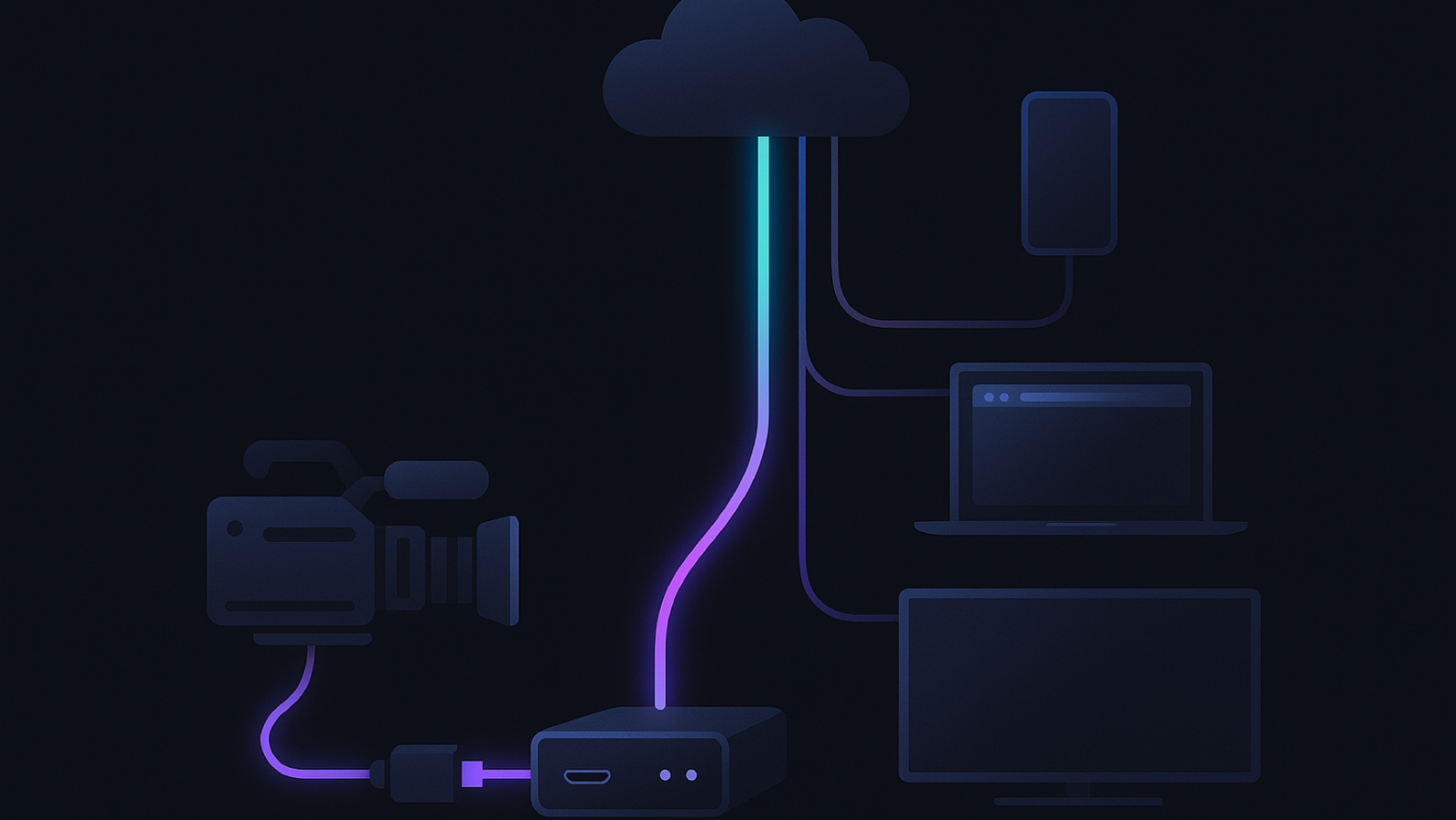
HDMI HLS Encoder: How to Set One Up for Live OTT Streaming
An HDMI HLS encoder can serve HLS itself, but viewers should not stream from it. Learn how to wire one into a live OTT app or website with SRT, a cloud ABR ladder, and a CDN.
Deep dives on OTT engineering, player performance, video infrastructure, and the business of streaming — written by the people who build it.
An HDMI HLS encoder can serve HLS itself, but viewers should not stream from it. Learn how to wire one into a live OTT app or website with SRT, a cloud ABR ladder, and a CDN.
An HDMI HLS encoder can serve HLS itself, but viewers should not stream from it. Learn how to wire one into a live OTT app or website with SRT, a cloud ABR ladder, and a CDN.
Show ads that drop new installs on a generic home screen waste the click. See how deep linking and deferred deep linking land viewers on the exact title and lower OTT CAC.
Firebase Dynamic Links shut down in August 2025, quietly breaking share buttons, emails, QR codes, and campaign deep links. A seven-step migration plan for streaming apps.
Channel-level reports reward shows that bring cheap installs. Learn how title-level OTT campaign attribution finds the shows and creatives that actually produce subscribers.
Same link, same app, two outcomes: one phone opens the episode, the other opens the browser. A setup and debugging guide to Universal Links and App Links for OTT apps.
Compare revenue models, devices, DRM, ownership, and costs, then use a practical scorecard to choose the best OTT platform for your streaming business.
Learn what TV Android OS is, how it differs from Google TV and Fire TV, and what OTT teams must build, test, certify, and monitor for a reliable launch.
Plan an Android TV launch across Google TV discovery, remote-first UX, Media3, Widevine DRM, real-device QA, Play review, scope, and vendor evidence.
Use an MP4 player online with confidence. Compare local playback, URL testing, privacy, codec support, captions, and stream diagnostics before choosing.
Build a native video player Android experience with Media3 ExoPlayer, HLS/DASH, Widevine DRM, lifecycle handling, analytics, and launch testing at scale.
Learn what is bitrate on Twitch, choose stable settings for 720p or 1080p, configure OBS, and fix dropped frames, buffering, and pixelation for viewers.
Full HD is 1920×1080 resolution. Learn how 1080p compares with HD, 2K, and 4K, plus when it delivers the right balance of quality and bandwidth today.
Learn how the AV2 video codec improves compression, HDR, and multiview delivery, where support stands in 2026, and how streaming teams should prepare.
Eighteen OTT app development companies grouped by the decision that actually matters — own a custom build, license a white-label platform, or rent hosted SaaS — with three-year cost math and a due-diligence checklist.
Learn how variable bit rate encoding balances video quality, file size, and bandwidth, plus when OTT teams should choose VBR, CBR, or ABR streaming today.
Augmented reality television is more than 3D graphics on a match. Here are seven practical OTT use cases, the architecture behind them, and a pilot plan that protects the core viewing experience.
Learn how to autobox Java primitives safely, avoid null and identity traps, inspect bytecode, and reduce wrapper allocations in performance-sensitive code.
A polished player is only one layer of a reliable streaming product. Learn how to scope the media path, entitlements, DRM, device testing, QoE release gates, and build-versus-buy decisions before launch.
An OTT cloud bill is more than compute. This buyer’s guide shows how a cloud cost optimization service should audit CDN, encoding, storage, Kubernetes, telemetry, and contracts without weakening playback.
Choose a FAST channel platform with a practical guide to playout, SSAI, EPG, distribution, launch gates, metrics, and build-versus-buy decisions today.
The ingest-to-screen pipeline behind every streaming platform: encoding, adaptive bitrate streaming, multi-CDN delivery, DRM, and the backend microservices — plus the architecture decisions that quietly set your cloud bill.
Full form of OTT means Over-the-Top. Learn how OTT streaming works, how it differs from cable, IPTV and CTV, plus devices, examples and revenue models.
OTT testing guide for reliable streaming: validate playback, DRM, devices, networks, accessibility, analytics, and release readiness before every launch.
Subscription fatigue drives streaming churn. Learn seven practical ways OTT platforms can improve value, discovery, flexibility, and subscriber retention.
See how a smart cloud TV platform works, compare Tizen, webOS, Android TV, Fire TV, and tvOS, and plan a secure, scalable multi-device OTT launch plan.
Why does Netflix have ads? Learn how its lower-priced AVOD tier earns subscription and ad revenue, what viewers get, and how to choose the right plan.
Microdrama monetization explained: compare coins, subscriptions, ads, and licensing, then use a launch framework to protect margins and audience retention.
An OTT marketing strategy built for platform operators: acquire and retain subscribers profitably by tying tactics to your monetization model, acquisition funnel, and retention motion.
Outdoor broadcasting explained: plan cameras, audio, connectivity, redundancy, power, and monitoring for a resilient live stream from any location today.
PPV succeeds when checkout, entitlement, security, and video delivery survive the same event-night spike. This engineering guide maps the architecture and launch decisions from payment to protected playback.
Build a native iOS video player with AVPlayer, SwiftUI, HLS, FairPlay, PiP, telemetry, and a production checklist for reliable streaming apps at scale.
Super aggregation is more than putting streaming apps in one launcher. This blueprint explains the metadata, entitlement, commerce, playback, rollout, and measurement decisions behind a credible unified experience.
OTT teams do not need more dashboards; they need a decision system. This guide connects playback metrics, session architecture, governance, vendor selection, and an auditable ROI model.
A Netflix-like interface is the easy part. This practical guide maps the features, architecture, rights, monetization, cost drivers, and launch gates behind a production-ready streaming service.
Vega OS does not eliminate developer sideloading, and the Cloud App Program is not a nine-month deadline. A device compatibility matrix, the real Vega developer tooling story, and a migration plan built on Amazon's own documentation.
Electronic sell through explained: assess EST fit, design rights, payments, entitlements, DRM, pricing, and launch a reliable digital ownership platform.
Clone Amazon Prime Video with a practical guide to OTT features, architecture, DRM, monetization, devices, budgeting, testing, and launch planning steps.
Learn how real time streaming protocol controls media sessions, uses RTP, and fits into secure, scalable live video and OTT architectures.
Plan a production-ready smart TV launch across Tizen, webOS, and VIDAA, from shared architecture and DRM to real-device testing, certification, scope, and vendor evidence.
Compare SVOD, AVOD, TVOD, FAST, fees, billing, ad tech, DRM, analytics, and scaling trade-offs when choosing a video monetization platform.
Infrastructure cost derived from a declared workload against AWS and Mux published pricing, the architecture decisions that actually move the bill, and a procurement checklist for evaluating vendors — including us.
Choose and launch a live streaming player with the right protocols, latency, DRM, captions, analytics, and production testing for every target device.
Secure streaming takes more than DRM. Learn how entitlement, signed CDN access, multi-DRM, session policy, watermarking, monitoring, and testing work as one protection system.
Learn how aligned segments, HLS and DASH manifests, player decisions, CDN behavior, device limits, and QoE data work as one production streaming system.
Get a clear OTT service definition, learn how internet video reaches every screen, compare OTT with IPTV and CTV, and explore common revenue models today.
A practical guide for OTT teams evaluating custom Roku channel development, including Roku's current app model, architecture decisions, monetization requirements, and common launch mistakes.
Compare current video CDN pricing with declared assumptions, exact 500 TB calculations, architecture cost levers, and a vendor-neutral pilot plan.
A build-vs-buy model with every formula declared, every rate sourced from a published price list, and a sensitivity table in which several outcomes say don't build. One workload, worked end to end.
New articles on OTT engineering, performance, and industry trends — straight to your inbox. No spam, unsubscribe any time.
A 30-minute call. No deck, no pitch — just a working architecture, a ship date and a number.