

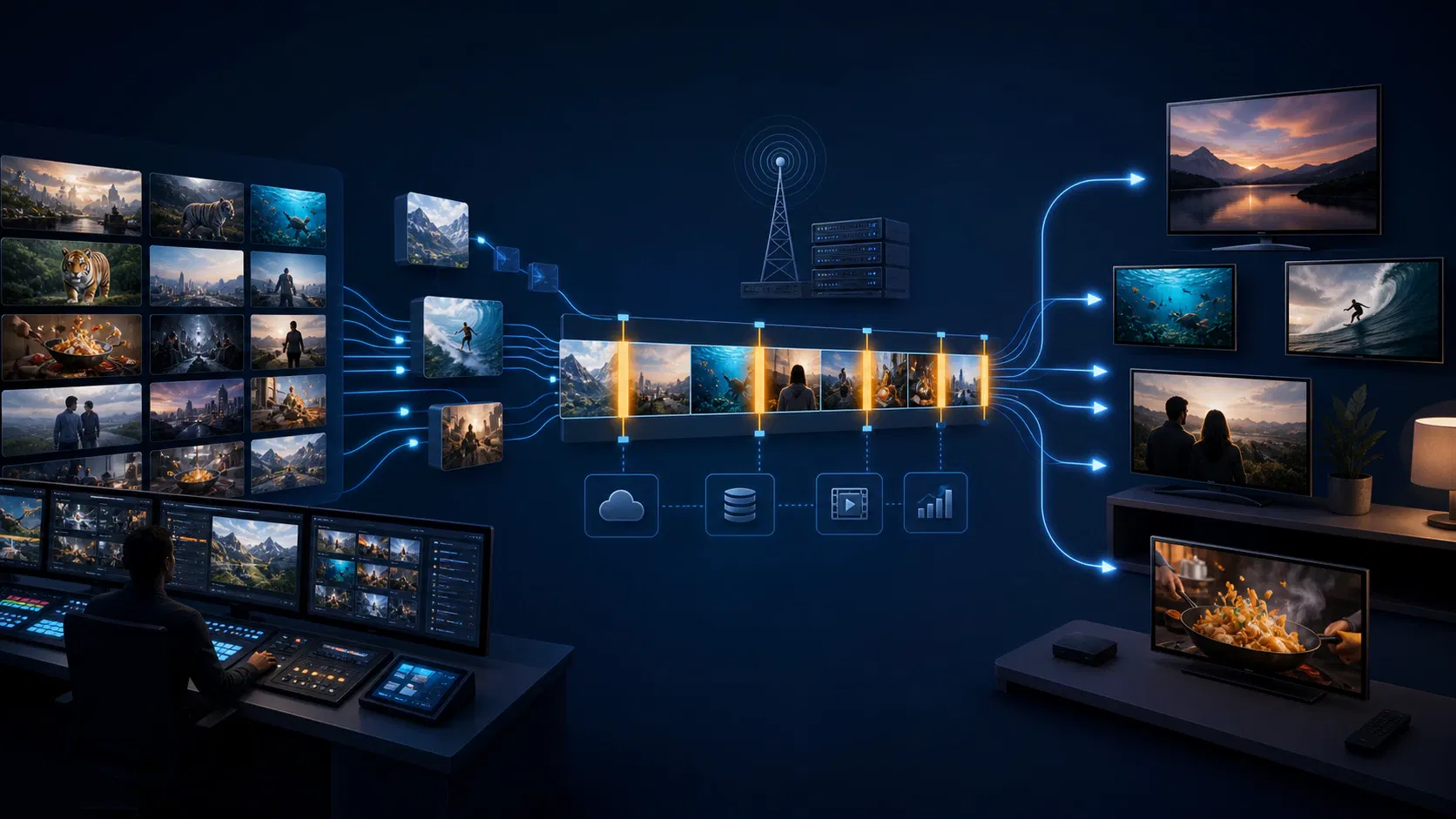
FAST Channel Platform: How to Choose, Build, and Launch
A FAST channel can turn an underused video catalog into a scheduled, free viewing experience—but only if the channel stays on air, the guide stays accurate, and every eligible ad break can be monetized. Choosing a FAST channel platform is therefore less like selecting a video player and more like designing a small broadcast operation.
The right platform combines content management, scheduling, cloud playout, encoding, ad signaling, server-side ad insertion, distribution, an electronic program guide (EPG), and operations data. This guide shows media owners how to scope that system, choose between managed and custom approaches, and launch with evidence instead of vendor promises.
What is a FAST channel platform?
A FAST channel platform is the software and infrastructure used to create, operate, monetize, and distribute Free Ad-Supported Streaming Television. It turns live or on-demand assets into a continuous linear schedule, adds addressable ad breaks, publishes program-guide data, and sends the channel to connected-TV apps or third-party FAST services.
FAST is not simply AVOD with autoplay. In AVOD, a viewer selects an asset from a catalog. In FAST, programming is already playing on a schedule, so the system must keep the stream, ad timeline, and EPG synchronized around the clock.
That distinction explains why a FAST launch requires capabilities that a normal VOD stack may not have:
| Capability | What it does | Launch question |
|---|---|---|
| Rights and metadata management | Tracks territories, windows, ratings, captions, artwork, and program data | Can each asset legally run as ad-supported linear TV in every target market? |
| Scheduling and playout | Builds a 24/7 rundown with programs, promos, graphics, and fallback content | What happens if an asset is missing or a live input fails? |
| Encoding and packaging | Produces adaptive streams for reliable playback | Does the output meet every destination's profile? |
| Ad signaling and SSAI | Marks breaks, requests ads, and stitches them into the stream | Can the team diagnose an empty or failed break end to end? |
| EPG generation | Publishes accurate now/next schedule data | Will guide times remain aligned after overruns and schedule changes? |
| Distribution and monitoring | Delivers feeds and measures availability, playback, and revenue | Who responds when one destination degrades at 2 a.m.? |
Why FAST channel platform decisions start with the operating model
Begin with the channel thesis, not a feature checklist. Define the audience, programming promise, available rights, target territories, refresh cadence, distribution route, and revenue owner. A tightly positioned genre or single-franchise channel is easier to program and explain than an undifferentiated catalog feed.
Catalog depth alone is not the test. You need enough relevant, rights-cleared programming to avoid visible repetition, plus a dependable flow of fresh material. The New York Post's 2026 launch plan is instructive: its proposed channel drew from 150 hours of programming and planned to refresh roughly 20% each month, after the publisher concluded it finally had enough volume and consistency to sustain the format (Axios). Those figures are not universal minimums, but they show why refresh capacity belongs in the business case.
Write a one-page operating brief before talking to vendors. It should name:
- the channel promise and primary audience;
- territories and rights restrictions;
- planned live, scheduled VOD, and catch-up mix;
- expected number of channels and destinations over 12–24 months;
- who sells ads and who controls unsold inventory;
- programming, ad operations, distribution, and incident owners;
- pilot success and shutdown criteria.
If those decisions are unclear, a platform demo will only make uncertainty look polished.
The FAST channel platform architecture that has to work end to end
A production path starts with mezzanine files or live inputs and their metadata. The scheduler creates a rundown; playout turns it into a continuous signal; the encoder creates an adaptive bitrate ladder; the packager generates HLS or DASH; ad cues identify break opportunities; SSAI selects and stitches ads; a CDN delivers the result; and the EPG tells viewers what is on.
HLS is a common delivery foundation because it works over standard HTTP and CDNs and can switch among alternate bitrates as network conditions change (Apple's HLS documentation). That adaptability does not remove destination-specific validation: codec, resolution, segment duration, captions, audio layout, manifests, and failover behavior still need to match each receiving platform.
Ad monetization crosses several systems. SCTE describes SCTE 35-1 as a core signaling standard for advertising and distribution control across MPEG transport streams, DASH, and HLS. A cue says where an opportunity exists; it does not guarantee that an ad decision arrives, the creative is compatible, the splice is clean, or measurement succeeds.
VAST carries ad-response metadata between ad systems and players or stitching services. The current IAB Tech Lab VAST resource points implementers to VAST 4.3 and its CTV addendum, including considerations for higher-resolution connected-TV creative. Treat cueing, ad decisioning, transcoding, stitching, beaconing, and reconciliation as one observable workflow.
The EPG is a parallel product surface, not an export to create at the end. Its program IDs, titles, descriptions, ratings, artwork, start times, and durations must agree with the playout schedule. A substitution, live overrun, or missing asset should update both stream behavior and guide data predictably.

How to launch a FAST channel platform in six gates
Use gates so that commercial pressure cannot quietly turn unresolved technical risk into a public launch.
1. Validate content, rights, and metadata
Audit every asset for ownership, ad-supported linear rights, territory, license window, music and talent restrictions, captions, rating, artwork, and technical quality. Do not assume VOD rights include FAST distribution. Normalize identifiers early so the scheduler, EPG, analytics, and revenue reports refer to the same program.
Accessibility also belongs at ingest. FCC rules can apply to nonexempt full-length video delivered over IP when it previously aired on U.S. television with captions, and distributors must pass required captions through to viewers (FCC guidance). Legal obligations vary by content history and market, but technically valid, synchronized captions should be a default acceptance gate.
2. Design the programming clock
Build repeatable dayparts around audience behavior, then add premieres, themed blocks, live windows, promos, and contingency fillers. Simulate several weeks to expose excessive repetition, awkward transitions, missing durations, and rights conflicts. The schedule should automatically reject an expired or territory-blocked asset.
3. Prove the stream and failover
Create the adaptive ladder and validate every rendition, audio track, caption track, manifest, and discontinuity. Test cold starts, bitrate changes, long playback sessions, schedule edits, encoder restarts, input loss, and CDN failover on representative smart TVs—not just desktop browsers. A backup slate is useful only if monitoring can detect the fault and switch to it quickly.
4. Prove ad breaks as transactions
Test filled, partially filled, unfilled, late, malformed, and incompatible ad responses. Verify that duration, codecs, audio levels, break boundaries, quartile events, and billing records agree across the ad server, SSAI layer, CDN, and analytics warehouse. AWS separates channel assembly and personalized ad insertion into distinct MediaTailor workflows, which is a useful reminder that creating the channel and monetizing the channel are related but separately testable systems (AWS MediaTailor).
Include loudness in ad QA. California's SB 576 prohibits covered streaming services from transmitting commercial audio louder than accompanying content to state residents from July 1, 2026 (California Legislative Information). Even when that law does not govern a particular feed, matching program and ad loudness protects the viewer experience.
5. Certify EPG and destination packages
Generate a complete delivery package per destination: feed URLs, EPG, metadata, artwork, captions, support contacts, redundancy details, and test instructions. Run automated checks for missing fields, time-zone errors, duplicate IDs, schedule gaps, and drift between the EPG and the actual stream. Keep platform-specific transformations separate from the authoritative source data.
6. Run a limited, observable pilot
Launch in one territory or owned app before multiplying destinations. Hold the programming and ad-sales teams accountable to the same dashboard as engineering. Expand only after the channel meets its availability, playback, ad, discovery, and retention thresholds for a defined observation window.
For teams that have validated a multi-channel business and need control over playout, ad logic, data, and infrastructure, Apexnova's FAST channel development and cloud playout solution provide an owned-stack route. A managed service remains the better pilot choice when the goal is to test one channel with minimal engineering commitment.
Build, buy, or aggregate: choose the smallest irreversible bet
There are three common paths, and none is universally best.
| Route | Best fit | Main advantage | Main constraint |
|---|---|---|---|
| Managed playout SaaS | One or a few channels testing demand | Faster launch with less operations work | Recurring fees, bounded customization, and vendor-defined data access |
| Aggregator or managed distribution | Teams prioritizing reach and deal execution | One partner may handle playout, distribution, and monetization | Less control over placement, inventory, audience data, and revenue terms |
| Custom platform | Multi-channel operators or businesses where FAST is a core product | Control over workflows, integrations, data, and unit economics | Higher delivery and 24/7 operational responsibility |
The deciding inputs are channel count, launch deadline, catalog complexity, destination count, ad-sales model, data ownership, compliance needs, and in-house operating capacity. Model a two-year total cost that includes onboarding, transcoding, storage, playout, CDN, SSAI, support, integrations, revenue share, and staff—not just the advertised platform fee.
Keep the pilot reversible. Require exportable metadata, stable program identifiers, access to raw analytics, documented feed formats, and a clear exit process. If a vendor cannot explain how your content and operating data leave its platform, treat that as a cost.
How to evaluate a FAST channel platform vendor
Score a proof of concept against real workflows. A weighted scorecard is more useful than counting features:
- Reliability and operations: redundant playout, health checks, automated fallback, incident history, support coverage, and recovery objectives.
- Programming control: live and VOD scheduling, rules, regionalization, graphics, schedule simulation, bulk changes, and conflict validation.
- Monetization: SCTE cue support, SSAI integrations, creative normalization, house ads, frequency controls, privacy signals, and reconciliation exports.
- Distribution readiness: output profiles, destination templates, EPG formats, metadata validation, captions, artwork, and partner onboarding support.
- Data access: event-level playback and ad data, program IDs, APIs, retention, warehouse export, and role-based access.
- Economics and portability: all usage dimensions, minimums, overages, revenue share, migration assistance, and data-export rights.
Give each candidate the same sample library, schedule, metadata defects, ad responses, and failure scenarios. Ask the vendor to demonstrate a schedule change, expired-rights block, input failure, unfilled break, EPG correction, and incident trace. The best platform is the one your operators can diagnose under pressure, not the one with the smoothest happy-path demo.
Security and access control also matter. Separate scheduling, ad operations, finance, and administrator roles; log consequential changes; rotate feed credentials; and define how vendors access production. A continuous channel makes a small configuration mistake continuously visible.
Metrics that decide whether the channel earns expansion
Track the system as a viewer experience and a business, not just a stream endpoint.
- Availability: successful output minutes by channel and destination, failover events, and mean time to recover.
- Playback: video-start success, startup time, rebuffering, fatal errors, and rendition switches by device.
- Programming: unique hours, repeat rate, guide accuracy, average session duration, and retention by daypart or program.
- Advertising: eligible breaks, requests, fill, impressions, completion, ad errors, timeout rate, revenue per viewing hour, and reconciliation variance.
- Distribution: destination acceptance, placement, reach, consumption, and net revenue after platform or aggregator share.
Standardize measurement definitions before launch. IAB's Standardized Measurement Guide for CTV exists because fragmented connected-TV systems can otherwise produce inconsistent interpretations across publishers, technology partners, and buyers. Write each KPI's event source, denominator, time zone, deduplication rule, and owner into the launch plan.
Set expansion thresholds in advance. For example, a team might require stable guide accuracy, bounded rebuffering, reliable ad reconciliation, and improving revenue per viewing hour before adding another destination. Choose the actual thresholds from your economics and service commitments rather than copying industry anecdotes.
Common FAST launch failures to catch early
Most preventable failures happen at the boundaries between teams and systems:
- content is technically available but lacks FAST rights in one territory;
- the EPG duration differs from playout after a replacement;
- ad cues exist, but creatives fail because their media profile is incompatible;
- a dashboard reports impressions that finance cannot reconcile;
- captions disappear during packaging or ad transitions;
- a primary feed fails over, but the EPG and monitoring still show healthy;
- the channel launches broadly before anyone proves its programming refresh model.
Assign one owner to every boundary and rehearse failures before distribution review. A runbook should say what happened, how to detect it, who acts, what safe fallback exists, and how recovery is verified from the viewer's device.
Frequently asked questions
What does FAST stand for in streaming?
FAST stands for Free Ad-Supported Streaming Television. Viewers watch a scheduled linear channel without a subscription, while advertising funds the service.
What is the difference between FAST and AVOD?
FAST presents a continuously playing schedule through a channel guide; AVOD lets viewers choose individual videos from a catalog. FAST therefore needs linear playout, EPG synchronization, and timed ad-break workflows that a basic AVOD library may not need.
How do you launch a FAST channel?
Clear ad-supported linear rights, normalize the catalog and metadata, create the schedule, configure playout and adaptive streaming, implement ad cueing and SSAI, generate the EPG, certify destination packages, and run an observable pilot. Expand distribution only after programming, reliability, playback, and ad metrics meet predefined gates.
How much content does a FAST channel need?
There is no universal hour count. The practical requirement is enough rights-cleared content and ongoing refresh capacity to fulfill the channel promise without repetition that drives viewers away. Model the schedule over several weeks and measure unique hours and repeat frequency by daypart.
How does a FAST channel make money?
A FAST channel creates ad opportunities during scheduled breaks. Revenue depends on viewing hours, eligible ad requests, fill, pricing, completed impressions, invalid-traffic controls, and the share retained by platforms, aggregators, and ad-tech partners.
Should we build or buy a FAST channel platform?
Buy managed playout for a limited pilot or a small channel lineup when speed and low operational burden matter most. Consider a custom build when many channels, unusual workflows, direct ad control, first-party data, portability, or long-term unit economics make platform ownership strategically important.
Conclusion
Choose a FAST channel platform by proving the entire operating chain: rights, schedule, stream, ad break, guide, destination, measurement, and response. Start with the smallest pilot that can validate audience and revenue assumptions, but preserve the identifiers, data access, and portability needed to scale.
The next useful step is a written pilot brief with launch gates and a two-year cost model. Use it to make vendors demonstrate your difficult workflows before you commit the catalog, distribution relationships, and operating team.