

Video Monetization Platform: Revenue Models, Costs, and Selection Guide
A streaming service can attract viewers and still lose money on every hour watched. The problem is rarely a missing paywall. It is the combination of revenue share, app-store fees, failed payments, unfilled ad breaks, delivery costs, device gaps, and weak entitlement logic underneath it.
A video monetization platform should connect those moving parts into one measurable system. This guide explains how SVOD, AVOD, TVOD, FAST, and hybrid models work, what the platform must do beyond collecting payment, and how to choose an architecture that fits your content, audience, and operating team.
What is a video monetization platform?
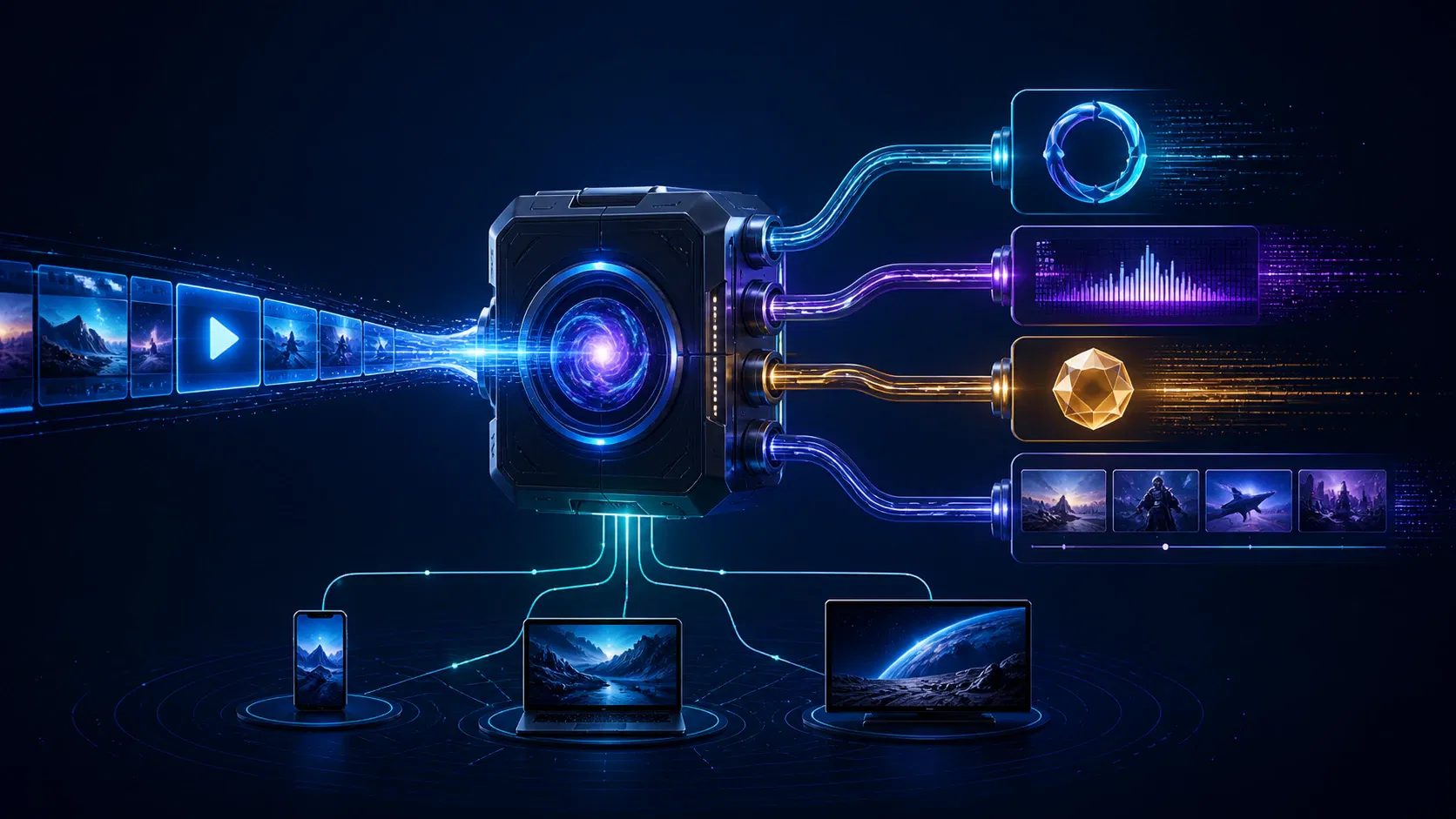
A video monetization platform is software that lets a content owner package access to video, collect revenue through subscriptions, transactions, or advertising, and enforce those access rules across playback devices. A complete platform also connects billing, ad delivery, entitlements, analytics, content protection, and revenue reporting so the operator can see what each viewer, title, and session earns and costs.
That definition matters because a payment page alone does not monetize video. The system must decide who can play a title, which ads or offers apply, how access changes after a purchase or cancellation, and what happens when a payment or ad request fails.
The commercial layer and the video layer therefore have to agree on the same facts:
- who the viewer is and where they are;
- which plan, purchase, or advertising tier applies;
- what content rights allow in that territory and time window;
- which device and playback capabilities are available;
- what revenue and delivery events must be measured.
When these decisions live in disconnected tools, discrepancies become revenue leakage: paid viewers can be denied access, cancelled viewers can remain entitled, ad breaks can return empty, and finance teams can struggle to reconcile storefront reports with internal analytics.
Video monetization platform revenue models compared
The right model is not the one with the most familiar acronym. It is the model whose value exchange matches the content, audience behavior, acquisition channel, and cost to serve.
| Model | Viewer pays with | Best fit | Platform dependencies | Main risk |
|---|---|---|---|---|
| SVOD | A recurring monthly or annual fee | Deep or frequently refreshed catalogs with repeat use | Plans, trials, renewals, entitlements, dunning, churn analytics | Acquisition and content costs outrun subscriber lifetime value |
| AVOD | Attention to advertising | Broad-reach content with enough viewing volume and sellable inventory | Ad server, VAST support, client- or server-side insertion, consent, fill and yield reporting | Low fill, weak CPMs, excessive ad load, or poor playback experience |
| TVOD / PPV | A one-time rental, purchase, or event ticket | Premium releases, courses, concerts, and live sports | Checkout, rental windows, concurrency rules, refunds, event scale | Revenue is episodic and demand is difficult to forecast |
| FAST | Attention to ads in scheduled linear channels | Large libraries that can be programmed into always-on channels | Playout, EPG, schedule management, ad markers, SSAI, distribution | Programming and ad operations are underestimated |
| Freemium | A free tier plus an upgrade | Services that need low-friction sampling and a clear premium benefit | Tiered entitlements, upgrade paths, offer testing, unified identity | The free tier satisfies demand without creating conversion pressure |
| Hybrid | Different payments for different content or tiers | Operators with multiple audience segments or content windows | A flexible rights and entitlement engine plus unified reporting | Complexity makes offers confusing and reporting unreliable |
SVOD: recurring revenue requires recurring value
Subscription video on demand works when viewers expect to return. A niche sports archive, faith service, learning library, or entertainment catalog can support SVOD when new releases, live access, community, or depth creates an ongoing reason to pay.
The platform must manage more than initial checkout. It needs trials, upgrades, downgrades, pauses, proration, cancellation timing, grace periods, taxes, regional payment methods, and recovery from failed renewals. Stripe’s subscription documentation shows why subscription state is a lifecycle rather than a Boolean flag, while its Smart Retries guidance explains how recoverable payment failures can be retried and monitored through events.
Measure SVOD with cohort retention, paid conversion, average revenue per paying user, voluntary and involuntary churn, and contribution margin after content and delivery. A growing subscriber count can hide a weak business if discounted cohorts cancel quickly or expensive viewers consume far more than the plan contributes.
AVOD: viewing volume is inventory, not revenue
Advertising video on demand removes the payment barrier for viewers and sells access to their attention. It can suit news clips, broad entertainment, highlights, catch-up television, and catalogs where audience scale matters more than direct payment from each viewer.
AVOD economics depend on eligible ad opportunities, fill rate, impressions actually delivered, net revenue per thousand impressions, ad load, and the cost of serving the session. A platform should distinguish an ad opportunity from an ad request, a filled response, a started impression, and a completed impression. Without that event chain, a dashboard can report strong viewing while hiding broken or unfilled inventory.
Google’s Interactive Media Ads documentation distinguishes client-side insertion, where the app manages content and ad playback separately, from dynamic ad insertion, which returns a combined stream. AWS documents a comparable server-side ad insertion flow in which the service coordinates the CDN, content origin, and ad decision server to stitch personalized ads into live or on-demand breaks.
Server-side insertion can simplify playback transitions and extend ad delivery across connected-TV environments, but it does not create demand by itself. You still need an ad server or demand partners, consent and privacy controls, accurate break markers, measurement, frequency management, and an operations process for investigating discrepancies.
TVOD and pay-per-view: monetize scarcity or urgency
Transactional video on demand charges for one asset or access window. Electronic sell-through grants durable access; rental grants a time-limited license; pay-per-view commonly grants access to a live event or premium program.
TVOD fits content with concentrated intent: a championship, concert, conference, new release, certification course, or specialist archive. The platform should support territory and availability windows, event-specific pricing, coupons, concurrency limits, refund workflows, replay access, and communication when a live event changes.
The technical risk is sharp because the transaction and viewing peak occur together. Load testing must cover authentication, checkout, entitlement issuance, license delivery, playback start, and customer support—not only CDN throughput.
FAST: turn a catalog into programmed, ad-supported channels
Free ad-supported streaming television combines linear scheduling with advertising. The viewer enters a channel already in progress rather than choosing every title. FAST can create new surfaces for older content, themed programming, or regional channels, but it introduces playout, scheduling, electronic program guide data, rights windows, and continuous ad operations.
Do not treat FAST as an AVOD toggle. The platform must generate reliable linear outputs, carry ad-break signals, recover from schedule or source failures, and distribute channel metadata correctly. Revenue depends on consistent programming and inventory quality as much as the streaming stack.
Hybrid: match the model to the content window
Hybrid monetization is useful when one audience contains several willingness-to-pay levels. A service might offer an ad-supported entry tier, an ad-free subscription, and pay-per-view premium events. Another might move a title from transactional early access to subscription and later to an ad-supported catalog.
The advantage is optionality; the cost is entitlement complexity. Your platform needs one rights model that can answer which offer applies to a title, user, device, territory, and date. If each monetization mode has a separate user identity or reporting stack, the viewer experience and the financial picture fragment quickly.
Model the economics before comparing platforms
Platform demos tend to showcase checkout screens and dashboards. A useful evaluation starts earlier, with a unit-economics model that makes every deduction visible.
For a paid model, calculate contribution at the cohort level:
Net paid revenue = gross receipts − taxes − storefront share − payment fees − refunds and chargebacks − platform revenue share
Then subtract content royalties, customer support, streaming delivery, encoding, storage, observability, and other costs that change with viewing. Compare the result with acquisition cost and retention by cohort. An annual plan, a mobile-store subscription, and a web subscription can have different margins even when the consumer price looks identical.
Store policies belong in this model. Apple states that standard auto-renewable subscription proceeds are 70% in a subscriber’s first year and 85% after one accumulated year, with different treatment for qualifying programs; it also recommends simple subscription groups for most apps in its current subscription guidance. Google Play’s published service-fee schedule lists 15% for automatically renewing subscriptions while also documenting regional and program-specific rules. Verify the terms for every storefront and market at launch because policies and eligibility can change.
For an ad-supported model, calculate contribution per viewing cohort or thousand hours:
Net ad contribution = recognized ad revenue − sales or partner share − ad-serving cost − incremental streaming cost − content royalties
Track opportunity fill, impression delivery, completion, net yield, ad minutes per viewing hour, and session abandonment together. Raising ad load can lift short-term impressions while reducing watch time or return rate; the combined view reveals whether the change improves the service.
For TVOD or PPV, model conversion, net receipts per order, refund rate, support cost, peak infrastructure, and the number of purchasers who return. An event can show a healthy gross total and still disappoint if payment failures, storefront deductions, support incidents, or a one-time acquisition spike consume the margin.
Build a scenario sheet, not a single forecast
Use conservative, expected, and upside scenarios. Vary the assumptions that actually move the result:
- paid conversion and retention for SVOD;
- viewing hours, fill, and net yield for AVOD or FAST;
- buyer conversion, price, and concurrency for TVOD or PPV;
- web versus app-store purchase mix;
- average delivered bitrate and CDN cost;
- content royalties and minimum guarantees;
- platform fees, minimum commitments, and overages.
The exercise exposes which platform terms carry the most risk. A revenue share may be tolerable during validation but expensive at scale. A lower fixed fee may hide bandwidth, application, support, or ad-insertion charges. A custom build may improve control but add engineering and operational ownership. Compare total cost and constraint over the same horizon rather than comparing headline monthly prices.
What a video monetization platform must do beyond checkout
Monetization is an end-to-end control loop. The platform needs to turn an offer into an entitlement, enforce it during playback, observe the outcome, and reconcile the money.
Catalog, rights, offers, and entitlements
The content model should separate the asset from its commercial rules. A title may have different packages, prices, territories, availability windows, devices, and playback limits. The entitlement service then resolves those rules for the authenticated viewer.
Look for explicit support for bundles, seasons, live events, rentals, purchases, trials, coupons, grace periods, and concurrent-stream limits. Test changes as well as happy paths: upgrade, downgrade, refund, expiration, cancellation, regional travel, and account recovery.
Billing and storefront reconciliation
Web payments, iOS purchases, Android purchases, connected-TV billing, vouchers, and partner bundles can produce different transaction identifiers and settlement reports. The platform should validate storefront receipts, process webhooks idempotently, map every transaction to one customer and entitlement, and retain an audit trail.
Ask how finance reconciles gross receipts to processor fees, taxes, refunds, partner shares, and recognized revenue. If exporting a reliable ledger requires manual spreadsheet stitching, the monetization system is incomplete.
Advertising and yield operations
AVOD and FAST support should cover the actual workflow: ad tags, VAST compatibility, break signaling, client-side or server-side insertion, targeting inputs, consent, fallback behavior, frequency rules, and impression telemetry. Confirm device coverage because web success does not guarantee equivalent behavior on mobile, casting, Roku, Fire TV, or smart-TV platforms.
The operator also needs diagnostics. Can the team trace a session from break opportunity to ad decision, stitched stream, player events, and revenue report? Can it distinguish no demand from a malformed creative or playback error? These details shorten investigations that otherwise span several vendors.
Content protection and playback policy
Paid access is only useful when playback rules are enforceable. Premium catalogs commonly need multiple DRM systems because device ecosystems differ. Google describes Widevine as its protection system for premium media, while Apple’s FairPlay Streaming protects encrypted HLS delivery on Apple platforms.
Evaluate key and license workflows, offline policies, device limits, geographic controls, tokenized URLs, watermarking requirements, and the failure experience. DRM errors need actionable telemetry; otherwise support sees only that a paying viewer cannot play.
Cross-device identity and product experience
A viewer expects a purchase on one screen to work on another. That requires a stable account model, receipt linking, profile and household rules, watch-state synchronization, and consistent merchandising across web, mobile, and connected TV.
Check whether the platform supports the devices that matter now and whether adding a device preserves the same catalog, entitlement, analytics, and experimentation model. Separate implementations often drift into different offers and business rules.
Analytics that connect quality to revenue
Financial totals alone cannot explain why revenue changed. Join commercial events with playback and audience behavior so teams can answer:
- Which acquisition channels produce retained, profitable viewers?
- Which titles drive trial starts, paid conversion, upgrades, or ad yield?
- Where do checkout, entitlement, or playback failures suppress conversion?
- How do startup time, buffering, and crashes affect session length or cancellation?
- Which cohorts consume more delivery cost than their revenue supports?
Define the event contract before launch. Include consistent identifiers for user, anonymous device, session, content, offer, transaction, entitlement, storefront, experiment, and ad break. Specify which system owns each metric so product, ad operations, and finance do not publish conflicting numbers.
How to choose a video monetization platform
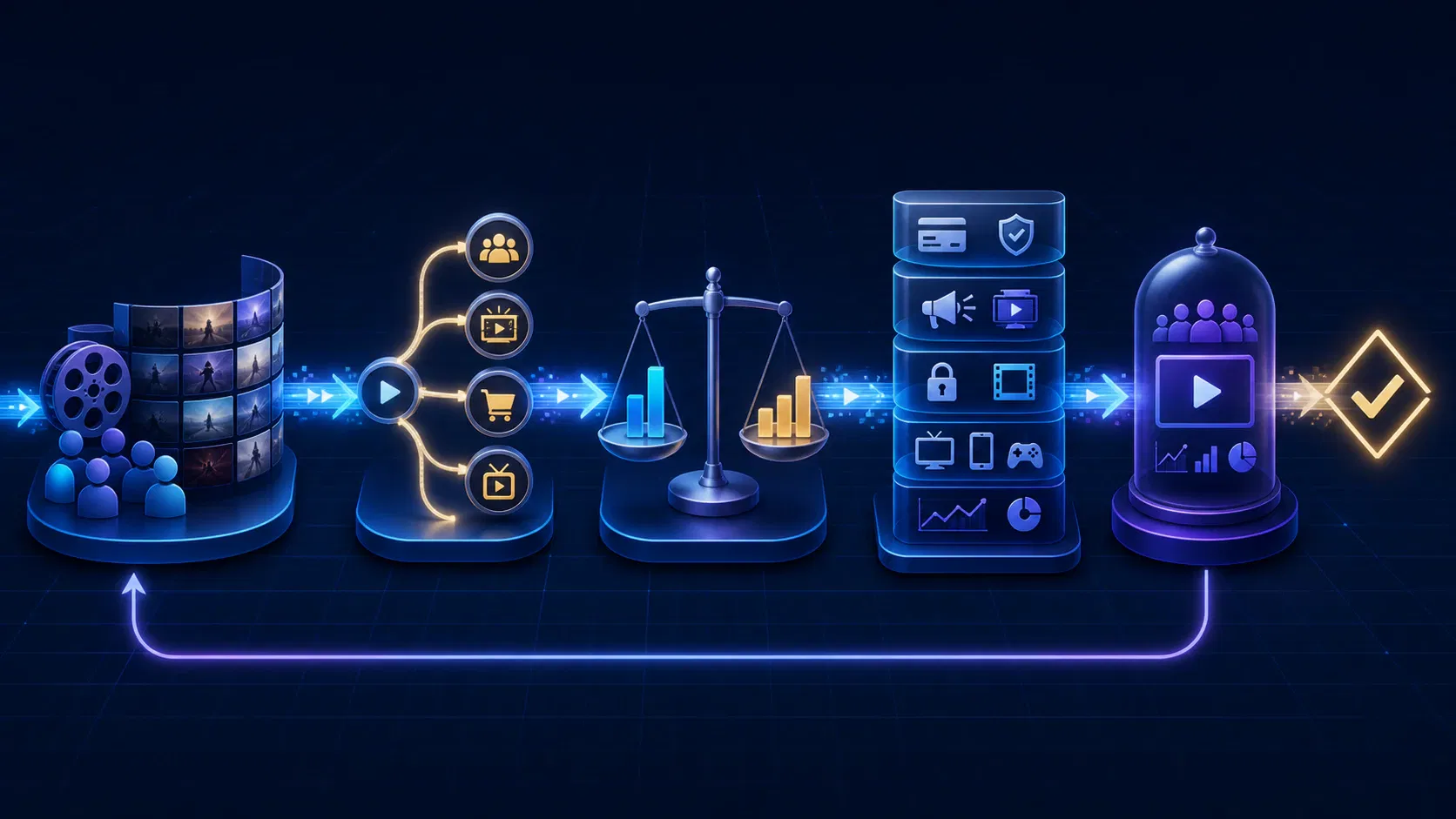
Choose through evidence, not a generic feature checklist. The following process turns your business assumptions into scenarios a vendor or engineering team must demonstrate.
1. Define the audience and content promise
Document the primary viewer, target countries, supported languages, target devices, catalog shape, live requirements, rights constraints, release cadence, and expected viewing behavior. Be specific about why the viewer returns or pays.
Then choose one primary monetization hypothesis and one plausible extension. Starting with every model at once creates operational complexity before you have evidence that the audience wants it.
2. Map offers and entitlement states
Write the commercial rules in plain language. For example: a free viewer may watch selected titles with ads; a premium member receives the full catalog without ads; a special live event requires an additional ticket; the replay remains available for a defined window.
Turn each rule into states and transitions: trial started, payment pending, active, grace period, refunded, expired, cancelled, restored. Include storefront purchases and cross-device access. This becomes both an architecture input and an acceptance-test suite.
3. Model revenue and cost by channel
Build the scenarios described above using your own quotes and assumptions. Separate web, mobile storefront, partner bundle, and connected-TV economics. Separate subscription, advertising, and transaction contribution if you plan a hybrid service.
Request a complete fee schedule from shortlisted providers: base platform, applications, monthly active users, subscribers, transactions, revenue share, encoding, storage, delivery, DRM, analytics, support, migration, and overages. Record minimum commitments and contract exit terms as carefully as unit prices.
4. Decide how much control to own
There are three broad delivery choices:
- Marketplace or creator platform: fastest validation, with limited control over audience, branding, data, and revenue mechanics.
- Hosted or white-label OTT platform: faster branded launch with recurring platform constraints and a vendor roadmap.
- Custom or composable platform: greater product, data, and cost control with more engineering and operating responsibility.
The correct answer can change with stage. A hosted product may be rational for proving demand; ownership becomes more valuable when revenue share, per-subscriber pricing, inflexible workflows, data access, or device limitations constrain growth.
If the scorecard points to owned product logic and infrastructure, Apexnova’s OTT app development approach covers the apps, video delivery, DRM, monetization, and cloud stack as one system. That route is earned when the forecast and workflow require more control than a hosted configuration can provide—not simply because custom software offers more options.
5. Test the hardest workflows in a proof of concept
Do not spend the pilot on video upload and basic playback. Test the risks that could invalidate the choice:
- purchase on one device and playback on another;
- cancellation, refund, renewal failure, and entitlement recovery;
- a live concurrency spike with checkout and playback together;
- ad insertion and measurement on the least forgiving target device;
- rights changes by territory and time window;
- DRM license failure and customer-facing recovery;
- export of transaction, entitlement, playback, and ad data for reconciliation.
Use representative content and production-like integrations. Record pass criteria before the demo so polished UI cannot substitute for proof.
6. Evaluate operations, security, and exit
Ask who responds when payments, ads, licenses, playback, or a storefront integration fails. Review service levels, support coverage, incident communication, observability access, data retention, security controls, privacy obligations, backup and recovery, and change-management process.
Also design the exit before signing. Confirm that you can export catalog metadata, media masters, users, consent, subscriptions or billing references where portable, entitlements, transactions, analytics, images, captions, and watch history. Document domains, app-store accounts, signing keys, DRM credentials, and third-party contracts that must remain under your control.
7. Run a limited launch and compare cohorts
Launch to a defined audience, content set, region, or device group. Validate entitlement accuracy and playback health before optimizing price or ad load. Then compare conversion, retention, viewing, support burden, net revenue, and contribution by cohort.
A pilot should resolve a decision: continue, change the offer, change the platform, or stop. Avoid declaring success from registrations or gross receipts alone.
Use a weighted scorecard for the final decision
A scorecard prevents a dramatic demo from outweighing business-critical gaps. Set weights before vendor presentations and make every score reference evidence.
| Category | Example weight | Evidence to request |
|---|---|---|
| Monetization and entitlement flexibility | 20% | Working scenarios for your SVOD, AVOD, TVOD, FAST, or hybrid rules |
| Unit economics and contract | 20% | Complete fee model under conservative, expected, and upside usage |
| Device and playback coverage | 15% | Supported versions, DRM matrix, test results, certification ownership |
| Data and reconciliation | 15% | Raw event export, ledger mapping, revenue and ad discrepancy workflow |
| Integration and extensibility | 10% | APIs, webhooks, SDKs, identity, payments, ad tech, migration path |
| Reliability and operations | 10% | Service levels, observability, incident process, support coverage |
| Security, privacy, and rights | 5% | Control documentation, data flows, geographic and content policies |
| Ownership and exit | 5% | Export test, account ownership, contract terms, transition assistance |
The weights are an example, not a universal benchmark. An event business may increase live reliability and TVOD workflow weight; an AVOD broadcaster may emphasize ad operations and device reach; a niche subscription service may emphasize retention tooling and billing recovery.
Score only what the provider can demonstrate, document, or contractually commit to. Mark unknowns as risks rather than assuming they will work after launch.
Common video monetization platform mistakes
Choosing a model from a famous service
Copying a large streaming brand ignores differences in catalog, rights, audience, acquisition, and capital. Start with your viewer’s value exchange and your cost structure.
Treating “supports SVOD” as a complete requirement
The acronym says nothing about trials, upgrades, bundles, grace periods, storefront validation, taxes, refunds, dunning, or cross-device entitlements. Test lifecycle states.
Assuming a free video monetization platform has no cost
A free plan can be useful for learning or demand validation. Its real constraints may appear in branding, revenue share, data access, export, ads, video quality, storage, bandwidth, apps, support, or ownership. Price the migration path before the free tier becomes infrastructure.
Optimizing gross revenue instead of contribution
Gross subscriptions, purchases, or ad revenue do not include storefront deductions, payment costs, refunds, partner share, content, delivery, or support. Tie commercial dashboards to a contribution view.
Adding hybrid monetization without one entitlement model
Separate paywalls and identities create contradictory access states and poor reporting. Keep offers flexible but resolve access through one authoritative entitlement service.
Leaving finance, ad operations, and support until launch
These teams define reconciliation, break diagnostics, refunds, disputes, and customer recovery. Their workflows should be acceptance criteria, not post-launch administration.
Frequently asked questions
How do video monetization platforms make money?
They typically charge content owners through a subscription, usage fees, per-subscriber fees, transaction fees, revenue share, or a combination. The content owner then earns through viewer subscriptions, advertising, one-time purchases, pay-per-view, sponsorship, or hybrid offers. Compare the complete provider fee stack with your net revenue, not only the advertised plan price.
Which video monetization model is best?
There is no universal best model. SVOD fits repeat value and loyal niches; AVOD and FAST fit reach and sufficient sellable viewing; TVOD fits scarce or high-intent content; hybrid works when multiple audience segments justify the added operational complexity.
What features should a video monetization platform have?
At minimum, look for catalog and rights management, flexible offers, a reliable entitlement service, billing or ad integrations, device coverage, content protection, playback analytics, revenue reconciliation, APIs, observability, and a tested data-export path. The exact priority depends on the chosen revenue model.
Can I combine SVOD, AVOD, and TVOD?
Yes. A hybrid service can use ads for free discovery, subscriptions for the core catalog, and transactions for premium releases or live events. Use one identity, rights, and entitlement model so the offers remain understandable and access stays consistent across devices.
Are free video monetization platforms suitable for a business?
They can suit early validation when audience, requirements, and revenue are still uncertain. Before committing, evaluate branding, revenue share, data ownership, export, supported models, device reach, video limits, advertising control, support, and the cost of moving to another platform.
How long does it take to launch a video monetization platform?
The timeline depends on device scope, catalog readiness, monetization model, integrations, rights rules, app-store review, migration, and testing. A web-only proof of concept is much smaller than a multi-device service with subscriptions, server-side advertising, live events, DRM, and legacy customer migration; estimate the workflow and acceptance criteria before choosing a date.
Choose the platform by proving the revenue system
A video monetization platform is a commercial operating system for streaming, not a decorative paywall. The right choice connects offers, entitlements, billing or advertising, protected playback, cross-device identity, analytics, and reconciliation—and makes the net economics visible.
Start with one primary model, build conservative and upside scenarios, test the hardest lifecycle on real target devices, and score evidence against your own requirements. If the pilot shows that viewer value, net revenue, and operational control align, you have a basis to scale. If you want to turn that scorecard into a technical architecture and launch scope, share your content, devices, and monetization goals.