


Super Aggregation: How Streaming Platforms Become the Front Door
Viewers do not care which catalog, billing system, or delivery partner sits behind a title. They want to search once, know what they can watch, and press play. Super aggregation is the product and platform strategy that tries to make that journey feel unified even when the underlying services remain separate.
That promise is bigger than putting several app icons on a home screen. A credible super aggregator connects discovery, access, commerce, playback routing, and data while respecting each partner's rights and customer relationship. This guide explains what that means, how the architecture works, and when the model is worth building.
What is super aggregation in streaming?
Super aggregation is the integration of live TV, on-demand catalogs, FAST channels, and third-party streaming services into one discovery and access experience. A mature implementation may also add one account, one bill, subscription management, cross-service recommendations, and a consistent journey from search result to playback.
The word may matters. Commercial agreements and platform capabilities differ, so a product can unify discovery without processing every payment or playing every title inside its own player. In some cases, the correct final step is a verified deep link into a partner app; in others, the aggregator has rights to deliver the stream natively.
This creates four practical levels of aggregation:
| Level | Viewer experience | What the platform actually integrates |
|---|---|---|
| App aggregation | One launcher for separate apps | App placement, authentication shortcuts, basic promotions |
| Discovery aggregation | One search and browse layer across catalogs | Metadata, availability, ranking, recommendations, deep links |
| Commercial aggregation | One place to activate and manage services | Offers, billing, entitlements, partner provisioning, support |
| Experience aggregation | A coherent journey across services and devices | Profiles, watchlists, viewing state, personalization, analytics |
An app grid is useful, but it is not super aggregation on its own. The strategic shift occurs when the platform organizes content rather than merely organizing apps.
Why super aggregation is returning now
The direct-to-consumer era created more choice and more friction at the same time. Deloitte's 2025 aggregation outlook found that the average number of US SVOD services had held at four since 2020 and predicted a move back toward aggregators. It also reported that 43% of surveyed UK SVOD subscribers bought at least one service through a third party as of September 2024 (Deloitte's shift-to-aggregators analysis).
The pressure did not disappear after that forecast. Deloitte's Digital Media Monitor reported in March 2026 that 41% of US consumers had canceled a paid SVOD service in the previous six months (Deloitte Digital Media Monitor). Aggregation cannot repair a weak catalog or make an expensive bundle affordable, but it can remove avoidable discovery, activation, and account-management friction.
The model creates different value for each participant:
- Viewers get fewer dead ends, clearer availability, simpler subscription management, and potentially better bundle economics.
- Telcos and pay-TV operators can make their service the default entertainment entry point and connect video with broadband or mobile retention.
- Broadcasters and niche streamers gain distribution and discovery without having to win every customer directly.
- Device and operating-system providers can improve the home-screen experience and monetize discovery, advertising, or transactions.
- Large streamers can reach incremental households through partners, although they must weigh that reach against control of brand, data, and billing.
TELUS Stream+ shows the commercial layer in practice: its current offer combines Netflix, Disney+, and Amazon Prime under one subscription and bill, and lets existing subscribers transfer eligible accounts (TELUS Stream+). That is more valuable than an app folder, but a fully super-aggregated experience also has to make titles discoverable and reliably route each viewer to an entitled playback option.
Super aggregation is a data problem before it is a UI problem
A polished home screen cannot compensate for mismatched titles, stale availability, or broken entitlement data. The first hard problem is building a trustworthy model of what the content is, where it is available, who may watch it, and how playback should start.
Partner feeds will describe the same movie or episode differently. Titles, release years, cast lists, seasons, artwork, ratings, territories, languages, offer types, and availability windows can conflict. A normalization pipeline should ingest each source, validate required fields, resolve duplicates, attach stable internal IDs, preserve provenance, and publish changes quickly enough for live schedules and expiring rights.
Universal identifiers reduce ambiguity. The Entertainment Identifier Registry assigns one permanent ID to every title and version, giving a consistent reference point across the content lifecycle; broadcasters, streamers, FAST channels, AVOD and SVOD services use those IDs to match incoming content, cut ingestion errors, and keep catalogs clean (EIDR). An aggregator may also maintain its own canonical IDs, but every partner record still needs a durable mapping and an auditable confidence level.
Linear and hybrid services add program schedules and service discovery. The current DVB-I specification defines mechanisms for discovering broadband or broadcast services and retrieving electronic program data so they can appear in one consistent interface (DVB-I service discovery and programme metadata). This is useful standards-based groundwork, not a complete super-aggregation product: search, personalization, commercial logic, and partner entitlements still sit above it.
Metadata quality should be measured like service reliability. Track unmatched assets, duplicate rates, late availability changes, missing artwork, failed deep links, and search results that lead to unavailable offers. If the platform cannot explain why a title appeared, disappeared, or ranked first, operations teams will struggle to support it.
The super aggregation architecture that makes the promise real
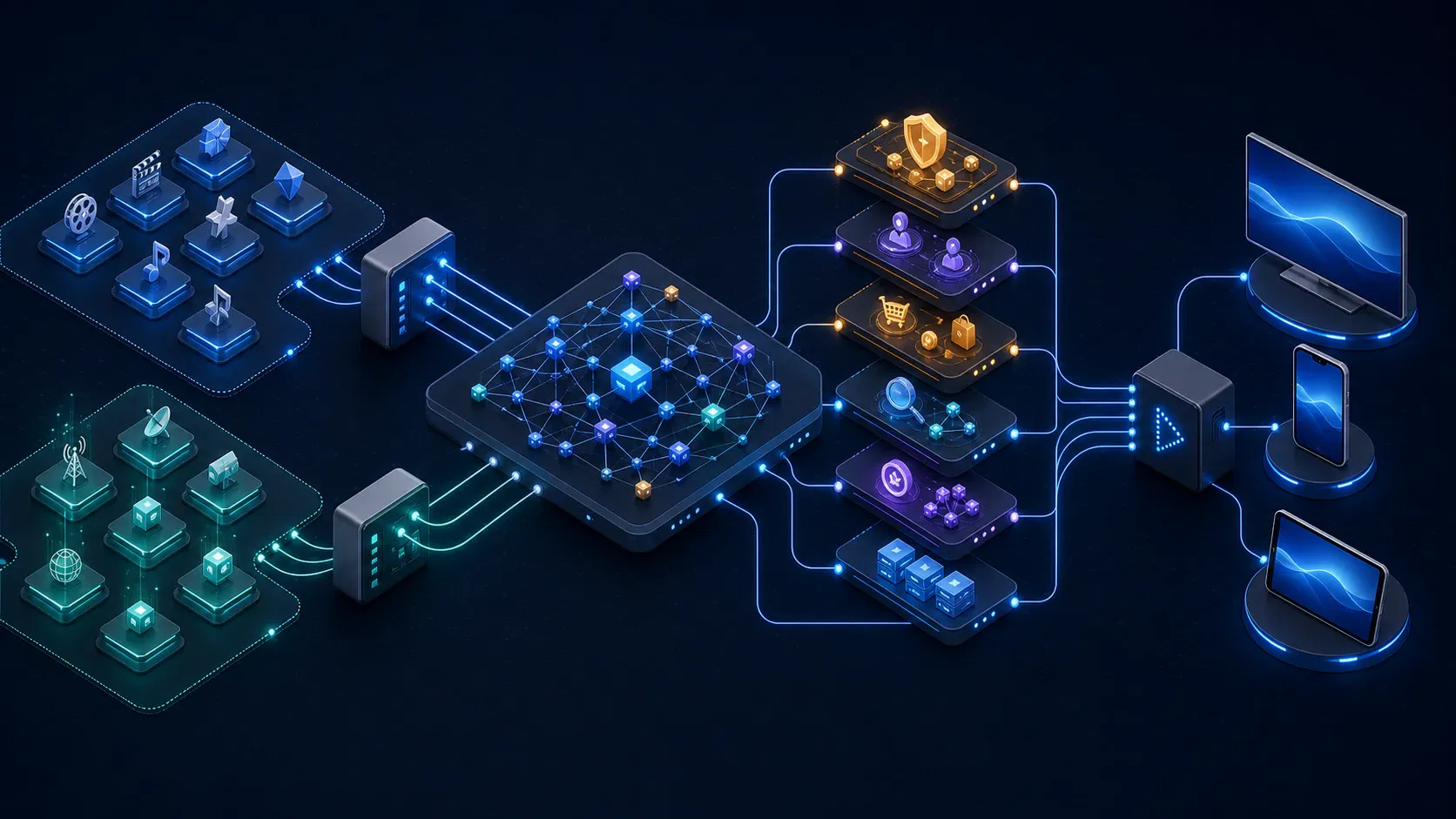
A scalable design separates partner-specific change from the core product. The exact services vary, but the responsibilities should remain clear.
- Partner adapters ingest catalog feeds, schedules, offers, availability, entitlement events, and playback endpoints. Each adapter owns retries, versioning, validation, and rate limits for one integration.
- Canonical content graph resolves works, seasons, episodes, channels, contributors, genres, and provider offers into stable entities without erasing source provenance.
- Rights and availability service answers whether an offer is valid for a viewer's country, plan, device, time, and playback mode.
- Search and recommendation layer indexes normalized metadata, applies editorial rules, and ranks only offers the viewer can realistically access.
- Identity and entitlement orchestration links the platform account to partner accounts, caches entitlement state safely, and handles activation, upgrades, cancellations, and reconciliation.
- Commerce layer manages bundles, taxes, promotions, revenue shares, invoices, refunds, and partner settlement when the aggregator is the merchant or billing agent.
- Playback router selects native playback or the correct partner destination, passes the minimum required context, and records success or failure. Android's official guidance describes deep links as direct app-to-app or web-to-app transitions and recommends verified App Links for associated domains (Android deep-link documentation).
- Experience and operations layer serves device clients, editorial tooling, customer support, observability, experimentation, consent, and analytics.
Do not collapse identity and entitlement into one boolean. A viewer can be signed in to the aggregator but not a partner, subscribed but outside a rights window, entitled on mobile but not television, or eligible for native playback only on certain devices. Model those states explicitly and make error messages actionable.
The same restraint applies to personalization. A larger pool of behavioral data can improve recommendations, but it also increases privacy and governance obligations across multiple companies. NIST recommends defining privacy requirements for external service providers and aligning system and data life cycles in complex data-processing ecosystems (NIST Privacy Framework guidance). Decide which events may be shared, for what purpose, for how long, and how consent changes propagate before combining partner histories.
How to build a super aggregation platform in four phases
The safest program earns integration depth in stages. Begin with one audience, one device family, and a small partner set that can prove the journey.
Phase 1: Define the promise and partner contract
Choose the problem the product will solve first: cross-catalog discovery, subscription savings, unified billing, local-content reach, or a broader household bundle. Then document what each partner will provide—catalog fields, update frequency, rights, deep links, entitlement APIs, activation flows, support ownership, data permissions, settlement rules, and exit procedures.
Write the viewer journey before the system design. Search for a title, compare available offers, activate a service if needed, start playback, return to the aggregator, and get support when something fails. Every handoff needs an owner and a measurable success event.
Phase 2: Launch unified discovery
Normalize a limited catalog, build availability-aware search, create provider pages, and test deep links across the target devices. Keep ranking rules transparent: editorial priority, relevance, entitlement, price, and business placement should not quietly contradict one another.
This phase can deliver value without taking over billing. It also reveals whether partner metadata and link reliability are strong enough for deeper integration. A real implementation example comes from Titan OS, which selected Simply.TV to aggregate and normalize third-party catalogs for cross-service discovery on smart TVs (Titan OS and Simply.TV announcement).
Phase 3: Add account linking, entitlements, and commerce
Introduce partner activation and account-linking flows, then make the content graph entitlement-aware. If the aggregator sells bundles, add plan changes, proration, refunds, tax handling, failed-payment recovery, partner settlement, and customer-support tooling before expanding the offer.
Treat reconciliation as a product feature. The platform's order, the partner's entitlement, the invoice, and the viewer's actual access must agree. Build exception queues for mismatches rather than relying on manual spreadsheet checks after complaints arrive.
Phase 4: Unify the ongoing experience
Add cross-service watchlists, continue-watching, personalization, household profiles, and cross-device state only where partner permissions support them. Test cold starts and shared-TV behavior so the recommendation system does not confuse a household profile with an individual.
Future experiences such as gaming or augmented reality television can use the same identity and discovery foundation, but they should not inflate the first release. Prove the core video journey and operating model before broadening the product category.
For media companies moving from a discovery pilot to an owned multi-device product, Apexnova's OTT app development service can connect catalog, entitlement, commerce, analytics, and connected-TV apps as one platform. That route is appropriate once partner access and success criteria are clear; an app-level prototype is usually the smaller way to validate demand first.
How super aggregation platforms make money
There is no single super-aggregator business model. The platform can combine several revenue streams, but each one changes incentives and technical scope.
| Model | Revenue mechanism | Critical dependency |
|---|---|---|
| Subscription bundle | Retail margin or negotiated revenue share | Attractive pricing, entitlement integration, settlement accuracy |
| Partner acquisition | Referral or activation fee | Attributable conversion and durable partner agreements |
| Advertising and FAST | Share of ad inventory or revenue | Rights, consent, identity, measurement, brand safety |
| Platform licensing | SaaS or managed-service fees | Repeatable integrations, administration, support commitments |
| Cross-product retention | Lower churn across broadband, mobile, or TV | Reliable measurement of incremental customer value |
| Transactional offers | Commission on rentals, purchases, or event passes | Payments, territorial rights, refunds, and customer support |
Model the economics per active household, not just per subscription. Include content minimum guarantees, revenue share, payment fees, taxes, support, partner integration maintenance, metadata licensing, device certification, cloud services, and promotional discounts. A bundle that grows gross revenue can still destroy margin or create support costs if activations fail.
Keep commercial influence visible in the interface. Sponsored placement, owned services, and personalized recommendations should be distinguishable in governance and measurement even if the visual design remains cohesive. Otherwise the platform may optimize short-term revenue at the expense of trust and discovery quality.
Metrics that prove super aggregation is working
The north star is not catalog size. It is the share of viewer intentions that end in satisfying, authorized playback with acceptable economics.
Use a funnel that operations, product, and commercial teams can reconcile:
- Discovery: search success, zero-result rate, browse-to-detail rate, offer coverage, and time to first relevant result.
- Access: entitlement-check success, activation completion, account-linking success, deep-link success, and playback-start success.
- Experience: time to play, abandoned searches, watchlist use, repeat visits, cross-device continuity, and support contacts per active household.
- Commercial: bundle conversion, attach rate, trial-to-paid conversion, payment recovery, contribution margin, partner settlement variance, and cross-product retention.
- Data quality: unmatched titles, stale offers, duplicate entities, rights errors, feed latency, and time to repair a broken partner integration.
Define every denominator. A 95% deep-link success rate means little unless the team agrees whether unsupported devices, logged-out users, and expired offers are included. Segment by partner, device, app version, country, and plan so one healthy integration cannot hide another's failures.
Set expansion gates before launch. For example, do not add ten more partners until the first three meet catalog freshness, activation, playback, reconciliation, and support thresholds for a defined period. The exact thresholds belong to your service goals and unit economics, not a generic benchmark.
Common super aggregation failures
Most failures appear at organizational and system boundaries:
- calling an app launcher a unified experience;
- merging catalogs without stable identifiers or source provenance;
- showing titles that are unavailable to the viewer's plan, territory, or device;
- promising one-click playback when a partner only supports a generic app launch;
- launching a bundle before activation, cancellation, refunds, and settlement reconcile;
- sharing behavioral data before partner permissions and consent propagation are defined;
- letting paid placement overwhelm relevance without governance;
- integrating many partners before building adapter monitoring and graceful degradation;
- assuming a larger catalog automatically improves discovery;
- failing to name who supports the customer when the aggregator sold the offer but the partner controls playback.
Design degraded states deliberately. If one catalog feed is stale, label or suppress its affected offers. If an entitlement API is unavailable, avoid telling the viewer to repurchase. If a partner app is missing, offer installation or another authorized option instead of ending the journey.
A decision checklist before you invest
Super aggregation is a strong fit when your company already owns a frequent customer touchpoint, can secure meaningful partner access, and has a reason to be the default discovery or commerce layer. It is weaker when the plan depends on catalogs or APIs that partners have not agreed to provide.
Before approving the roadmap, answer these questions:
- What specific viewer friction will disappear in the first release?
- Which partners have committed metadata, availability, linking, entitlement, commerce, and data rights?
- Which aggregation level can the product honestly deliver on each device?
- Who owns billing, refunds, customer support, fraud, and partner settlement?
- How will the content graph handle duplicates, conflicts, rights windows, and rapid updates?
- What data can be combined, and how will consent and deletion requests propagate?
- Which five metrics decide whether the pilot expands, changes, or stops?
- Can the platform remove a partner cleanly without corrupting customer state or analytics?
If those answers are contractual and testable, the architecture can follow. If they are assumptions, more code will only make the uncertainty more expensive.
Frequently asked questions
What is the difference between aggregation and super aggregation?
Basic aggregation places multiple apps or services in one destination. Super aggregation goes further by unifying content-level discovery and access, and may also integrate billing, entitlements, personalization, watchlists, and cross-device state.
Does super aggregation mean one app and one bill?
Not always. A platform may provide one search experience while using partner apps for playback and separate partner billing. The mature model can include one app and bill, but only when commercial agreements, APIs, rights, and device capabilities support them.
Who can become a streaming super aggregator?
Telcos, pay-TV operators, broadcasters, device platforms, operating-system providers, large streamers, and other companies with a recurring customer relationship can become super aggregators. The defensible advantage is usually partner access, distribution, billing reach, first-party audience insight, or a trusted interface—not software alone.
What technology is needed for super aggregation?
Core capabilities include partner adapters, metadata normalization, a canonical content graph, rights and availability, search and recommendations, identity, entitlement orchestration, commerce, playback routing, analytics, consent, multi-device clients, and operational tooling. The scope depends on whether the product unifies discovery only or also owns billing and playback.
Can super aggregation reduce streaming churn?
It can reduce friction that contributes to abandonment and make bundles more useful, but it cannot guarantee retention. Price, catalog quality, release cadence, service reliability, and the ease of canceling or changing plans still shape churn.
How should a super aggregation pilot start?
Start with one viewer promise, one or two device families, and a small set of committed partners. Prove catalog freshness, search quality, entitlement accuracy, deep-link or playback success, support ownership, and unit economics before adding more services.
Conclusion
Super aggregation succeeds when a fragmented supply chain feels simple without hiding its rules from viewers or operators. The strongest products begin with accurate metadata and availability, then earn their way from unified discovery into commerce, entitlements, playback, and personalization.
Decide first which level of aggregation your agreements can support and which viewer journey will prove demand. Then fund a narrow pilot with explicit expansion and shutdown gates; that decision will tell you whether to deepen the platform, renegotiate the partner model, or stop before complexity compounds.