


Electronic Sell Through: A Practical EST Platform Guide
A viewer pays for a film, the checkout succeeds, and then the title is missing from their library. For an electronic sell through business, that single failure breaks the promise customers thought they bought: dependable, long-term access without another subscription.
Electronic sell through (EST) can create high-value, direct VOD revenue from premium films, courses, sports archives, concerts, and specialist collections. But it is not merely a “Buy” button. A viable service has to join rights, pricing, payments, entitlements, DRM, playback, downloads, refunds, and support into one auditable purchase lifecycle.
This guide explains when EST fits, how the system should work, and what a media or product team should validate before launch.
What is electronic sell through?
Electronic sell through is a transactional video model in which a customer pays once for ongoing access to a digital title. The purchase usually creates an account-based license that permits repeated streaming and, where supported, protected offline downloads; it does not normally transfer copyright or an unrestricted media file to the buyer.
The industry also uses “download to own” (DTO), although modern products often keep the title in a cloud library rather than handing over an unprotected file. The Entertainment Merchants Association’s digital distribution definitions describe EST as purchasing or perpetually licensing a digital reproduction, delivered either as a local download or through a cloud service.
EST is part of transactional video on demand (TVOD). TVOD is the umbrella; EST is the buy-to-access branch, while download to rent (DTR) or rental VOD gives temporary access. Google’s current partner documentation makes the operational distinction explicit: EST is a purchase policy for unlimited viewing, while VOD is a rental policy.
| Model | Customer pays | Access promise | Typical use |
|---|---|---|---|
| EST | Once per title or bundle | Ongoing, subject to stated license terms | Films, seasons, courses, archives |
| Rental TVOD / DTR | Once per rental | Fixed start and viewing window | New releases, one-time viewing |
| SVOD | Recurring fee | While subscribed and while the title remains available | Broad, frequently used catalogs |
| AVOD | Attention to ads | While the ad-supported title remains available | Reach and catalog monetization |
“Buy” is still a license promise
Product copy needs legal and technical precision. A service may market a title as “buy” or “own,” but the customer usually receives a license governed by territory, devices, platform availability, and usage terms. Fandango’s streaming policy for EST purchases explains both sides of that expectation: purchased content can generally be watched repeatedly and may be downloadable, yet access is still subject to usage rights and can ultimately end.
That distinction should not be buried. Before checkout, state what the customer can do, which devices are supported, whether offline viewing is available, and what happens if content rights or the service itself changes. Trust starts with a promise the platform can actually enforce.
When does electronic sell through make commercial sense?
EST is strongest when the title has durable, specific value and an audience willing to make an intentional purchase. It is usually a weaker primary model for a large interchangeable catalog that viewers browse casually.
Good candidates include:
- event films and early home-entertainment releases with concentrated demand;
- professional education or certification material revisited over time;
- concert, faith, sports, and conference archives with a committed community;
- children’s or fitness programs with repeat viewing;
- collector editions, complete seasons, and themed bundles;
- premium content that complements an existing subscription.
The market evidence argues for clear-eyed planning, not hype. DEG’s year-end 2025 digital media report put U.S. spending on digital transactions—EST and VOD combined—at almost $3.9 billion. That total declined about 4% year over year, while EST alone declined 3.3%, with performance tied closely to the release slate. EST remains meaningful, but a purchase button cannot manufacture audience demand.
Use a simple qualification test before committing engineering budget:
- Demand: Can you name the audience and the reason they will buy this title now?
- Rights: Do your agreements permit digital sale in each target territory and format?
- Value: Does repeat access justify a purchase price above a rental?
- Reach: Can customers watch on the devices that matter to that audience?
- Operations: Can support restore purchases, resolve refunds, and explain access terms?
If several answers are uncertain, test a small EST catalog or a hybrid TVOD offer before making EST the central revenue model.
How electronic sell through works from purchase to playback
The customer sees one transaction. The platform has to complete a chain of state changes without losing the connection between money, rights, and playback.
1. Rights become a sellable offer
The source record should identify the title, territory, EST license type, sales start and end, price tier, languages, formats, and any download or device restrictions. These are not merely CMS labels. They determine whether the title appears, whether checkout is allowed, and whether playback can be authorized.
For studio-scale supply chains, use a structured avail rather than copying dates from email into code. MovieLabs maintains the EMA Avails standard; its current release history lists Avails 2.25, dated December 5, 2025. Even a smaller service benefits from the same data model: availability is evaluated per title, territory, business model, and time.
2. Checkout creates an order—not yet an assumption
At checkout, preserve the exact offer version, currency, tax context, customer, title, and rights policy. Do not recompute an old order later from whatever the catalog says today.
Payment completion should trigger server-side fulfillment. Stripe’s checkout fulfillment guidance recommends using webhooks and making fulfillment safe to run more than once because the same session can be processed multiple times, even concurrently. In EST, idempotency prevents one payment from creating conflicting entitlements or sending duplicate purchase events.
3. The entitlement ledger grants access
An entitlement is the durable record that says a customer may access a specific asset under a specific policy. It should reference the order and offer, record its status and timestamps, and support explicit transitions such as active, refunded, revoked, or superseded.
Keep this ledger separate from watch history and from the content catalog. Deleting a bookmark must not delete a purchase; changing title metadata must not silently alter the license the customer accepted. Every support action should leave an audit trail.
4. Playback asks for authorization
When the viewer presses Play, the platform checks identity, entitlement status, territory rules, device limits, concurrency policy, and asset availability. Only then should it issue a short-lived playback authorization and request the appropriate content license.
DRM is part of this authorization path, not the entitlement database itself. Google describes Widevine’s license flow as a client request passing through a partner-operated proxy that validates the request and applies business rules before license issuance. Apple’s FairPlay Streaming documentation similarly covers encrypted HLS delivery and secure key exchange on Apple platforms.
5. The library reflects the ledger
The “My Library” experience should be a read model derived from active entitlements. It needs reliable restore-purchase behavior, cross-device synchronization, clear format labels, and an honest distinction between available-to-stream and downloaded-on-this-device.
Offline access adds another state machine. A download may be complete while its offline key needs renewal, or a device may be removed while the account entitlement remains valid. Apple’s guidance on offline HLS with FairPlay shows that offline keys can have expiration dates and may need renewal, which is why “ongoing access” should not be implemented as a never-expiring anonymous file.
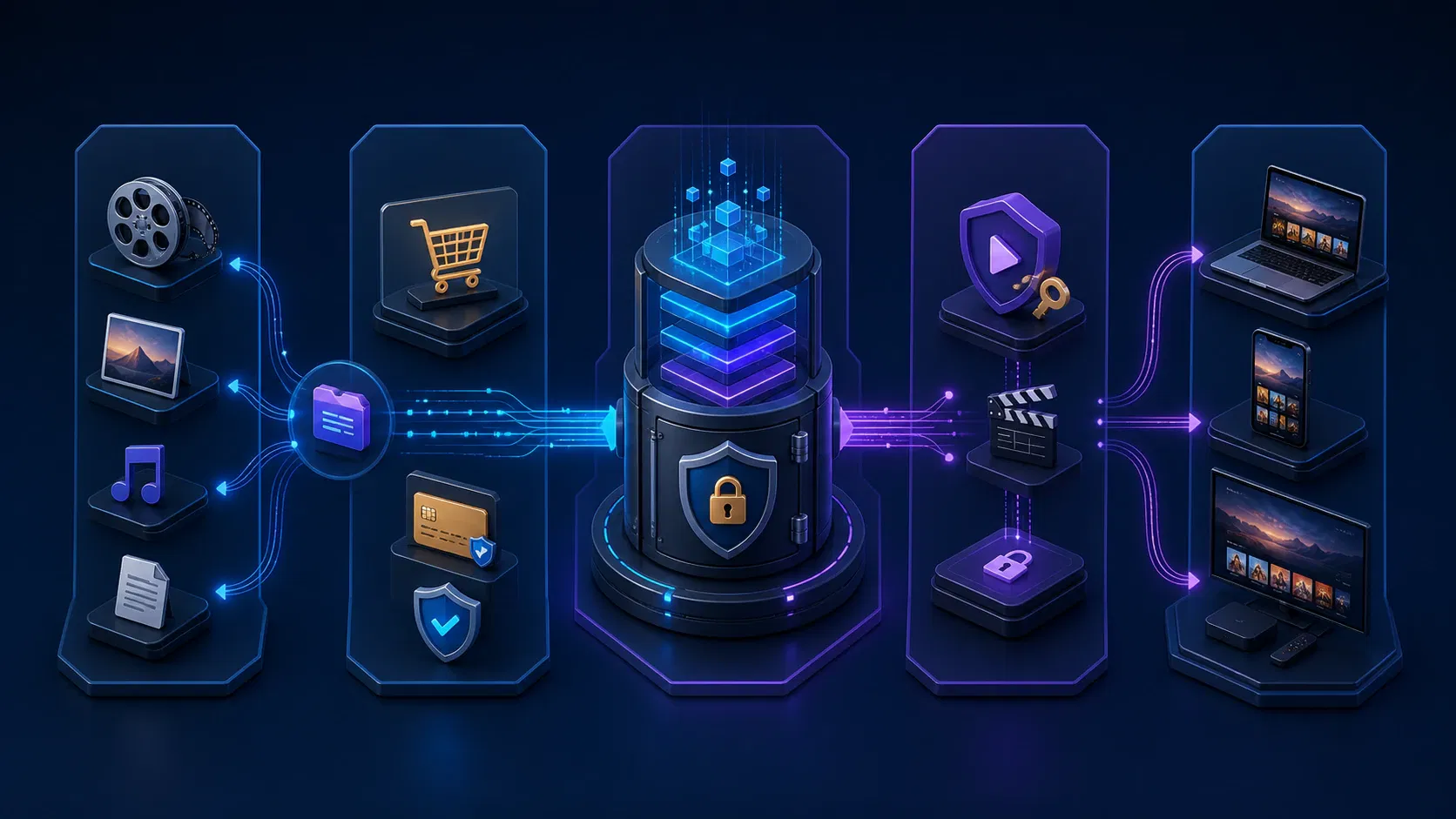
Electronic sell through platform architecture: what to build
A production EST platform needs one authoritative path from an offer to an entitlement and from that entitlement to a playback decision. The following components form the minimum dependable architecture.
Rights and offer service
Model rights separately from merchandising. The rights layer says whether a sale is permitted; the offer layer says how that permitted sale is presented and priced. A CMS editor should never be able to extend a territory or window beyond the underlying agreement by accident.
Support EST and rental as distinct license types even if they share a checkout. This prevents a “buy” offer from inheriting a 48-hour rental rule or a rental from accidentally appearing as permanent access.
Commerce and entitlement service
Use an immutable order record plus an append-only or fully audited entitlement history. Payment succeeded, entitlement granted, refund requested, refund completed, and access revoked are separate events. Reconciliation jobs should find paid orders without entitlements and entitlements without valid orders.
Make admin restoration a controlled operation with a reason code, operator identity, and timestamp. That turns a support workaround into an auditable recovery path.
Multi-DRM and secure delivery
Choose packaging, player, and DRM coverage from the promised device matrix. Web, Android, iOS, connected TV, and offline playback do not all use the same combination. Test policy behavior—not only successful playback—across new devices, expired offline keys, concurrency limits, output protection, and account changes.
For teams that want the EST commerce model integrated with native web, mobile, and connected-TV playback, Apexnova’s TVOD platform engineering can connect the entitlement, payment, multi-DRM, and application layers as one delivery scope. That is most useful when device coverage and ownership-like reliability matter more than assembling isolated vendor demos.
Customer-facing library and support console
The customer library should show the purchase, edition, available quality, supported actions, and any meaningful restriction in plain language. The support console should search by order, customer, title, or entitlement; display the state timeline; restore access safely; and initiate the correct refund workflow.
Instrument both. A successful charge followed by a license error is a revenue incident, not merely a player log.
How to price and window electronic sell through offers
Pricing should express the value of ongoing access while preserving a logical step between rental, purchase, bundle, and subscription. There is no universal multiplier that works across a new film, a training course, and a sports archive.
Build pricing around four inputs:
- Willingness to pay: audience research, comparable offers, and preorder behavior;
- Rights economics: minimum guarantees, rev shares, taxes, payment fees, and delivery cost;
- Window position: how early or exclusive the EST offer is;
- Product depth: resolution, bonus material, bundle size, offline access, and device reach.
Create a price ladder that customers can understand. A rental should be meaningfully cheaper than a purchase. A season or collection should make the bundle advantage visible. A temporary promotion should have explicit start and end times, not a manually edited price that can linger.
Windowing deserves the same rigor. A title can stop being sold after the EST sales window closes while existing purchasers keep their entitlements. This means “may sell now” and “an existing buyer may still play” are two different decisions. Conflating them is a common way to remove paid titles from libraries when a storefront offer expires.
Hybrid monetization can widen the funnel. For example, let an SVOD member purchase a premium release, offer EST after a live pay-per-view event, or move an older title to AVOD while honoring prior purchases. The system should evaluate each customer’s best entitlement rather than attach a single monetization flag to the title.
Launch checklist and metrics that reveal real EST performance
Before launch, run the complete lifecycle—not just happy-path checkout.
Rights and merchandising
- Validate territory, EST window, currency, tax, language, and format for every offer.
- Confirm that storefront expiry does not revoke an existing purchase.
- Review “buy,” “own,” “download,” and “forever” copy against actual license terms.
Commerce and recovery
- Retry payment webhooks and prove entitlement fulfillment is idempotent.
- Reconcile paid orders to entitlements automatically.
- Test full and partial refunds, chargebacks, manual restoration, and account merges.
Playback and devices
- Exercise every supported browser, mobile OS, TV platform, and casting route.
- Test online playback, download, offline playback, key renewal, device removal, and concurrency.
- Verify that the library remains correct after reinstalling an app or signing in on a new device.
Operations and analytics
- Give support a state timeline and documented recovery playbooks.
- Alert when payment succeeds but entitlement or first playback fails.
- Separate offer conversion, purchase activation, playback quality, and refund metrics.
Revenue alone can hide a broken experience. Track at least:
- product-page-to-checkout and checkout-to-purchase conversion;
- payment-success-to-entitlement latency;
- purchase-to-first-play activation;
- entitlement authorization and DRM license error rates;
- refund and chargeback rate by title, device, and territory;
- repeat purchase rate and bundle attach rate;
- support contacts per 1,000 purchases;
- contribution margin after rights, payment, tax, DRM, CDN, and support costs.
These metrics distinguish a weak content offer from a technical fulfillment problem. If product-page traffic is healthy but checkout conversion is low, revisit value and price. If payment conversion is healthy but first-play activation is poor, inspect entitlement creation, library visibility, and device playback before spending more on acquisition.
Frequently asked questions
What is an example of electronic sell through?
Buying a digital film or season once and adding it to an account library for repeated viewing is an EST transaction. The customer may be able to stream it across supported devices and download it for protected offline viewing, depending on the service’s terms.
Is electronic sell through the same as TVOD?
EST is a type of TVOD, not a separate umbrella model. TVOD includes both purchases such as EST and time-limited rentals such as DTR.
Does an EST customer own the video file?
Usually, no. The customer typically receives an ongoing license to access a digital reproduction under the provider’s terms, not the copyright or an unrestricted file. The service should disclose device, download, territory, and availability limitations before purchase.
Can electronic sell through work without downloads?
Yes. An EST purchase can provide ongoing streaming access through a cloud library, although audiences may expect offline access when the product uses ownership language. The checkout and help content should state whether protected downloads are included.
What is the difference between EST and rental VOD?
EST provides ongoing access after one purchase. Rental VOD provides access for a defined period, often with separate deadlines to start and finish viewing. They should use different entitlement policies even when sold through the same storefront.
What should an EST platform build first?
Start with the rights and offer model, payment-to-entitlement workflow, and playback authorization contract. Once those states are explicit, add the customer library, multi-device clients, offline downloads, support tooling, and optimization experiments.
Make the ownership promise operational
Electronic sell through is a good fit when premium content has repeat value, the audience has purchase intent, and the rights support ongoing access. It is a poor fit when a team expects checkout alone to compensate for weak demand or vague licensing.
The go/no-go decision should therefore be concrete: verify one catalog, one territory, one price ladder, and the full purchase-to-play lifecycle across the devices your audience actually uses. If the entitlement and recovery model survives that test, expand with confidence. If you are planning an EST or hybrid TVOD launch, book an architecture call to turn the rights, commerce, DRM, and device requirements into a buildable scope.