

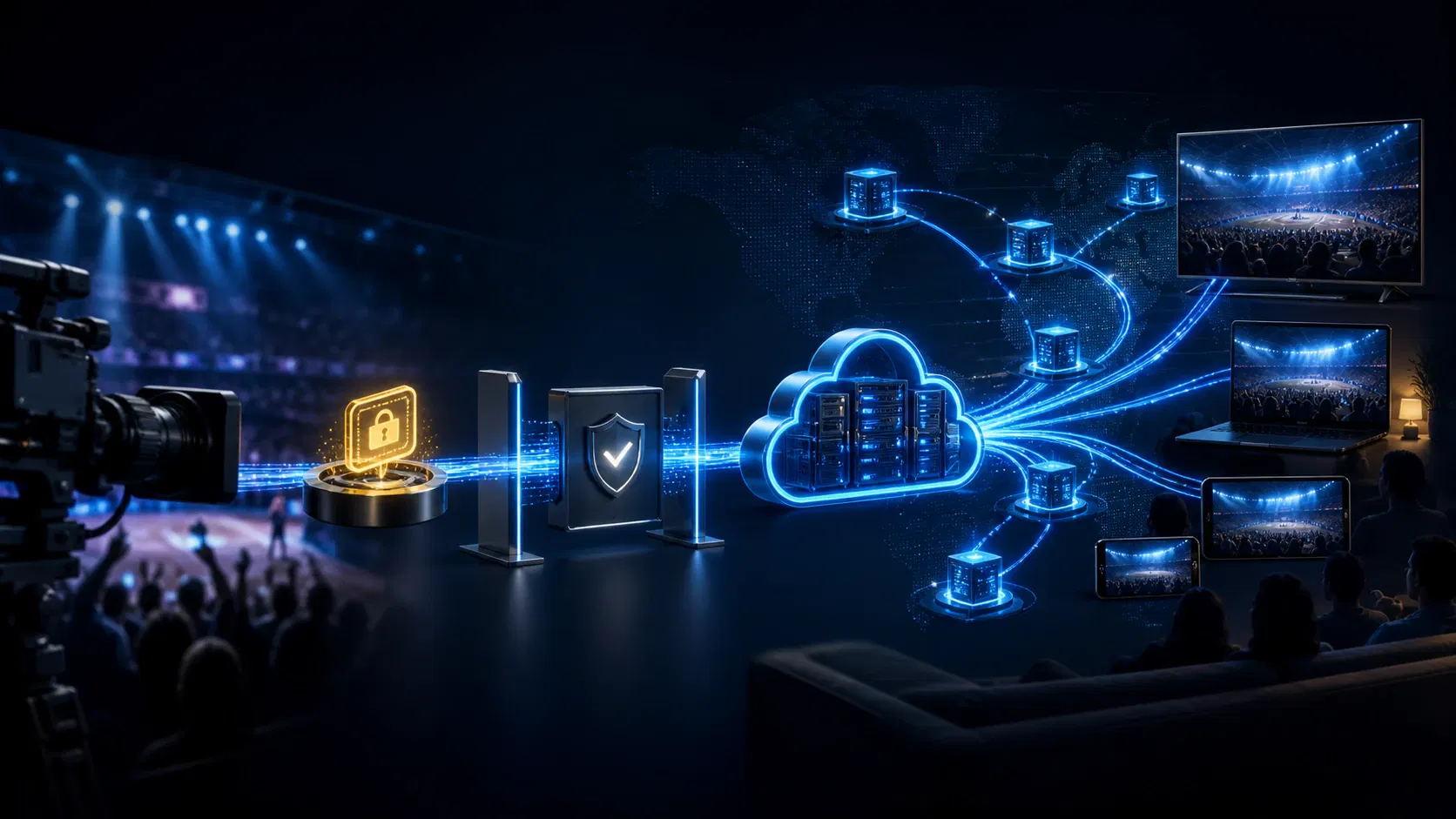
PPV Streaming: Architecture, Payments, and Live Event Scale
Your headliner walks on at 8:00 p.m. At 7:57, thousands of viewers arrive together, some still paying and others refreshing the player. A PPV streaming launch succeeds only if checkout, access control, and video delivery survive that shared deadline as one system.
The difficult part is not placing a paywall in front of a stream. It is making sure a successful payment creates the right viewing entitlement, that only an entitled viewer can request playback, and that the live pipeline can absorb a sudden audience without turning the event into refunds and support tickets. This guide gives product and engineering teams the architecture, payment flow, security controls, and event-night plan needed to evaluate a pay-per-view streaming service or build one.
What is PPV streaming?
PPV streaming is a monetization model in which a viewer makes a one-time payment to access a specific live event or video for a defined viewing window. The purchase creates an entitlement, and the platform checks that entitlement before issuing protected playback access.
That makes PPV different from a subscription. A subscriber buys continuing access to a catalog; a PPV buyer purchases one event, a bundle of events, or a time-limited replay. The underlying system still needs the familiar OTT layers—ingest, encoding, packaging, CDN delivery, applications, player, analytics, and content protection—but it adds transaction and entitlement state to the playback decision.
This model fits content with a clear moment of intent:
- a live fight, match, race, or tournament;
- a concert, theatre performance, or comedy special;
- a conference, workshop, or professional class;
- a premium premiere or limited-window release;
- a niche event with an engaged audience but no need for a year-round catalog.
It is less suitable when viewers expect frequent releases and broad library access. In that case, SVOD or a hybrid model may create less purchase friction and more predictable revenue.
| Model | Viewer pays for | Best fit | Main operational risk |
|---|---|---|---|
| PPV / live TVOD | One event or viewing window | Premium, scarce, time-sensitive programming | A traffic and checkout spike near start time |
| SVOD | Ongoing catalog access | Frequent releases and habitual viewing | Churn and subscription fatigue |
| AVOD | Attention through advertising | Broad-reach, lower-friction content | Fill rate, yield, and ad experience |
| Hybrid | A base subscription plus selected events | Loyal audiences with occasional premium events | Complex pricing and entitlement rules |
A hybrid offer can be especially useful for sports. Subscribers might receive regular-season content while marquee events remain PPV, or receive the event as part of a higher tier. The key is to express those rules as explicit entitlements instead of scattering pricing conditions across the player, checkout, and CMS.
How a PPV streaming platform works
A reliable pay per view streaming flow has three linked planes: commerce, control, and media. Commerce collects money, the control plane decides who may watch, and the media plane delivers video. Keeping those responsibilities separate makes each layer easier to scale and failure-test.
The viewer journey should work like this:
- Discover the event. The catalog returns localized time, price, currency, device support, replay window, and regional availability.
- Create an order. The backend locks the event, account, amount, currency, and promotion into a unique order record.
- Complete payment. A hosted checkout or tokenized payment component handles card details and any required authentication.
- Confirm payment server-side. A verified payment webhook moves the order to paid. The browser redirect is useful for responsiveness, but it is not the source of truth.
- Grant an entitlement. The platform creates a durable record linking the account to the event, allowed window, territory, and concurrency policy.
- Authorize playback. The player exchanges its authenticated session for a short-lived playback token, signed cookie, or signed URL.
- Deliver and measure. The CDN serves adaptive video while player telemetry records startup time, errors, bitrate changes, and rebuffering.
- Transition to replay. When the live window ends, the same entitlement policy determines whether the buyer receives a replay and when it expires.
Vimeo's operating guidance illustrates why these states matter: its live PPV workflow distinguishes preorder from ready-for-sale access, recommends releasing large preorder volumes ahead of the event, and suggests retaining a replay window for buyers who had technical trouble (Vimeo live PPV guidance). Your implementation may differ, but the product states should be just as unambiguous.
The core data model does not need to be exotic. It does need to be authoritative. At minimum, keep separate records for event, offer, order, payment, and entitlement. An entitlement should be reproducible from an order but should not be inferred from a success page in the browser.
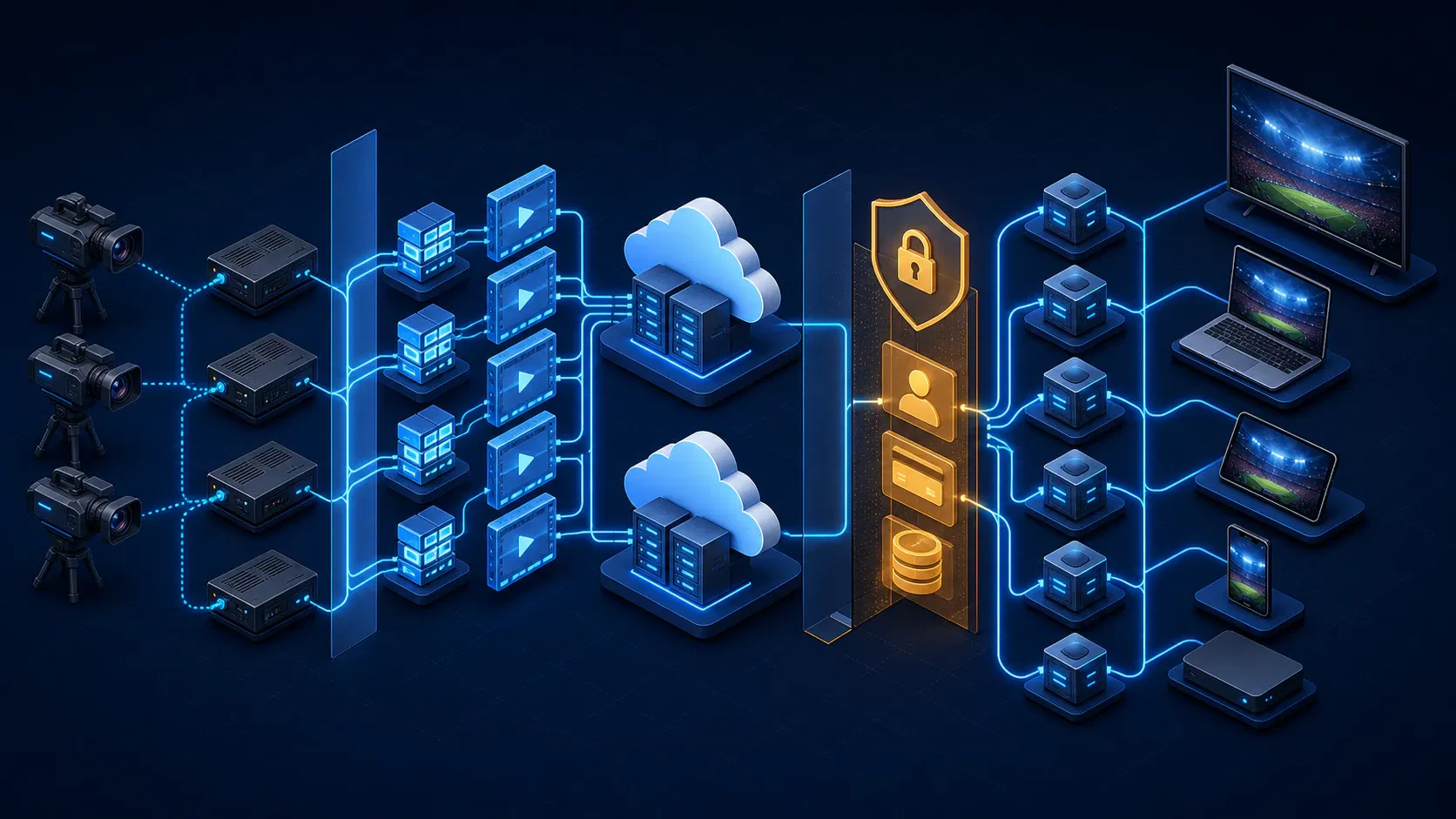
PPV streaming architecture for live event scale
Live events combine a steady media workload with a highly uneven control-plane workload. The encoder may run for hours, but sign-ins, payments, entitlement checks, and playback starts cluster around the opening bell. Design the system for both shapes.
Build redundancy from contribution to origin
Start with two independent contribution paths when the event value justifies it. That can mean redundant encoders, power, network uplinks, and geographically separate receiving endpoints. A backup that shares the same switch, circuit, or configuration error is not truly independent.
The live service should turn the source into an adaptive bitrate ladder, package it for the required devices, and send it to a scalable origin. AWS's reference live architecture processes two input feeds in parallel, packages ABR output into HLS, DASH, and CMAF, and places CloudFront in front of the origin (AWS live streaming architecture). The named services are optional; the pattern—redundant ingest, adaptive encoding, packaging, origin, CDN—is the durable part.
Do not create a ladder from habit. Test the expected source, motion level, device mix, and weak-network conditions. Too few renditions cause buffering or visible quality loss; too many increase encoding and storage complexity without necessarily improving experience.
Keep the CDN cacheable and the origin private
Video segments should be cache-friendly even though the viewer session is personalized. Put authorization in short-lived tokens, cookies, or license requests rather than generating unique media bytes for every viewer. This lets edge caches absorb the audience while the origin serves a much smaller request volume.
Protect the origin from direct access. CloudFront, for example, supports signed URLs and signed cookies for paid private content and recommends preventing viewers from bypassing the CDN to reach the origin (AWS private-content guidance). The same principle applies with any CDN: the public path should enforce authorization, and the origin should accept only trusted delivery traffic.
For a high-value event, define failover before you need it. Decide whether the player retries the same CDN, changes hostnames, or requests a fresh manifest from a traffic router. Test the failover with real playback sessions; a dashboard showing two healthy origins does not prove that a television app can recover mid-event.
Scale the control plane independently
The event page, login, checkout, webhook handler, entitlement API, token service, chat, and analytics collector do not share the same scaling profile. Separate them so a flood of chat messages cannot starve playback authorization and a slow payment provider cannot exhaust application workers.
Useful design choices include:
- stateless API instances behind load balancing;
- cached event and offer data with explicit invalidation;
- an indexed entitlement lookup keyed by account and event;
- a queue between payment confirmation and non-critical work such as email;
- idempotent consumers for payment and entitlement events;
- rate limits that distinguish abuse from legitimate event-start bursts;
- degraded modes that preserve playback for already-authorized viewers.
Capacity tests should reproduce arrival, not just concurrency. Ten thousand viewers starting over an hour is easier than ten thousand starting in three minutes. Model sign-in requests, checkout creation, payment callbacks, token issuance, manifest retrieval, DRM license requests, and telemetry at the same time.
Payments and entitlements that do not lose buyers
Payment is an asynchronous state machine, not a boolean returned by a button. A buyer may require additional authentication, abandon the flow, retry after a decline, or complete a delayed method after leaving the page. The order and entitlement model must survive every one of those transitions.
Use one payment object per order or checkout session and reuse it for retries. Stripe's PaymentIntents guidance recommends an idempotency key to prevent duplicate objects and a stable mapping between the payment and the cart or customer session (Stripe PaymentIntents). Apply that pattern even if you use a different processor.
Grant access from a verified server-side event. Stripe explicitly advises handling fulfillment through webhooks because a customer can close the page after paying and before a client callback runs (Stripe payment-status guidance). Your webhook handler should verify the signature, record the provider event ID, return quickly, and process the state change idempotently.
A practical order state machine is:
created → payment_pending → paid → entitled → refunded/revoked
Keep payment_pending distinct from paid. For delayed payment methods, access policy is a business decision, but the interface must tell the buyer whether payment is processing and whether they can watch. For cards, handle authentication failure without creating a new order each time.
Reconciliation is the safety net. Run a periodic job that compares paid orders with entitlements and alerts on any mismatch. It should be safe to reprocess a payment event without issuing a second entitlement, sending repeated receipts, or incrementing revenue twice.
Reduce payment-data exposure by using a hosted or tokenized integration. Stripe notes that card data can go directly to the processor rather than through your server, reducing—though not eliminating—your PCI responsibilities (Stripe integration security guide). Store provider tokens and non-sensitive references, not raw card details.
Secure PPV streaming without punishing legitimate viewers
No control eliminates piracy. The goal is to make unauthorized access difficult, detectable, and limited while keeping paid playback simple.
Use layered controls:
- Authenticated entitlement checks. Validate account, event, window, territory, refund status, and allowed device concurrency.
- Short-lived playback authorization. Signed cookies or URLs should expire and be scoped narrowly. AWS supports expiry and optional IP restrictions in signed access policies (CloudFront signed-access controls). Be cautious with strict IP binding on mobile networks, where addresses can change.
- Multi-DRM where rights require it. FairPlay protects HLS playback on Apple platforms through encrypted media and secure key exchange (Apple FairPlay Streaming); Widevine is Google's premium-media protection system across many browsers, Android devices, televisions, and other platforms (Google Widevine overview). Device coverage determines the DRM combination.
- Concurrency policy. Limit simultaneous sessions based on the offer, but give viewers a clear way to release an old device or recover a stuck session.
- Forensic or visible watermarking. For valuable rights, session-linked marks can help investigate restreaming. Design this with privacy, player performance, and false-positive handling in mind.
- Geo and rights enforcement. Apply territory rules at entitlement and playback time, not only on the event page.
Do not confuse a hidden player URL with protection. URLs leak through browser tools, logs, screenshots, and shared messages. The entitlement check, delivery token, DRM license, and origin restriction must agree on who is allowed to watch.
Planning PPV sports streaming for event night
PPV sports streaming has a sharper deadline than most digital launches. A viewer who misses a dramatic live moment cannot be made whole by a generic apology. Operations should therefore be designed around time-to-watch, not simply infrastructure uptime.
| When | Product and engineering work | Exit evidence |
|---|---|---|
| 4–6 weeks out | Lock rights, territories, devices, price, taxes, refund terms, replay window, and support policy | Signed decision log and entitlement rules |
| 2–3 weeks out | Run end-to-end purchase and playback tests on every supported device class | Paid test orders reach protected playback |
| 1 week out | Load-test arrival bursts, webhook replay, token issuance, DRM licensing, CDN failover, and origin recovery | Measured headroom and named owners for failures |
| 24 hours out | Freeze risky changes, verify monitoring, pre-warm support content, and open sales if the event policy allows | Go/no-go review complete |
| 60 minutes out | Confirm primary and backup contribution, player health, payment health, clock sync, and incident channels | Green operational checklist |
| During and after | Watch conversion and QoE together; preserve logs; publish replay and reconcile orders | Buyers retain correct access and mismatches are resolved |
Create a runbook with thresholds and actions. If playback-start failures rise, the team should know whether to roll back a player release, switch origin, extend tokens, or disable a nonessential feature. If checkout failures rise, it should know how to isolate a payment method, preserve orders, and tell buyers what to do next.
Support needs the same event model as engineering. Give agents searchable order and entitlement status, device-reset controls, incident messages, and a safe way to grant or restore access. Never make the viewer prove a payment with a screenshot when your payment provider and order database can be reconciled.
Choose a pay per view streaming service or custom build
The right delivery model depends less on audience size than on how unusual your rights, commerce, devices, and integrations are.
| Approach | Choose it when | Validate before signing |
|---|---|---|
| Hosted PPV platform | You need a standard branded event quickly and accept platform workflows | Revenue share, payout timing, device apps, event limits, support coverage, data export, and replay rules |
| White-label platform | You need stronger branding and apps with mostly standard commerce | Store ownership, roadmap control, API coverage, DRM, regional payments, and migration path |
| Custom platform | Entitlements, rights, data, integrations, or unit economics are strategic | Delivery timeline, reference architecture, event operations, test plan, ownership, and ongoing team |
Estimate total cost using the workload, not the headline license. Include contribution and production, encoding, DRM and license traffic, CDN delivery, payment and refund fees, application hosting, monitoring, support staffing, app-store commerce rules, and replay storage. For delivery planning, model traffic as viewers × average delivered bitrate × viewing time, then add realistic overhead and regional distribution rather than treating peak registrations as peak concurrency.
For teams whose PPV rules or integrations exceed a template, Apexnova's live streaming platform development service covers the media pipeline, web and device apps, payments, DRM, multi-CDN delivery, and analytics as one owned system. A custom build is earned when control and differentiated operations justify it; a hosted product remains the faster answer for a standard one-off event.
Mobile commerce must be reviewed early. Store policies vary by platform and region; Apple's current guidelines, for example, govern how in-app access to premium digital content may be sold and when alternative purchase links or multiplatform access are allowed (Apple App Review Guidelines). Treat app review, product configuration, fees, and restore behavior as architecture inputs, not launch-week paperwork.
Metrics that reveal whether PPV streaming works
Gross ticket revenue is a result, not a diagnostic. Instrument the full path so teams can see where buyers fail and whether paid viewers receive the promised experience.
Track at least:
- event-page visit to checkout-start conversion;
- checkout completion by device, region, and payment method;
- payment authorization and authentication failure rate;
- paid-order-to-entitlement latency and mismatch count;
- entitlement-to-first-frame time;
- video start failure, startup time, rebuffer ratio, and fatal player errors;
- concurrent viewers and average delivered bitrate;
- support contacts and refunds per paid order;
- replay starts and completion after the live event;
- contribution margin after delivery, payment, platform, and support costs.
Join commerce and playback data with privacy-conscious identifiers. A revenue dashboard that cannot show whether paid users pressed play is incomplete; a QoE dashboard that cannot distinguish buyers from preview viewers is equally limited.
Common PPV streaming failures to prevent
The buyer is charged but locked out. The client redirect grants access, the webhook is delayed, or the entitlement write fails. Use server-side confirmation, idempotent entitlement creation, reconciliation, and a support override with an audit trail.
The stream works in rehearsal but fails at kickoff. The test measured steady concurrency rather than the arrival burst. Replay a realistic mix of login, checkout, token, manifest, DRM, and telemetry traffic.
One failure takes out both primary and backup. Redundant encoders share power, network, credentials, configuration, or origin. Map common dependencies and deliberately break each path during testing.
A shared link becomes unlimited access. Media is public once someone knows the manifest URL. Restrict the origin, issue short-lived delivery authorization, enforce entitlement at DRM licensing, and monitor concurrent sessions.
Legitimate viewers trigger anti-sharing controls. Rigid IP binding or unexplained concurrency limits block mobile and household use. Make policy proportional to rights risk and provide clear device management.
The event ends with no replay plan. The recording, access window, and customer message are improvised after the broadcast. Decide them with the offer and automate the live-to-VOD transition.
Teams change production during the countdown. An untested player, paywall, or configuration release introduces avoidable risk. Set a change freeze, define emergency exceptions, and keep a rollback path.
PPV streaming launch checklist
Before opening sales, verify that:
- the organization owns or licenses the rights for every target territory and device;
- event time, time zone, price, tax, replay, refund, and cancellation terms are visible;
- successful payment produces exactly one correct entitlement;
- failed, abandoned, retried, refunded, and disputed payments follow defined states;
- signed playback access expires and the origin cannot be reached directly;
- DRM and playback work on every advertised device class;
- primary and backup contribution paths have been failover-tested;
- burst capacity covers sign-in, checkout, webhook, entitlement, token, DRM, and video starts;
- monitoring connects commerce health with playback quality;
- support can find orders, restore legitimate access, and publish incident updates;
- live-to-VOD processing and replay expiry have owners;
- the team has completed a timed, end-to-end dress rehearsal.
Frequently asked questions
How does PPV streaming work?
The viewer pays once for a specific event or viewing window. After the payment provider confirms success, the platform creates an entitlement and exchanges it for short-lived, protected playback access.
Is PPV the same as TVOD?
PPV is commonly treated as a form of transactional video on demand because access is bought per item rather than through a recurring subscription. In practice, “PPV” often refers to a live, time-sensitive event, while “TVOD” also covers rentals and purchases of on-demand titles.
What does a PPV streaming platform need?
It needs event catalog and pricing, account and payment flows, an entitlement service, protected playback authorization, live ingest and adaptive encoding, packaging and origin, CDN delivery, a multi-device player, analytics, support tools, and a replay workflow. High-value rights may also require multi-DRM, geo-restriction, concurrency controls, and watermarking.
Can viewers watch a PPV event on multiple devices?
That depends on the offer's concurrency policy and rights agreement. A good platform makes the limit clear before purchase, prevents excessive simultaneous viewing, and lets a legitimate buyer release or replace an old device.
How do you stop people from sharing a PPV stream?
Use several layers: authenticated entitlements, short-lived signed delivery access, DRM licensing, concurrency limits, origin restriction, and monitoring. No measure stops all copying, so controls should reduce unauthorized reach without creating more failures for paying viewers.
Should a PPV purchase include a replay?
Include a replay when rights permit and it improves the buyer promise, especially for viewers who join late or experience technical trouble. Define the replay window before sale, show it on the event page, and enforce it through the same entitlement used for live access.
Conclusion
Choose PPV when the event is scarce enough to justify a separate purchase and your team can operate the whole paid-viewer journey. Choose a hosted service for a standard one-off event; choose white-label or custom development when rights, device coverage, payments, data ownership, integrations, or unit economics make those workflows strategic.
Before evaluating vendors, document five numbers: expected peak concurrency, arrival window, target territories, supported device classes, and replay duration. Then require a working demonstration from completed payment to protected playback—and a failure test for the same path. If your rules call for an owned system, request a PPV architecture review before committing to the build.