


Microdrama Monetization: How Short-Form Series Make Money
A microdrama can earn millions of views and still fail as a business. The problem is rarely a lack of cliffhangers. It is the gap between feed discovery, paid acquisition, episode economics, and a product that gives viewers a fair reason to keep watching.
For media founders, producers, and product teams, the useful question is not whether microdrama is growing. It is how to turn short, serialized stories into repeatable revenue without making every episode feel like a payment trap. This guide connects the content, monetization, and platform decisions that determine whether a micro drama series becomes a durable catalog or a costly burst of traffic.
What is a microdrama?
A microdrama is a serialized, mobile-first story told in very short episodes, commonly one to three minutes long. Unlike a standalone Reel or Short, its episodes form a continuing narrative designed to move viewers from one instalment to the next.
The vertical frame is only the visible part of the format. A microdrama also has recurring characters, a season arc, compressed scenes, frequent story turns, and an explicit continuation loop. Omdia describes microdramas as short serialized stories typically running two to three minutes, positioned between social video and traditional scripted television.
That distinction matters commercially. A short clip optimizes for the current view; a serialized microdrama must also earn the next episode start. The product, therefore, has to preserve narrative momentum across the feed, landing page, app install, account creation, payment, and playback experience.
Why microdrama economics are different
There is real demand, but demand alone does not settle the business model. Omdia projected the format to generate $11 billion in global revenue in 2025, with more than 60% coming from subscription or transactional payments, often after a free introduction. In India, the opportunity starts higher in the funnel: a 2026 Meta-Ormax study of 2,000 viewers across 14 states found that 89% discovered microdramas through social feeds.
Those figures reveal a tension. The feed is a powerful sampling engine, but the publisher does not own the feed, its algorithm, or the customer relationship. Moving a viewer into an owned experience introduces friction precisely when the story feels most urgent.
The Indian market shows why conversion assumptions must be tested locally. Mint reported that only 28% of surveyed viewers had ever paid, with low trust in platforms and payment mechanisms constraining monetization. The same audience may happily watch several sessions a week while rejecting a full-catalog subscription.
There is also an acquisition-cost problem. The Associated Press reported in 2026 that executives at MIP London said some large microdrama platforms spend as much as 90% of their budgets on marketing. A high-grossing series can still destroy value if paid installs, platform fees, production, and churn absorb the revenue.
How does microdrama monetization work?
Microdrama monetization usually combines free sampling with one or more paid or ad-supported paths. The right model depends on whether the product has one compelling series, a deep catalog, a high-frequency release schedule, or an audience that is more comfortable trading attention than money.
| Model | Best fit | Main advantage | Main risk |
|---|---|---|---|
| Coins or episode unlocks | A strong standalone series with sharp episode hooks | Payment maps directly to the viewer's desire to continue | Surprise costs and repeated friction can damage trust |
| Subscription | A deep catalog with frequent releases | Predictable recurring revenue and simple access | Weak value when viewers want only one show |
| Advertising or rewarded access | Large, price-sensitive audiences | Monetizes non-payers and lowers the access barrier | Interruptions can break tension; revenue depends on fill and yield |
| Hybrid | Platforms serving several willingness-to-pay segments | Gives viewers a choice among time, money, and commitment | More complex entitlements, messaging, and analytics |
| Licensing and brand funding | Producers with valuable IP or a defined audience | Adds revenue without charging every viewer directly | Less control over distribution, data, or creative decisions |
Coins and episode unlocks
The common pattern is simple: let viewers watch enough free episodes to understand the premise, then ask them to unlock the next instalment. Some products also let people earn coins through rewarded ads. The My Drama help center documents both purchased coins and coins earned through actions such as watching ads, illustrating how payment and attention can coexist in one entitlement system.
The paywall should arrive after demonstrated intent, not at an arbitrary episode number. Test it after a meaningful revelation and before the next major question—not before the audience knows the characters or after the central tension has already peaked. Always show the real price, what it unlocks, and whether the user is buying one episode, a bundle, or recurring access.
Subscriptions
Subscription works when the catalog—not one cliffhanger—is the product. A service needs enough related series, reliable release cadence, and recommendations that lead a viewer from a completed show into another relevant one. Otherwise, users subscribe for a single season and cancel.
Weekly plans may match a fast binge cycle, while monthly plans give the catalog more time to prove value. The correct interval is an experiment, not a convention. Compare renewal, completed seasons per subscriber, and movement between titles rather than celebrating the initial trial conversion.
Advertising, licensing, and hybrid access
Advertising can keep the free path viable, particularly where payment trust is still developing. Rewarded access is often more coherent than inserting a disruptive mid-roll into a 90-second scene: the viewer knowingly exchanges time for the next episode. Ad load still needs a cap because completion and continuation are part of the product's future revenue.
Licensing, commissioned production, sponsorship, and IP adaptation can diversify producer income. They are especially useful when a studio has creative capability but does not want to fund its own consumer acquisition. The trade-off is less first-party audience data and potentially less control over rights, release windows, and localization.
A hybrid model is not permission to activate every option at once. Start with one primary path and one fallback—for example, episode unlocks plus rewarded access—then add subscription only when the catalog can support it.
Build a microdrama series around continuation, not just clicks
Every episode needs two jobs: deliver a satisfying piece of story and create a legitimate reason to continue. If an episode contains only setup, viewers feel stalled. If it resolves everything, there is no pull into the next instalment.
Use a simple episode rhythm:
- Re-establish the immediate problem within seconds.
- Change the situation through a decision, discovery, or reversal.
- Pay off at least one small expectation.
- Open a specific next question.
That last question should be narrative, not merely mechanical. “Will she reveal the evidence?” is stronger than cutting mid-sentence. The objective is anticipation, not confusion.
Design the free sample as a miniature season journey. It should establish the protagonist, stakes, and recurring promise before the first transaction. Then use recaps selectively; repeated padding is expensive in a format where each minute must move the story.
The platform stack behind profitable microdramas
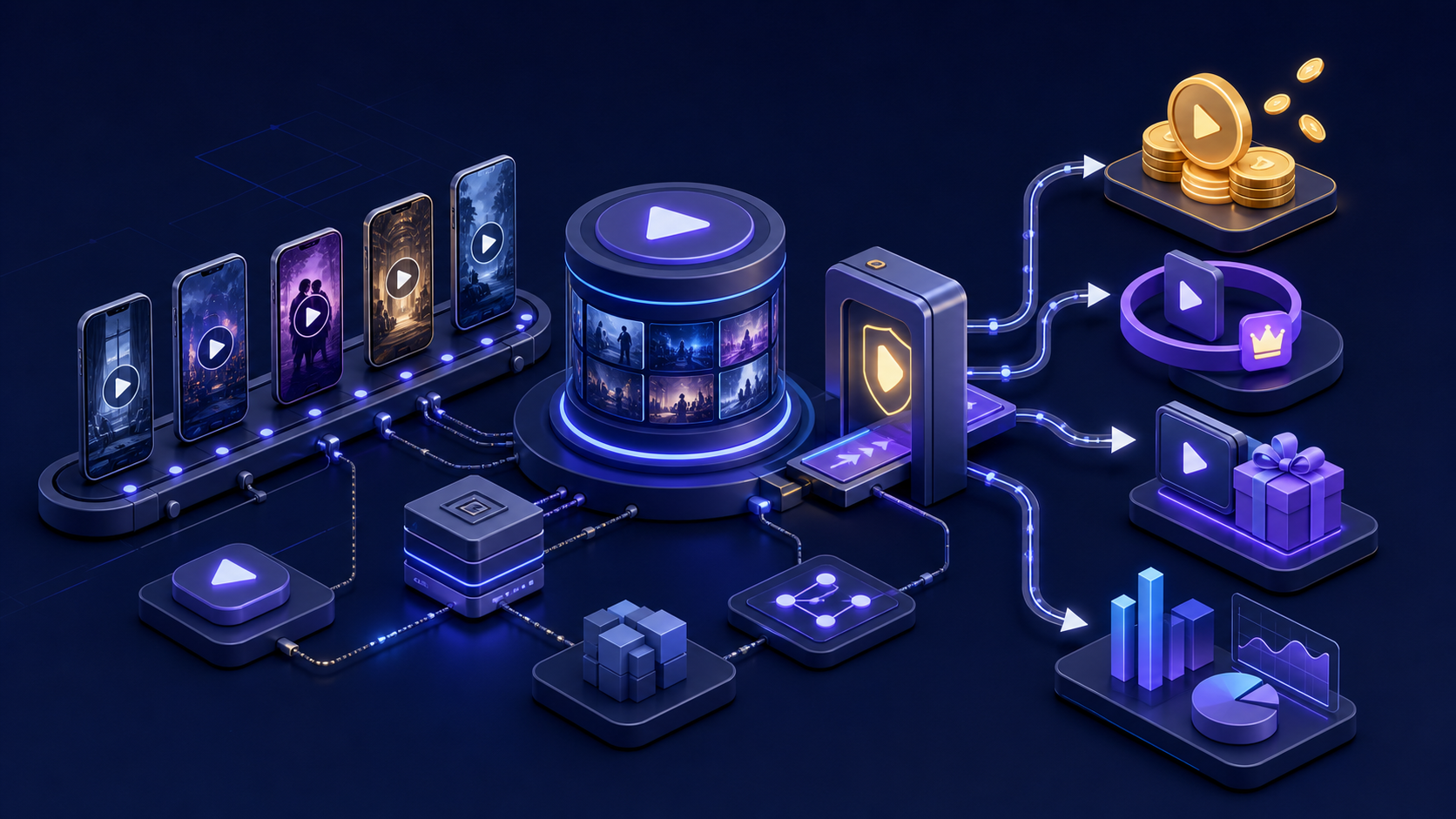
A short episode is lightweight; a reliable commercial system is not. Teams need a video CMS that can group dozens of episodes into seasons, schedule releases, manage languages and artwork, and preserve rights by territory. In practice, one CMS should remain the source of truth for episode order, availability, localization, and rights. The playback layer should start quickly on variable mobile networks and remember the exact next episode across sessions.
Entitlements must understand coins, bundles, subscriptions, promotional access, and ad-earned unlocks without exposing users to inconsistent balances. Analytics should join acquisition source, episode behavior, paywall exposure, purchase, and retention into one viewer journey.
This is where a purpose-built OTT foundation becomes more valuable than stitching together a social feed and a generic checkout. Apexnova's OTT development services combine content management, monetization, playback, analytics, and multi-platform delivery in an owned stack, so a microdrama team can test access rules without losing the customer journey between vendors. That foundation is most useful once a pilot has shown repeatable continuation and the business is ready to scale its catalog.
Before commissioning a full platform, confirm that the system can answer these questions without spreadsheet reconstruction:
- Which campaign and creative brought in each viewer?
- Where do viewers stop within an episode and across a season?
- Which free episode produces the highest next-episode intent?
- What percentage of paywall viewers purchase or choose rewarded access?
- Do buyers start another series after finishing the first?
- How quickly does gross profit recover acquisition spend?
Metrics that reveal whether the model works
Views are a discovery metric, not proof of a healthy microdrama business. Track the funnel as connected cohorts by campaign, series, language, device, and first-watch date.
Start with these measures:
- Episode completion rate: viewers who reach the end divided by episode starters.
- Next-episode continuation: viewers who start the next episode divided by those who complete the current one.
- Free-to-paywall reach: viewers who see an offer after beginning the sample.
- Paywall conversion: purchasers divided by unique viewers who saw the offer.
- Revenue per payer and per acquired viewer: both are needed; payer-only averages hide a weak conversion rate.
- Day-7 and Day-30 retention: whether viewers return after the first binge.
- Catalog continuation: the share of season finishers who begin another title.
- Contribution after acquisition: revenue less payment or store fees, rewarded-ad costs, user acquisition, and allocated delivery and content costs.
Do not optimize each number independently. Moving the paywall earlier may raise paywall reach while lowering trust and purchase rate. Increasing ad frequency may lift revenue per session while depressing continuation. The goal is a cohort that returns its acquisition and variable costs within an acceptable window, then creates margin through renewal, repeat unlocks, ads, or movement into another series.
A practical 90-day launch sequence
Days 1–30: prove the story loop
Choose one audience, language, and genre. Produce enough episodes to test a complete free sample and paid continuation, but resist building a huge catalog before the format earns retention. Distribute several opening hooks through social feeds and measure qualified episode starts, not just impressions.
Days 31–60: prove willingness to pay or watch
Test one primary offer and one fallback. Compare paywall timing, transparent bundles, and rewarded access with controlled cohorts. Interview both buyers and viewers who abandon at the offer; quantitative data shows where they leave, while interviews help explain whether price, trust, story quality, or checkout caused it.
Days 61–90: prove repeatability
Release a second title or adjacent story for the same audience. A single breakout can conceal weak catalog economics. Repeatability appears when acquisition creatives produce similar qualified viewers, a meaningful share starts another series, and the combined cohort approaches a sustainable payback period.
Scale only after those signals hold. More episodes and more marketing amplify the system already in place—healthy or otherwise.
Common microdrama monetization mistakes
- Treating a long script as chopped-up television: microdramas need episode-level turns, not arbitrary cuts.
- Buying installs before validating continuation: a low-cost install is expensive if the viewer leaves after one episode.
- Hiding the real cost behind coins: unclear conversion between money and access erodes payment trust.
- Offering subscription too early: one good show is not yet a catalog.
- Measuring only aggregate views: blended totals conceal weak campaigns, languages, or series.
- Ignoring rights and localization metadata: expansion becomes slow and risky when contracts, territories, subtitles, and dubs are not attached to the content record.
- Letting rewarded ads overwhelm the story: the free path should support conversion, not make viewing exhausting.
Frequently asked questions
What is a microdrama?
A microdrama is a serialized story created for short, mobile viewing sessions. Episodes are usually only a few minutes long, but together they form a continuing season with recurring characters and plot arcs.
How long is a microdrama episode?
Many microdrama episodes run about one to three minutes. The right length is the shortest time needed to deliver a clear story turn and a reason to continue; it should not be stretched to meet an arbitrary duration.
Where can people watch microdramas?
Viewers discover microdramas in social feeds, on video platforms, and in dedicated short-drama apps. A publisher may release full episodes on ad-supported channels or use social clips as a free sample that leads into an owned app or website.
How do microdrama apps make money?
They commonly combine episode unlocks or coins, subscriptions, advertising, and licensing. A hybrid model can let one viewer pay, another watch a rewarded ad, and a subscriber access the full catalog.
What is the future of microdrama in India?
India has strong feed-led discovery, regional-language demand, and frequent mobile viewing, but payment trust and willingness to pay remain constraints. The likely winners will pair localized stories with transparent offers, low-friction payments, and disciplined acquisition economics rather than relying on reach alone.
Turn a microdrama pilot into a repeatable business
Choose the model your current asset can support. A single irresistible season is a candidate for clear episode bundles or unlocks; a deep, frequently refreshed catalog can justify subscription; a broad price-sensitive audience may need ads or rewarded access. Licensing can reduce consumer-acquisition risk for a producer that prefers to focus on IP.
Then run the smallest pilot that can test story continuation, offer acceptance, and payback. If those three signals repeat across a second title, you have more than a viral microdrama—you have the beginnings of a scalable short-form video business.