

Netflix Clone: Architecture, Features, Cost, and Launch Roadmap
Your team can reproduce a familiar streaming home screen in weeks and still be months away from a viable service. The expensive failures sit behind the interface: unreliable playback, unclear content rights, fragmented billing, weak entitlement checks, and device-specific bugs that appear only after viewers arrive.
A production-ready Netflix clone is therefore not a visual copy of Netflix. It is an original, branded video business built around dependable discovery, playback, monetization, content operations, and measurable quality. This guide shows founders and media product leaders what to build, what to defer, and how to scope the platform without mistaking a demo for a launch.
What is a Netflix clone?
A Netflix clone is a custom or white-label video-on-demand platform that uses proven streaming patterns—profiles, catalogs, search, subscriptions, recommendations, and cross-device playback—under its own brand. It should reproduce the business capabilities viewers expect, not Netflix's protected code, content, name, or visual identity.
The word “clone” is useful shorthand during planning, but it can hide three very different products:
- A front-end demonstration copies familiar browsing interactions but may play only public trailers or static sample files. It is useful for learning, not commerce.
- A launchable MVP has licensed content, a working media pipeline, account and entitlement logic, billing, analytics, support tooling, and tested apps for a deliberately limited device set.
- A scaled OTT service adds a wider app matrix, multi-DRM, deeper personalization, redundancy, sophisticated content operations, and cost controls for sustained viewing volume.
That distinction matters when comparing proposals. A low quote may cover a responsive website and a generic player; another may include encoding, CDN delivery, native mobile apps, smart-TV certification, subscription lifecycle handling, and operational support. They are not quotes for the same outcome.
Start with the service, not the Netflix interface
The fastest way to overscope a streaming product is to list everything Netflix has. Start instead with a narrow programming promise: one audience, one content advantage, one primary viewing context, and one monetization hypothesis.
A useful product brief answers six questions before architecture work begins:
- Who is this for? Define the audience by a real need—regional cinema fans, a sports league, faith communities, professional training, independent filmmakers—not “everyone who watches video.”
- What can they watch? Record whether content is owned, licensed, commissioned, live, user-generated, or supplied by partners. Rights can vary by country, device, language, and date.
- Why will they return? A differentiated catalog, community, schedule, expertise, or access model matters more than a familiar carousel layout.
- How will it earn? Choose subscriptions (SVOD), ads (AVOD), individual purchases or rentals (TVOD/EST), pay-per-view, sponsorship, or a deliberate hybrid.
- Where will viewing happen first? Web and mobile may validate demand; living-room viewing may make Android TV, Fire TV, Apple TV, Roku, Tizen, or webOS essential from day one.
- What proves the launch worked? Pick a small metric set such as trial-to-paid conversion, playback-start success, rebuffering, completion, week-four retention, and revenue per active viewer.
This brief protects the roadmap from “parity” work that adds development and testing without validating the business. If most sessions will be ten-minute lessons on phones, television profiles and cinematic previews may wait. If the product is premium live sport, concurrency planning, entitlement speed, and failure recovery move to the front.
Choose the right Netflix clone delivery model
There is no universally best build path. The right choice depends on differentiation, control, internal capability, and how costs should behave as the audience grows.
| Approach | Best fit | Main advantage | Main constraint |
|---|---|---|---|
| Template or clone script | Prototype, internal demo, technical learning | Lowest barrier to a visible product | Usually lacks production media operations, security, and device depth |
| Hosted OTT SaaS | Standard catalog and monetization with a fast launch | Managed infrastructure and common features | Recurring platform limits, fees, and a vendor-controlled roadmap |
| White-label platform | Branded service with modest workflow customization | Faster than a ground-up build | Differentiation and ownership depend on the contract and product |
| Custom platform | A distinct product, unusual workflows, cost control, or strategic ownership | Full control of experience, integrations, data, and infrastructure | Higher discovery, engineering, QA, and operational responsibility |
Ask vendors to mark every requirement as native, configured, integrated, custom-built, or unavailable. Then request ownership terms, service limits, migration paths, and a sample monthly infrastructure model. A feature checkbox does not reveal whether the feature works across every promised device or becomes an extra service after launch.
Before selecting a path, run the same exit test against every option:
- Can you export users, catalog metadata, watch history, analytics events, artwork, captions, and billing references in usable formats?
- Who owns the source code, cloud accounts, app-store listings, signing keys, domains, DRM relationships, and analytics data?
- Can another team operate or extend the service without permission from the original vendor?
- Which costs scale with subscribers, viewing hours, delivery volume, apps, support, or revenue?
- What happens to viewer access and stored media if the contract ends?
Also separate platform ownership from component ownership. A custom service can sensibly use managed cloud, search, payment, or encoding products while retaining its application code, data model, deployment definitions, accounts, and replacement options. Conversely, a branded front end may still be tightly locked to a proprietary CMS and delivery stack. Document each critical component, its system of record, its operator, its contract, and a credible migration route.
The result is a decision based on control and operating responsibility rather than labels. “White-label” and “custom” are sales terms until the architecture, accounts, source rights, data portability, and support boundaries appear in writing.
Netflix clone features: what belongs in the MVP?
An MVP should complete the viewer's journey and the operator's daily workflow. “Minimum” means the smallest coherent service you can safely operate—not the smallest number of screens a developer can demonstrate.
Viewer and account essentials
- Email or phone authentication, password recovery, session management, and account deletion
- A browseable catalog with collections, detail pages, search, and useful filters
- A resilient player with adaptive quality, captions, audio-track selection, seek, and clear error states
- Watch history, continue watching, and a watchlist synchronized across the launch devices
- Subscription or purchase entitlement that changes promptly after payment, cancellation, expiry, refund, or renewal failure
- A help path for playback, billing, and account problems
Profiles, parental controls, offline downloads, casting, and simultaneous-stream limits may be essential for a family entertainment service. They may be phase two for a single-user learning library. Requirements should follow the audience and rights agreements, not a generic clone checklist.
Operator essentials
Viewers see an app; the business operates a catalog. The first release needs a CMS that can ingest masters, validate metadata, manage artwork and captions, schedule availability, define geographic and subscription rights, publish collections, and withdraw an asset without a deployment.
Operators also need customer lookup, entitlement inspection, refund or support workflows, audit logs, and basic content and playback reporting. If every catalog correction or access issue requires an engineer, the MVP is not operationally complete.
Accessibility is a core player requirement
Captions, focus states, remote-control navigation, screen-reader labels, contrast, and keyboard support are easier to design into components than bolt on later. The W3C media accessibility guidance identifies captions as a WCAG Level A requirement for prerecorded video with meaningful audio and a Level AA requirement for live video. Treat timed-text ingestion, language metadata, caption styling, and player testing as part of the media pipeline rather than content cleanup.
Netflix clone architecture for production streaming
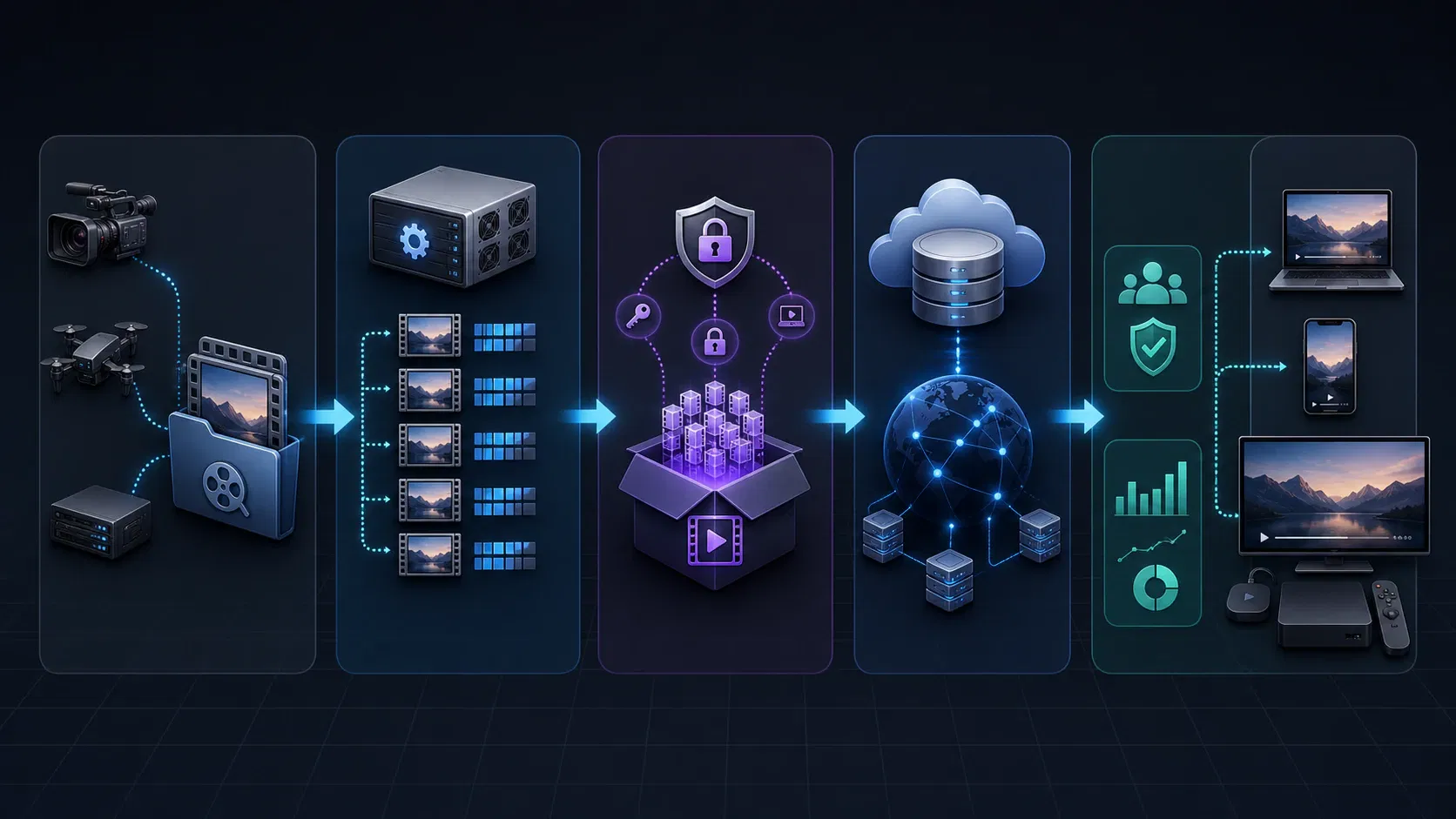
The solution has two connected paths. The media plane ingests, processes, protects, and distributes large video objects. The control plane manages users, catalog metadata, offers, payments, entitlements, recommendations, and analytics. Keeping them conceptually separate makes scaling and troubleshooting far easier.
1. Ingest, metadata, and quality control
Store the high-quality master separately from playback outputs. On ingest, validate the container, codecs, duration, audio layout, captions, artwork, and required metadata. Generate checksums and retain job history so operators can trace a bad rendition back to its source.
The CMS should model titles, series, seasons, episodes, contributors, genres, languages, ratings, and availability rules. Rights are data, not notes in a spreadsheet: playback decisions may depend on territory, plan, purchase, device, concurrency, and a start or end timestamp.
2. Transcoding and adaptive packaging
One large MP4 is not a production streaming workflow. The platform encodes several renditions and packages short segments plus a manifest so the player can change quality as network conditions change. AWS describes the standard VOD sequence as object storage, transcoding into multiple resolution and bitrate assets, then CDN delivery; see its CloudFront VOD workflow.
Start with a conservative H.264 ladder for broad compatibility, then add HEVC or AV1 where device support and delivery savings justify the extra encoding and storage. Do not copy a universal bitrate table blindly. Test by content type: animation, grainy film, talking heads, and high-motion sport need different treatment. Apple's current HLS authoring specification explicitly recommends evaluating its example bitrates against the actual content and encoding workflow.
3. Content protection and entitlement
Encryption prevents casual access to the media objects; DRM governs license issuance and playback rules. Premium services usually need a device-aware combination of Widevine, FairPlay, and PlayReady rather than a single integration. Google's Widevine overview shows support across Android, common browsers, Roku, Fire TV, and many smart TVs, while its documented license flow puts business-rule validation in a partner-operated proxy.
That proxy must check the authenticated user, active entitlement, asset rights, device policy, concurrency, and license duration. Use signed, short-lived playback URLs; protect secrets and keys; rate-limit sensitive endpoints; and log decisions without leaking tokens. The OWASP API Security Top 10 places broken object-level authorization and broken authentication at the top of its current API risk list—both directly relevant when APIs expose profiles, purchases, and asset identifiers.
DRM does not replace content rights, watermarking, account controls, or incident response. It is one layer in a system designed to make unauthorized access harder and investigation possible.
4. Origin, CDN, and playback applications
Package outputs land in durable object storage behind an origin-protection strategy. A CDN caches segments closer to viewers, while signed access and origin rules prevent the storage endpoint becoming a public bypass. Multi-CDN routing can improve resilience and commercial leverage at scale, but one well-observed CDN is usually enough to validate an MVP.
Client apps should share APIs, design tokens, analytics names, and business rules, but not force identical player implementations everywhere. Web, iOS, Android, Roku, and television operating systems have different media stacks, DRM capabilities, remote interactions, memory limits, and store requirements. Plan a device capability matrix covering codecs, HDR, audio, subtitles, DRM level, playback rate, downloads, casting, and analytics events.
5. Control services and event data
The control plane commonly includes identity, profiles, catalog, search, offers, billing, entitlements, playback-session authorization, watch state, notifications, recommendations, and administration. An MVP does not need dozens of microservices. It needs clean domain boundaries, idempotent payment handling, reliable queues for slow work, caching around hot reads, and traceability across a playback request.
Emit a consistent event vocabulary from every app: impression, detail view, play request, playback started, startup time, bitrate change, rebuffer start and end, fatal error, progress, completion, subscription event, and search result selection. Separate product analytics from player quality-of-experience data, but give both a shared session and anonymous/device context that respects the privacy policy.
Monetization is more than connecting a payment gateway
SVOD needs offers, trials, renewals, upgrades, downgrades, grace periods, failed-payment recovery, cancellations, refunds, taxes, invoices, and entitlement reconciliation. TVOD adds rental windows and purchase ownership. AVOD adds ad inventory, cue points, frequency policy, consent, measurement, and client- or server-side insertion. A hybrid combines their edge cases.
Mobile distribution rules must be scoped early because they affect checkout design and economics. Google's current Play payments policy generally requires Play Billing for digital content and video subscriptions in Play-distributed apps, subject to regional programs and listed exceptions. Apple's App Review Guidelines define in-app purchase rules and storefront-specific external-link provisions; eligible video “reader” apps can also request an External Link Account Entitlement under specific conditions.
Policies change and vary by market. Capture the intended storefronts, countries, purchase flows, and existing-subscriber experience in discovery, then verify the current policy before implementation and submission. Do not leave billing compliance to the final review week.
Is it legal to build a Netflix clone?
Building a video service with common functional ideas can be lawful, but copying protected expression, brand assets, code, or content is a different matter. The U.S. Copyright Office explains that copyright can protect expression in a computer program but not ideas, program logic, algorithms, systems, methods, concepts, or layouts; see its computer program guidance. Application-specific advice still belongs with qualified counsel in each launch market.
Use an original name, visual system, copy, information architecture, and codebase. License every film, episode, image, font, music track, and third-party component for its intended use. Netflix's own brand asset terms prohibit confusing use and imitation of its website design, typefaces, distinctive style, graphics, or imagery without permission.
Store policies create another practical boundary. Apple's guidelines reject copycat representations and impersonation, while Google Play's impersonation policy warns against titles, icons, descriptions, and in-app elements that mislead users about a relationship with another company or app. “Netflix clone” should remain an internal category or descriptive search phrase—not the product name or design brief.
Before development, create a rights matrix for each asset and territory, obtain privacy and terms documentation, review child-directed or age-rated content obligations, and document moderation when users or creators can upload material. These are launch dependencies, not post-launch legal polish.
A practical Netflix clone development roadmap
Phase 1: Discovery and evidence
Define the audience, content supply, rights, revenue model, launch geography, device priorities, support model, and success metrics. Prototype the riskiest flows—often television navigation, playback authorization, payment reconciliation, or partner ingest—before polishing a home screen.
The output should be a prioritized scope, architecture, rights model, event taxonomy, device matrix, acceptance tests, operating-cost model, and launch plan. If the content rights or unit economics do not work on paper, code will not repair them.
Phase 2: Platform foundation
Build identity, catalog, CMS, ingest, encoding, packaging, storage, CDN, entitlements, billing integration, and the first player together. Establish environments, infrastructure as code, secrets management, observability, backups, and deployment pipelines now, while the system is small.
For teams choosing the custom route, Apexnova's OTT app development approach covers viewer apps, backend, player, DRM, and delivery as one owned platform rather than disconnected vendor projects. Its 30-day delivery model is most credible when content, device priorities, monetization, integrations, and approval responsibilities are settled during discovery; a broad multi-device or live scope can extend that baseline.
Phase 3: Apps and operational workflows
Ship the narrowest device set that reaches the audience, using real protected content and production-like accounts. Build the operator workflows in parallel: publishing, rights changes, customer lookup, entitlement repair, takedown, refund support, and incident communication.
Automate high-value tests across API contracts, subscription states, manifest and license access, seek and resume behavior, subtitle and audio combinations, and representative devices. Add network-condition playback tests and sustained load tests based on expected concurrency, not an arbitrary impressive number.
Phase 4: Controlled launch and expansion
Start with staff and rights-holder acceptance, then a small external cohort. Watch actual startup time, playback failures, rebuffering, search behavior, payment completion, support tickets, and retention. Fix the dominant failure mode before adding another app platform or recommendation model.
Expand by evidence. A smart-TV app earns priority when viewers request living-room access; per-title encoding earns priority when delivery spend justifies it; recommendation sophistication earns priority after the catalog and event data are rich enough to improve results.
How much does a Netflix clone cost?
There is no defensible universal price because “Netflix clone” does not define scope. Published vendor estimates illustrate the problem: one guide quotes roughly $6,000–$30,000, while another quotes $40,000–$300,000 or more (CloneAppz, Appinventiv). Those ranges are not useful until you know which apps, infrastructure, protection, workflows, integrations, QA, and post-launch obligations they include.
Estimate the build in workstreams:
- Product discovery, user experience, and design system
- CMS, catalog, search, identity, profiles, and administration
- Ingest, quality control, encoding, packaging, storage, DRM, and CDN
- Monetization, taxes, subscription state, offers, and entitlement reconciliation
- Web, mobile, and individual connected-TV applications
- Analytics, observability, accessibility, security, privacy, and compliance
- Device lab, automated QA, store preparation, launch, and support tooling
Then model ongoing cost separately: encoding jobs, stored renditions and masters, CDN egress, DRM/license services, observability, search, email or messaging, payments and store fees, support, maintenance, content operations, and incident coverage. Traffic estimates should use viewing minutes, bitrate mix, geography, cache efficiency, and concurrency—not registered users alone.
Three scope decisions dominate many budgets: the number of device families, whether live streaming or offline downloads are required, and how much of the platform is owned versus managed. A phased estimate with explicit assumptions is more valuable than a single low headline number.
Launch gates: when is the platform actually ready?
Do not approve launch because the happy-path demo works. Set measurable release gates and test them on supported devices, accounts, territories, and network conditions.
| Gate | What to verify |
|---|---|
| Rights | Every launch asset has valid territory, window, device, and monetization rules |
| Playback | Startup, seek, bitrate changes, captions, audio, resume, and errors work across the device matrix |
| Protection | Unentitled, expired, geo-blocked, and over-limit sessions fail safely; keys and origins are not exposed |
| Billing | Purchase, renewal, cancellation, refund, grace, and failed-payment states reconcile to access |
| Operations | Staff can publish, correct, withdraw, support, and audit without engineering intervention |
| Resilience | Backups restore, alerts reach owners, runbooks work, and critical dependencies have a response plan |
| Measurement | Product, revenue, and quality events arrive with consistent names and useful context |
| Compliance | Store materials, privacy choices, accessibility, content ratings, and rights evidence are ready |
Set thresholds appropriate to the business and record who can waive them. A niche archive and a live championship have different availability needs, but both deserve explicit decisions rather than optimistic assumptions.
Frequently asked questions
How long does it take to build a Netflix clone?
A focused MVP can be delivered much faster than a broad, multi-device service, but the timeline depends on content readiness, device count, monetization, DRM, integrations, and approval cycles. Treat any fixed timeline as conditional on a written scope, named dependencies, acceptance tests, and fast stakeholder decisions.
What technology stack is best for a Netflix clone?
Choose by team capability and device requirements rather than fashion. Common choices include React or Next.js for web, Swift with AVPlayer for Apple platforms, Kotlin with Media3 for Android, a typed backend language with PostgreSQL and Redis, object storage, HLS or DASH packaging, multi-DRM, and CDN delivery. Managed encoding, search, identity, and observability can reduce operational load when they do not compromise the required control or economics.
Do I need content licenses for a streaming app?
Yes, unless you own the relevant rights or the material is genuinely licensed for the intended use. Rights can be limited by territory, term, device, language, subscription tier, advertising model, rental window, or download capability, so store them as enforceable platform rules and have counsel review the agreements.
Can a Netflix clone support SVOD, AVOD, and TVOD together?
Yes. A hybrid service can offer subscriptions, ads, rentals, purchases, and pay-per-view, but each model adds catalog rules, billing states, reporting, and viewer-experience edge cases. Launch with the smallest combination that matches the content and audience, while designing offers and entitlements so another model can be added later.
Should I use a clone script or build a custom OTT platform?
Use a clone script for learning or a disposable prototype. Choose hosted or white-label software when speed and standard workflows matter most; choose a custom platform when experience, integrations, data ownership, infrastructure control, or differentiated operations are strategic. Compare total cost and exit options over several years, not only the launch fee.
Which devices should the first release support?
Support the smallest set that reaches the target audience in its primary viewing context. Web plus iOS and Android is a common validation set, but a television-first audience may require one or two connected-TV ecosystems earlier. Add devices only with a funded maintenance and testing plan.
Conclusion
A credible Netflix clone begins with a distinctive content business and ends with repeatable operations; the familiar browsing experience sits between them. Define the audience and rights first, choose the delivery model deliberately, build a secure adaptive-streaming core, and let real usage determine which devices and advanced features come next.
If you can state the launch catalog, countries, monetization model, target devices, concurrency, and ownership preference, you are ready for a scoped architecture—not another generic feature list. Book a strategy call to turn those decisions into a phased build plan with clear launch gates and operating assumptions.