

Clone Amazon Prime Video: Build Your Own OTT Platform
Your team can reproduce a polished home screen in weeks and still be months away from a service viewers will trust. The expensive work in a clone Amazon project sits behind the interface: content rights, encoding, entitlements, DRM, billing, cross-device playback, release operations, and a product reason to exist.
In this OTT context, “clone Amazon” means building an independently branded streaming platform with capabilities users associate with Prime Video—not copying Amazon’s code, name, assets, or screen designs. Start with a narrow audience and a complete viewing journey, then add the infrastructure and operational controls needed to deliver licensed video reliably.
That framing turns a vague clone request into a product you can scope, test, and own.
What Does “Clone Amazon” Mean for an OTT Product?
The bare keyword is ambiguous. Search results for “clone amazon” commonly lead to e-commerce marketplaces or front-end coding exercises. For a media business, however, the relevant product is a Prime Video-style OTT service: a catalog, applications, streaming infrastructure, monetization, security, and an operator console working as one system.
A useful clone brief describes outcomes rather than pixels. It may call for household profiles, search, watchlists, continue watching, subscriptions, rentals, offline downloads, parental controls, and playback on phones and TVs. It should also state the audience, content rights, launch countries, device priorities, revenue model, and service levels.
Prime Video clone vendors emphasize similar surface features. Miracuves lists profiles, watchlists, continue watching, offline viewing, subscriptions, analytics, and casting, while Enveu groups its offer around CMS, monetization, security, analytics, interactivity, and multi-platform applications. Those lists are useful inputs, but they are not a product strategy or an acceptance test.
Build a familiar journey, not a confusing imitation
Viewers already understand rows, detail pages, watchlists, profiles, and playback controls. Reuse those interaction conventions where they reduce effort, but create an original information architecture, visual identity, recommendation logic, and content proposition.
This distinction also reduces intellectual-property risk. The USPTO explains that names and logos used to identify a business may function as trademarks, and the U.S. Copyright Office treats source code as copyrightable program material in its computer-program registration guidance. Obtain advice for your launch jurisdictions, but make the engineering rule simple: do not reuse proprietary code, creative assets, branding, or a confusingly similar product presentation.
Define the wedge before the feature set
Prime Video serves a broad audience and many commercial models. A new service rarely needs that breadth on day one. It needs a reason for a specific viewer to open this app instead.
The wedge could be a regional film catalog, a sports league, a faith community, professional education, children’s programming, local news, or premium live events. That choice drives nearly every downstream decision:
- Sports may prioritize low latency, concurrency, replay markers, and event passes.
- Education may prioritize progress tracking, courses, certificates, and institutional access.
- Children’s content may prioritize profiles, age gates, parental controls, and safe discovery.
- Premium films may prioritize studio-grade DRM, territorial windows, rentals, and TV apps.
- News may prioritize live channels, clips, alerts, and rapid publishing workflows.
If the wedge is unclear, a long clone feature list only increases cost without clarifying what success looks like.
Clone Amazon Prime Video Features: What to Prioritize
The best first release completes a commercial loop: an operator can publish entitled content, a viewer can discover and pay for it, playback works on priority devices, and the team can see whether the experience succeeded.
| Capability | Launch baseline | Add when evidence supports it |
|---|---|---|
| Accounts | Sign-up, sign-in, password recovery, one primary profile | Household profiles, social login, delegated access |
| Catalog | Titles, series, seasons, episodes, genres, artwork, availability windows | Editorial collections, personalized rails, deep taxonomy |
| Discovery | Browse, search, detail page, watchlist | Semantic search, voice search, advanced recommendations |
| Playback | Adaptive streaming, captions, audio tracks, resume position | Offline downloads, watch parties, advanced playback modes |
| Monetization | One primary model and reliable entitlement checks | Hybrid offers, coupons, bundles, complex promotions |
| Security | Signed access, encryption, platform-appropriate DRM, session controls | Forensic watermarking, advanced anti-sharing rules |
| Operations | CMS, publishing workflow, user support tools, playback telemetry | Automated rights workflows, experimentation platform |
| Devices | Web plus the one or two platforms your audience actually uses | Long-tail smart-TV and console coverage |
Treat continue watching as distributed state
“Continue watching” looks like a row on the home page, but it is a cross-device data problem. The platform must record position, duration, completion threshold, profile, title version, and timestamp; handle offline or delayed events; reject stale updates; and synchronize quickly enough that a viewer can leave a TV and resume on a phone.
Define the rules before implementation. Decide when credits count as completion, whether the next episode starts automatically, how kids’ profiles remain isolated, what happens when rights expire, and how a viewer removes an item. These edge cases shape trust more than the artwork on the row.
Design monetization and entitlement together
Do not bolt payments onto a finished player. The offer catalog, checkout, receipts, refunds, renewals, grace periods, regional taxes, app-store rules, and playback authorization form one chain.
Choose one primary model for launch:
- SVOD: recurring access to a catalog or tier.
- TVOD/EST: rent or purchase an individual title.
- AVOD: free or reduced-price access supported by advertising.
- FAST: scheduled, linear channels supported primarily by advertising.
- PPV: one-time access to a live event or limited window.
- Hybrid: a deliberate combination, such as subscription plus premium rentals.
An entitlement service should answer a narrow question consistently: may this profile play this asset, on this device, in this territory, at this time? Keep that decision separate from the user interface so web, mobile, TV, customer support, and playback services apply the same business rules.
For a deeper comparison of subscriptions, advertising, transactions, and hybrid offers, use the video monetization platform guide to map revenue design to the required product and operational capabilities.
Make discovery operable before making it intelligent
Recommendations cannot repair weak metadata. Start with reliable titles, descriptions, people, genres, languages, maturity ratings, rights windows, artwork variants, and relationships between series, seasons, and episodes.
Give editors tools to curate home-page rails and collections. Add behavioral recommendations after you can measure impressions, detail-page opens, play starts, completion, search exits, and saves. A controlled editorial fallback is essential when a model has little data, a new title launches, or an automated rail becomes repetitive.
Include security in the playback design
Signed URLs alone do not provide the same control as DRM. Google describes Widevine as its protection system for premium media, with platform coverage that includes Android, major desktop browsers, Fire TV, Roku, and several smart-TV environments. Apple’s FairPlay Streaming protects HLS delivery on Apple platforms through encrypted content and secure key exchange.
Your rights agreements should determine the required protection level, device restrictions, output controls, offline-license behavior, concurrency, and geographic rules. Test license acquisition, renewal, expiry, clock changes, device revocation, and recovery—not merely whether one protected asset plays on a developer laptop.
DRM is one control within a broader protection model. The secure streaming guide covers access control, delivery, monitoring, and operational safeguards around it.
A Clone Amazon OTT Architecture That Can Ship
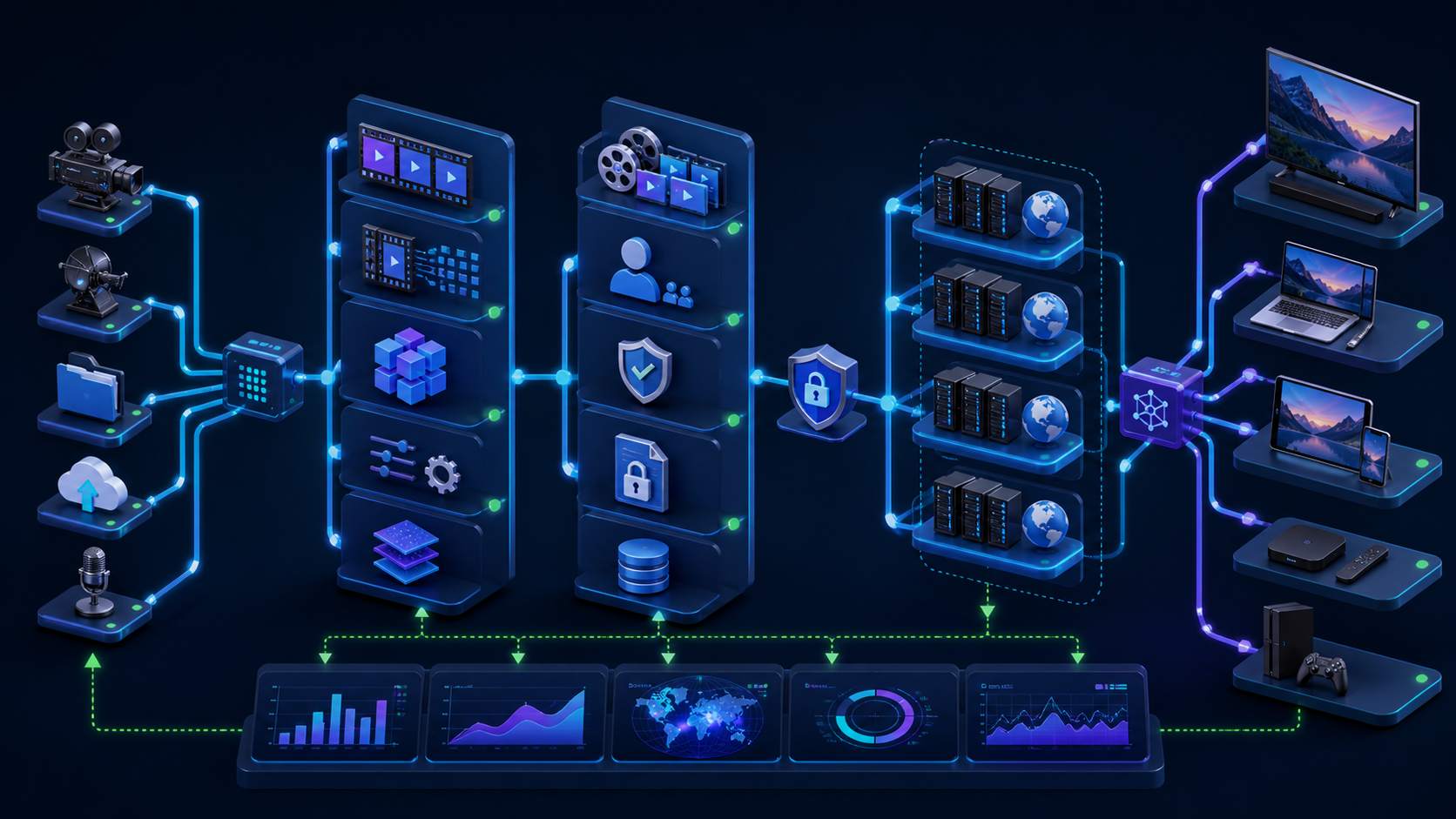
A production architecture should be modular enough to change vendors without rewriting every client, yet simple enough for a small team to operate. Think in six connected layers.
1. Ingest, encode, and package media
The media pipeline receives masters, validates them, creates renditions, packages streams, extracts thumbnails, and associates captions and audio tracks. Apple says HLS uses ordinary web servers and CDNs and adapts playback to available network conditions. A practical VOD ladder therefore includes multiple tested renditions rather than one large file.
Our adaptive bitrate streaming guide explains how rendition ladders, manifests, players, and delivery behavior work together when bandwidth changes.
Keep the master immutable. Store transformation jobs, media fingerprints, quality-control results, and package versions so a bad encode can be traced and regenerated. Validate loudness, caption timing, black frames, audio mapping, aspect ratio, and playback before publishing.
AWS’s CloudFront streaming guidance describes the basic delivery chain: encode and package segments plus manifests, store the packaged output at an origin, and distribute it through a CDN. Your cloud may differ, but the separation between source, processing, origin, and edge delivery remains useful.
2. Build a content and rights model
The CMS is more than an upload form. It should model movies, series, seasons, episodes, clips, live events, channels, people, taxonomy, artwork, languages, captions, audio, publishing state, and territorial windows.
Rights are first-class data. A title can be available in one country, on one plan, for one date range, with specific download or concurrency restrictions. Make those rules queryable and auditable; otherwise they become conditionals scattered across applications.
3. Separate identity, billing, and entitlement
Identity proves who the account or profile is. Billing records the commercial relationship. Entitlement decides what can be watched. They exchange events, but they should not collapse into a single opaque service.
This separation makes failures recoverable. A delayed renewal webhook should not permanently remove access. A refund should create an auditable entitlement change. Customer support should be able to see why playback was allowed or denied without reading application logs.
4. Use a playback gateway
Clients should not assemble storage paths, keys, and policy rules themselves. A playback gateway can accept the viewer, profile, asset, and device context; evaluate entitlement and rights; then return a short-lived manifest URL, DRM configuration, subtitle tracks, ad context, and session identifiers.
On Android, Media3 ExoPlayer supports multiple streaming protocols and exposes customizable buffering and rendering components. Use the native or well-supported player stack for each device family, then put product-specific controls and telemetry around it. A single abstract player API is helpful, but do not pretend web, iOS, Android, Roku, Tizen, and webOS have identical lifecycle or DRM behavior.
5. Deliver through a CDN with failure plans
The CDN serves the bandwidth-heavy segments, but your control plane still manages tokens, manifests, keys, and routing. Establish cache rules, origin protection, signed access, geographic policies, and observability before a major premiere.
At larger scale, decide how traffic moves when an origin, region, or CDN underperforms. Multi-CDN routing is valuable only when it is driven by trustworthy telemetry and tested failover. Otherwise it becomes another complex dependency that may fail during the event it was meant to protect.
6. Instrument the entire viewing funnel
Separate product analytics from playback quality of experience. Product events answer whether people find and value content; playback events answer whether the system lets them watch it.
Track at least:
- catalog impressions, searches, zero-result searches, saves, and detail views;
- checkout starts, payment outcomes, renewals, cancellations, and entitlement decisions;
- play attempts, time to first frame, rebuffering, rendition switches, fatal errors, and exits;
- device, app version, network type, CDN, asset, and anonymized session context;
- support-impacting events such as login failures, device limits, and DRM denials.
Define event names, required fields, privacy rules, sampling, and ownership before implementation. A dashboard built on inconsistent client events creates confidence without accuracy.
How to Build a Clone Amazon Streaming Platform
The sequence matters. Building every screen before validating content rights or device economics creates polished rework.
Step 1: Write the commercial brief
Name the audience, content source, territories, monetization model, launch date, priority devices, service expectations, and business KPI. Identify who owns content operations, customer support, merchandising, and incident response after launch.
Step 2: Map the critical journeys
Prototype sign-up, browse, search, purchase, play, resume, cancel, and support. Include failure states: payment rejected, rights unavailable, device limit reached, DRM license denied, bandwidth reduced, and app update required.
Step 3: Select the launch surface
Use audience evidence, not executive preference. Web may validate the catalog quickly; mobile may suit commuting or learning; connected TV may be indispensable for long-form entertainment. Every additional TV ecosystem adds development, certification, test hardware, remote-control behavior, and release management.
Step 4: Prove one end-to-end protected stream
Before multiplying features, ingest one representative master, encode its ladder, package it, protect it, authorize it, distribute it, and play it on the priority devices. Capture playback telemetry and force failure cases. This technical spike exposes constraints while scope is still flexible.
Step 5: Build the operator path
Give the content team a safe way to create metadata, attach media, schedule rights, preview, publish, unpublish, and audit changes. An OTT service cannot launch reliably if every catalog correction requires a database edit or engineering deployment.
Step 6: Complete the revenue loop
Implement offers, checkout, receipts, renewals, refunds, webhook reconciliation, entitlement, and support visibility as one tested journey. Use sandbox and production-like test accounts, and document how failed or delayed payment events recover.
Step 7: Test devices and adverse conditions
Create a matrix of operating systems, app versions, screen classes, codecs, DRM levels, network conditions, account states, and territories. Test backgrounding, app termination, clock changes, casting, subtitle selection, binge transitions, and resume synchronization.
Step 8: Rehearse launch and rollback
Load-test the control plane, estimate CDN demand, freeze critical changes, prepare dashboards, assign incident roles, and define rollback triggers. Seed the catalog, verify rights windows, test customer-support tools, and run a simulated launch before marketing sends traffic.
Choose Custom Development, a Builder, or a White-Label Platform
There is no universally best OTT platform. The right delivery model depends on differentiation, launch pressure, integrations, device coverage, data ownership, and the team available to operate it.
| Approach | Best fit | Main advantage | Main tradeoff |
|---|---|---|---|
| No-code/SaaS builder | Standard catalog and monetization, lean operator team | Faster configuration and managed infrastructure | Platform constraints, recurring fees, limited deep customization |
| White-label product | Branded service with a known feature model | Existing apps and workflows reduce build scope | Vendor roadmap, migration, and code-ownership questions |
| Custom development | Differentiated experience, complex rights, integrations, or scale needs | Control over architecture, data, roadmap, and UX | Higher delivery and ongoing operational responsibility |
| Hybrid | Custom experience on selected managed services | Focuses engineering on differentiators | Requires disciplined integration and vendor boundaries |
Muvi’s streaming-app-builder comparison illustrates the managed route, while broader custom-development guides such as Appinventiv’s video streaming app guide emphasize product definition, infrastructure, features, security, testing, and ongoing iteration. Evaluate both categories against the same requirements and exit plan.
For teams that need a differentiated custom or hybrid build, Apexnova engineers production-ready OTT platforms across web, mobile, and connected TV, including adaptive delivery, Widevine/FairPlay DRM, monetization, analytics, and multi-CDN infrastructure. Its model is aimed at media companies that want project ownership and a launch plan rather than another self-serve dashboard.
Before signing, ask every vendor or delivery partner to demonstrate:
- Your priority content type on your priority devices.
- Entitlement and DRM failures, not only successful playback.
- The CMS workflow your operators will use daily.
- Data export, source-code ownership, hosting boundaries, and termination terms.
- Release responsibilities for each app store and TV ecosystem.
- Monitoring, incident response, backups, recovery, and post-launch support.
Scope and Budget the Platform Around Risk
A credible estimate comes from a written scope, not the word “clone.” Price and schedule change with the number of device applications, content types, DRM requirements, monetization models, integrations, migration volume, languages, regions, accessibility needs, and expected concurrency.
Budget in four buckets:
- Product delivery: research, design, backend, applications, QA, release, and project management.
- Media operations: storage, encoding, packaging, quality control, captions, artwork, and catalog work.
- Recurring platform costs: cloud compute, databases, DRM providers, communications, observability, analytics, payments, support tools, and app accounts.
- Variable delivery costs: CDN traffic, encoding volume, ad serving, payment fees, and concurrency-driven capacity.
Compare total cost of ownership over a realistic operating period. A low build quote can hide mandatory add-ons, revenue share, per-app charges, expensive data export, or a platform migration. A larger custom build can also be wasteful if the business has not proven its audience or content economics.
Create a scope ladder instead of one all-or-nothing proposal:
- Proof: one protected asset and one critical journey on priority devices.
- MVP: complete publish-to-payment-to-play loop with operator tools and telemetry.
- Launch: catalog migration, production integrations, app distribution, support, security review, and operational rehearsal.
- Growth: more devices, monetization options, personalization, multi-CDN, experimentation, and automation based on evidence.
Each rung should have measurable exit criteria. “App completed” is not one; “a new subscriber can pay, receive entitlement, start protected playback, resume on a second device, and produce traceable telemetry” is.
Clone Amazon Launch Readiness Checklist
Use this checklist before calling the platform ready:
- The product has an original brand, interface, and content proposition.
- Content ownership, licenses, territories, and availability windows are recorded.
- Priority devices and supported versions are explicit.
- Encoding ladders, captions, audio tracks, artwork, and metadata pass quality control.
- Subscription or transaction events reconcile to entitlements.
- Widevine, FairPlay, or other required protection works across the device matrix.
- Continue-watching state resolves conflicting and offline updates.
- Playback is tested on constrained networks and representative hardware.
- Product and quality-of-experience events reach validated dashboards.
- CMS users can preview, schedule, publish, correct, and unpublish content safely.
- Customer support can explain access, billing, and playback failures.
- Load, failover, backup, recovery, rollback, and incident procedures are rehearsed.
- App-store assets, privacy disclosures, policies, and review timelines are accounted for.
- The team owns a post-launch backlog tied to viewer and operational data.
Frequently Asked Questions
Can we clone the Amazon app?
You can build an original OTT service with comparable categories of functionality, such as profiles, search, subscriptions, watchlists, adaptive playback, and TV apps. Do not copy proprietary source code, creative assets, branding, or a confusingly similar interface; obtain legal guidance for the countries where you will operate.
What features does an Amazon Prime Video clone need?
The launch baseline is accounts, a structured catalog, search and browse, watchlists, adaptive playback, captions, entitlement, one monetization model, content protection, a CMS, support tools, and playback analytics. Add recommendations, offline downloads, live channels, ads, and more devices only when the audience and rights model require them.
How long does it take to build a Prime Video-style OTT platform?
It depends on scope. A focused launch using managed components can move faster than a custom multi-device service with content migration, several payment models, advanced DRM, and TV-app certification; estimate only after defining journeys, devices, integrations, rights, and acceptance tests.
How much does it cost to build an OTT platform like Prime Video?
There is no responsible fixed price for the phrase alone. The budget should cover product delivery, media preparation, recurring platform services, and variable streaming costs, with device count, security, integrations, concurrency, and content operations as major drivers.
Is an Amazon clone legal?
Building software with similar functional categories is different from copying protected code, assets, branding, or presentation. Because trademark, copyright, licensing, privacy, and consumer rules vary by jurisdiction and implementation, review the product with qualified counsel before launch.
Which OTT platform is best for launching a Prime Video alternative?
The best option is the one that meets your content, device, rights, monetization, integration, ownership, and operating requirements at an acceptable total cost. Compare SaaS builders, white-label products, custom development, and hybrid architectures against the same end-to-end demo and exit criteria.
Conclusion
Do not begin with every feature Prime Video has. Begin with a specific audience, original content proposition, one commercial model, and one complete path from publishing to protected playback.
Then choose the delivery model that gives you the right control without creating an operation your team cannot sustain. If you are evaluating a build now, the next useful artifact is a scoped architecture and acceptance matrix covering content, devices, entitlements, playback, operations, and launch risk.