

Best OTT Platform for Your Streaming Business: A Practical Guide
Choosing the best OTT platform is difficult because every shortlist mixes different products: consumer apps such as Netflix, creator membership tools, video infrastructure, and complete white-label streaming systems. They may all deliver video over the internet, but they solve very different business problems.
For a media company, the best OTT platform is the one that supports your revenue model, priority devices, content rights, launch timeline, and expected scale without creating unacceptable lock-in. Start with those requirements, then compare vendors; a generic “top 10” ranking cannot make that decision for you.
This guide gives founders, CTOs, and product leaders a way to build a defensible shortlist. It compares platform categories, explains the technical and commercial features that matter, and ends with a scorecard you can use during demos and proofs of concept.
The best OTT platform is not the best streaming service
Search for “best OTT platform” and you will see two different questions answered on the same results page.
A viewer usually wants to know which subscription has the right films, series, sports, languages, and price. In India, that comparison might include JioHotstar, Netflix, Prime Video, ZEE5, or SonyLIV. A media business, however, is looking for the technology used to launch and operate its own branded service.
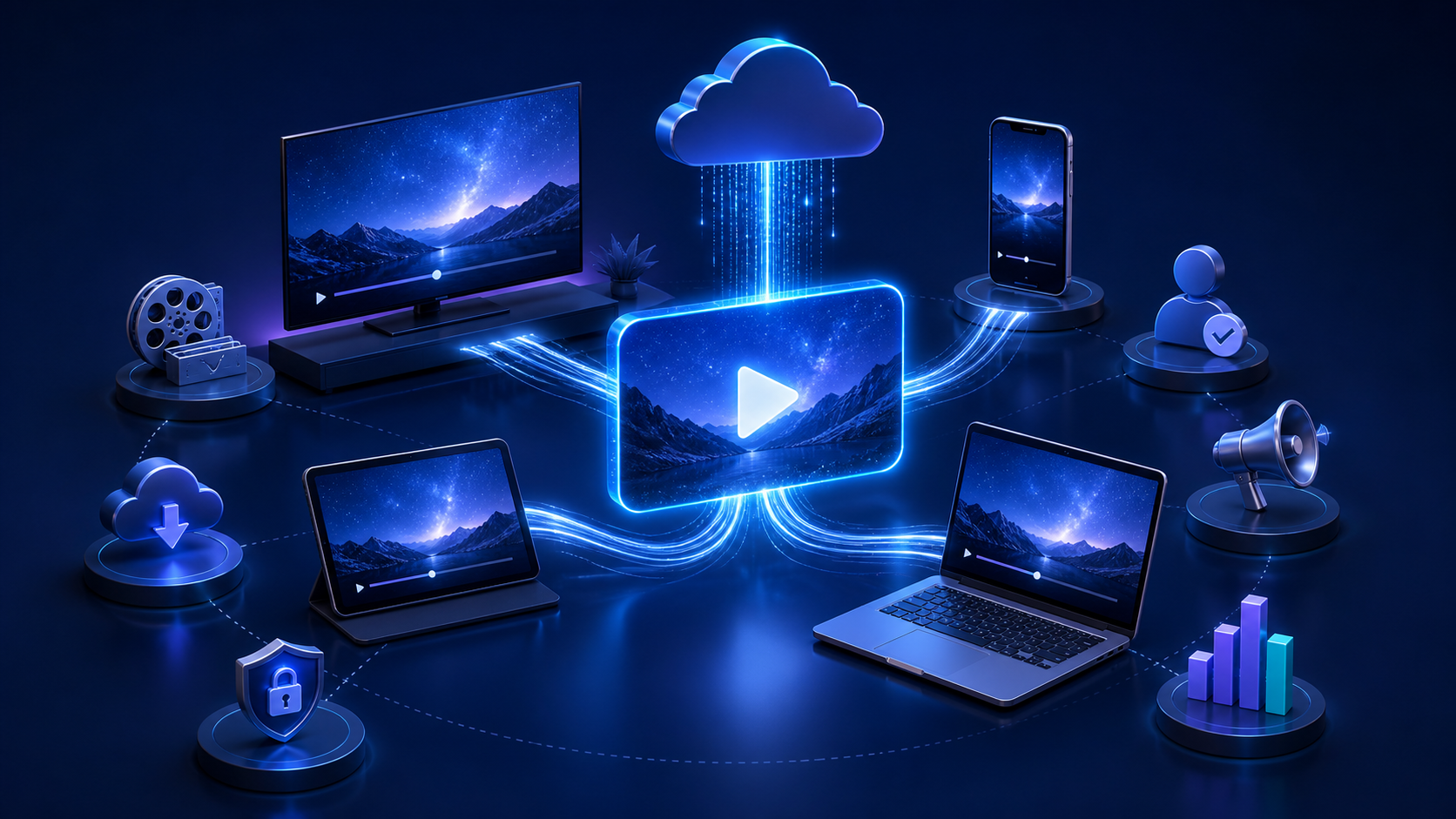
That business platform normally combines several layers:
- A video content management system for assets, metadata, rights, and publishing
- Encoding and packaging for multiple bitrates and device formats
- A player and apps for web, mobile, connected TV, and streaming devices
- Authentication, entitlements, payments, and subscription management
- Monetization through subscriptions, ads, transactions, live passes, or a hybrid
- Content protection, analytics, customer support, and operational tooling
If you are still separating the terms, our guide to the full form of OTT and how OTT delivery works explains the underlying model. The important distinction here is that Netflix is an OTT service; a B2B OTT platform is the system a company uses to create a service with its own content, brand, customers, and economics.
Begin with the business constraint
Do not begin with the longest feature list. Begin with the constraint that would make the launch fail.
A sports broadcaster may care most about live reliability, latency, concurrent peaks, replay workflows, and pay-per-view. A fitness creator may care more about subscriptions, community, mobile apps, and churn. A regional entertainment company may prioritize television apps, local payments, language metadata, downloads, and strict studio DRM.
Write one sentence before you contact vendors:
We need to deliver [content type] to [audience and markets] on [priority devices], earn primarily through [revenue model], and launch by [date] while retaining [required level of control].
That sentence is your first filter. A platform that cannot meet it is not a candidate, regardless of its market visibility.
Best OTT platform shortlist by business model
The table below is a category map, not a universal ranking. It shows where common options tend to fit so you can decide which category deserves deeper evaluation.
| Platform or approach | Best fit | Useful strengths to validate | Main trade-off to investigate |
|---|---|---|---|
| Muvi One | Teams seeking an all-in-one, no-code white-label launch | Website, apps, CMS, monetization, payments, hosting, and security in one product | Depth of customization, total recurring cost, and migration options |
| Vimeo OTT | Subscription or transactional services that value managed delivery | Integrated CMS, checkout, subscriber data, adaptive streaming, and enterprise apps | Which capabilities require Enterprise and how fees change with growth |
| Uscreen | Creator-led memberships in fitness, education, or coaching | Video, livestreaming, community, subscriptions, and managed native apps | Fit for complex rights, broadcast workflows, or deeply custom experiences |
| Brightcove | Established media organizations with enterprise video needs | Advertising, subscription, transactional monetization, and enterprise integrations | Quote-based scope, implementation complexity, and dependency on add-ons |
| Dacast or similar hosted video platform | Live events and teams that need secure delivery quickly | Live and VOD hosting, paywalls, player controls, APIs, and CDN delivery | Whether it provides the full consumer-app and lifecycle stack you need |
| Kaltura or modular video infrastructure | Enterprises with engineering resources and integration-heavy workflows | APIs, extensibility, media management, and configurable video experiences | Solution design effort, specialist skills, and time to assemble the stack |
| Custom or composable platform | Media businesses with differentiated workflows, scale, or ownership needs | Full product control, tailored apps, infrastructure choice, and custom economics | Higher upfront discovery burden and ongoing engineering responsibility |
These descriptions come from current product positioning, not assumed parity. For example, Muvi One presents content management, monetization, payments, security, hosting, websites, and apps as one platform. Vimeo OTT documents an integrated CMS, subscriber analytics, checkout, adaptive delivery, and branded apps, while Uscreen focuses on video memberships, livestreaming, community, and cross-device experiences.
Brightcove describes support for advertising, subscription, and transactional monetization, which makes it relevant to larger media workflows. The point is not that one vendor wins every row; it is that each option starts with a different product philosophy.
How to narrow the shortlist to three
Score every option against five non-negotiables before scheduling a demo:
- Revenue fit: Does it natively support your primary and likely secondary models?
- Device fit: Are the devices that drive your audience included now, not promised later?
- Control fit: Can you control the experience, customer data, integrations, and release cadence you need?
- Operational fit: Can your team actually run the CMS, support flow, analytics, and incident process?
- Economic fit: Does the three-year cost still make sense after bandwidth, storage, apps, support, payment, and revenue-share charges?
Eliminate any option that fails a non-negotiable. A three-platform proof of concept produces better evidence than ten polished sales presentations.
Features the best OTT platform must get right
Feature counts are easy to inflate. Evaluate end-to-end workflows instead: what happens when an editor publishes a title, a subscriber pays, a stream fails, a content right expires, or an audience surge arrives?
1. Monetization and entitlement logic
The platform must connect pricing to actual viewing rights. A subscription purchase should create the correct entitlement, renew or expire predictably, work across devices, and survive refunds, pauses, coupons, plan changes, and payment failures.
Ask vendors to demonstrate your real catalogue structure. Can one live event be sold separately to non-subscribers but included for premium members? Can a title be free with ads in one market and subscription-only in another? Can an education buyer purchase seats for a cohort? These are entitlement questions, not just payment-gateway checkboxes.
2. Device coverage and release ownership
“Available everywhere” can hide a web-only launch with apps sold separately. Create a device matrix with web, iOS, Android, Apple TV, Android TV or Google TV, Fire TV, Roku, Samsung Tizen, LG webOS, and any set-top boxes relevant to your audience.
For each device, verify who owns the developer account, source code, analytics, app-store submission, signing keys, release process, and crash response. Uscreen’s documentation, for example, says its team handles submissions and revisions for the native apps it builds, and recommends starting with web before adding mobile and TV apps as a membership grows. That can reduce operational work, but you should still understand release timing and portability.
Connected-TV applications are separate products, not enlarged mobile screens. Remote-control navigation, focus states, memory limits, television overscan, player capabilities, login flows, and store certification all need device-specific QA. The decision becomes clearer when you map the differences involved in building for TV Android OS.
3. Playback, encoding, and delivery
A logo-free player is not enough. Inspect the entire media path: ingest, transcoding ladder, packaging, origin, CDN, player startup, bitrate switching, captions, audio tracks, and playback analytics.
Apple describes HLS as adaptive streaming over standard HTTP, with support for segmented delivery, encryption, captions, multiple audio tracks, and alternative variants. Adaptive bitrate streaming lets a player change quality as network conditions change; your evaluation should confirm that the encoding ladder matches the content, devices, and audience networks rather than applying one template to every title.
Ask for quality-of-experience metrics such as video start time, rebuffering ratio, playback failures, average bitrate, and error breakdown by device and application version. Business dashboards tell you what viewers watched. Playback telemetry tells engineers whether they could watch it reliably.
4. DRM, security, and rights enforcement
Premium licensing often requires more than signed URLs. Your rights agreements may call for multiple DRM systems, output controls, concurrent-stream limits, geographic restrictions, watermarking, and device security levels.
Google identifies Widevine as its premium-media content protection system and documents support across Android, Chrome, Fire TV, Roku, Tizen, webOS, and other environments. Apple devices commonly use FairPlay, while parts of the Microsoft ecosystem use PlayReady. On the web, the W3C Encrypted Media Extensions specification defines the browser API used to interact with content-decryption systems; it does not replace the DRM service, packaging, license policy, or operational controls.
Ask the provider to trace one protected stream from packaging to license issuance and playback. Then test screen limits, expired entitlements, rooted or compromised devices where relevant, and the support process for DRM errors. A feature-page badge is not evidence that your rights rules have been implemented correctly.
5. Content operations and metadata
A usable video CMS should model seasons, episodes, clips, live events, linear channels, people, genres, languages, territories, availability windows, and artwork variants without forcing editors into spreadsheets and manual re-entry.
Test bulk import, scheduled publishing, rights expiry, replacement assets, caption workflows, image crops, preview environments, and approval roles. If you plan to serve several regions, confirm that metadata and artwork can vary by locale and that rights rules can be applied without duplicating the whole catalogue.
The hidden question is throughput: how long does it take an operations team to move 100 titles from delivery to a correctly published catalogue? A beautiful homepage builder does not compensate for a slow or error-prone publishing workflow.
6. Analytics that connect viewing to revenue
The platform should give product, content, growth, finance, and engineering teams the data they need. At minimum, evaluate:
- Acquisition source, trial starts, conversions, renewals, cancellations, and failed payments
- Watch time, completion, content affinity, search behaviour, and recommendation performance
- Revenue by plan, title, market, device, and campaign where attribution permits
- Playback quality, app crashes, API errors, ad errors, and incident timelines
- Export access to your warehouse or analytics tools using documented APIs or event streams
Do not accept screenshots as the data strategy. Ask for field definitions, retention periods, export latency, identity rules across anonymous and signed-in sessions, and a sample raw event. Your team should be able to reproduce important KPIs outside the vendor dashboard.
7. APIs, integrations, and ownership
Your OTT service will touch customer support, marketing automation, identity, payments, tax, advertising, recommendations, data warehousing, and content supply systems. Confirm that APIs cover both read and write workflows, webhooks are reliable, rate limits are documented, and a test environment exists.
Ownership has several dimensions: source code, cloud accounts, customer records, media files, metadata, application-store listings, domains, analytics events, encryption keys, and deployment pipelines. You may not need to own every component, but you should know what can be exported, in what format, at what cost, and how long migration would take.
8. Reliability, support, and migration
Request the actual service-level agreement before procurement. Check how uptime is measured, which components are excluded, incident severity definitions, response targets, service credits, maintenance windows, recovery objectives, and status-page history.
Then test the human workflow. Who responds when a championship stream fails on a Sunday? Does support stop at the video API, or can it diagnose an app release, DRM policy, entitlement error, or CDN issue? An end-to-end platform is valuable only if operational ownership is equally clear.
Finally, request a written exit plan. It should cover media export, metadata, user and entitlement records, payment-token portability where legally and technically possible, analytics history, app transfers, DNS, and transition assistance. Migration is not a future edge case; it is part of today’s architecture decision.
Choose the revenue model before the platform
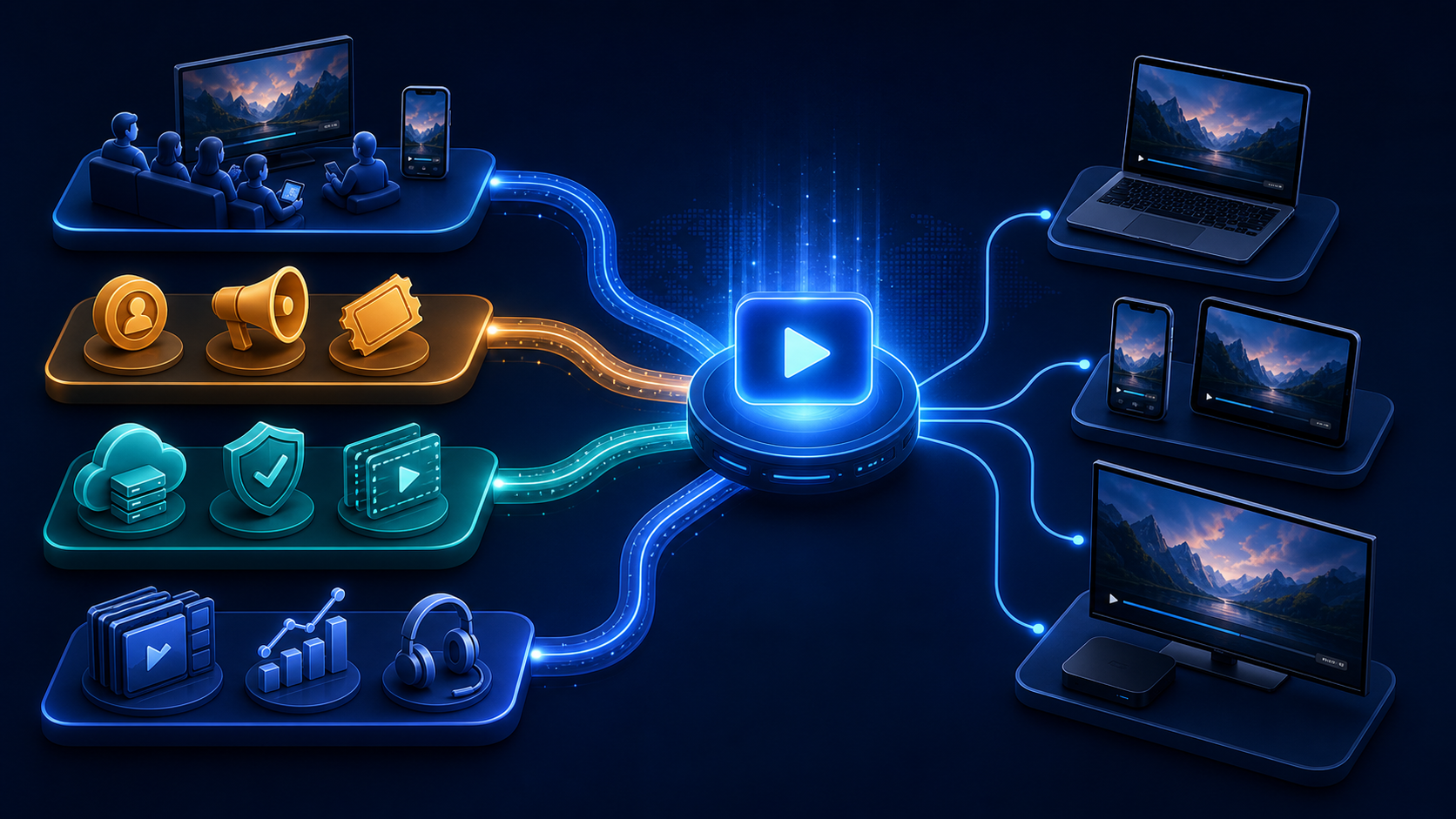
Revenue architecture changes product design, data, playback, and operations. Pick the dominant model first, then confirm that the platform handles it natively.
| Model | How it earns | Best suited to | Capabilities to validate |
|---|---|---|---|
| SVOD | Recurring monthly or annual subscription | Deep catalogues with frequent viewing | Trials, renewals, dunning, plan changes, churn analytics, app-store billing |
| AVOD | Advertising around free or registered viewing | Broad reach and repeat viewing at sufficient ad scale | Ad server support, consent, targeting, CSAI or SSAI, measurement, fill and error reporting |
| TVOD/EST | Rental or purchase per title | Premium releases, courses, films, or episodic transactions | Rental windows, ownership rules, refunds, territory pricing, tax, entitlements |
| Live PPV | One-time access to an event | Sports, concerts, conferences, and special events | Concurrency, countdown and replay, access codes, fraud controls, live support |
| FAST | Free scheduled channels funded by ads | Large libraries that can be programmed into linear feeds | Scheduling, playout, EPG metadata, SSAI, distribution, ad-break signalling |
| Hybrid | Two or more models combined | Services balancing reach, conversion, and revenue diversity | Cross-model entitlements, packaging rules, unified identity, attribution |
Current platform documentation demonstrates why you must verify plan-level availability. Vimeo OTT lists AVOD, free viewing, PPV, TVOD, and SVOD, but notes that advertising is an Enterprise capability and has additional Google Ad Manager requirements. A vendor may therefore “support AVOD” without including it in the package you are considering.
SVOD needs retention mechanics, not just checkout
Recurring revenue works when viewers repeatedly find something worth watching. Beyond payments, assess catalogue discovery, recommendations, continue-watching, watchlists, lifecycle messaging, household profiles, and cancellation or pause flows.
Track trial-to-paid conversion, voluntary and involuntary churn, retention by acquisition cohort, average revenue per account, content-driven starts, and payment recovery. The platform should make these metrics usable, not merely display a subscriber total.
AVOD and FAST need an advertising architecture
Advertising affects the player, content workflow, privacy choices, measurement, and reliability. Client-side ad insertion gives the app more control but introduces a separate ad playback path. Server-side ad insertion can create a more continuous stream but brings its own manifest, targeting, measurement, and troubleshooting requirements.
Google’s Interactive Media Ads documentation distinguishes client-side SDKs from dynamic ad insertion: client-side implementations combine ads in the app, while DAI combines content and advertising on Google’s servers before returning a stream. During a proof of concept, test ad starts, quartile tracking, seeking, casting, live discontinuities, consent behaviour, and failure fallbacks on every priority device.
TVOD and live PPV concentrate risk
Transactional products create a direct promise: the customer paid for this title or event now. Entitlements, refunds, fraud rules, customer support, and playback reliability must work together. A failed stream is more visible when the charge appears next to it.
For live PPV, load-test authentication and entitlement services as well as video delivery. Make replay availability explicit, prepare a customer-support runbook, and ensure operational teams can grant access or issue refunds without engineering intervention.
Hybrid models demand one identity and entitlement layer
A service may offer free clips, an ad-funded tier, a premium subscription, and paid live events. That mix can expand reach and revenue, but only if one account can move between products without contradictory rights or fragmented analytics.
Ask vendors to demonstrate the exact transition you expect: an anonymous viewer registers for free, upgrades to an ad-free plan on iOS, buys a live event on the web, and watches it on a television. If reporting, tax, or entitlements break across that path, the hybrid model exists on a slide rather than in the product.
Build, buy, or combine: which OTT platform approach is best?
There are three practical operating models. The right choice depends less on company size than on where your service must be different.
Buy a managed SaaS platform
Choose SaaS when speed, standard workflows, and low internal engineering load matter more than deep differentiation. It is often appropriate for validating a catalogue, launching a membership, or serving a straightforward subscription audience.
The advantages are pre-integrated components, managed infrastructure, established publishing tools, and a clearer initial implementation. The trade-offs may include plan-gated features, recurring platform or revenue-share fees, limited backend control, a vendor release cadence, and migration constraints.
Assemble a composable stack
Choose a composable approach when you have a product team and want control without building encoding, delivery, or payments from first principles. You might combine a video API, specialized CMS, identity service, payment platform, analytics stack, and custom applications.
This gives you choice at each layer and makes differentiation possible. It also makes your team the integrator responsible for contracts, data models, observability, incident boundaries, and upgrades across services.
Commission a custom platform
Choose custom engineering when ownership, differentiated workflows, unusual revenue logic, multi-cloud requirements, or a demanding cross-device roadmap are central to the business. The organization gains control of product and infrastructure decisions but must fund discovery, implementation, QA, operations, and continuous releases.
Apexnova works with media companies that need a production-ready OTT product across web, mobile, and connected TV rather than a fixed template. Its engineering approach combines app development, video delivery, DRM, monetization, cloud infrastructure, and analytics, which is most relevant when those layers must be designed around the business rather than accepted as vendor defaults.
Use a hybrid delivery model
Many teams should not choose a pure extreme. A custom viewer experience can run on managed encoding and CDN services; a SaaS launch can use custom data integrations; a platform can begin managed and move selected layers in-house as scale or differentiation justifies it.
Define architecture boundaries early. Decide which components are strategic, which are commodities, and which can be replaced without rebuilding the service. This is the same discipline required when planning a Prime Video-style OTT product without blindly cloning its interface.
A 30-day OTT platform evaluation scorecard
Use weighted evidence, not demo impressions. Adjust the weights to your business, but make every vendor answer the same test.
| Evaluation area | Suggested weight | Proof to request |
|---|---|---|
| Monetization and entitlements | 20% | Complete purchase-to-play flow for your hardest product bundle |
| Playback quality and scale | 20% | Test streams, QoE dashboard, load plan, device error data |
| Device and app coverage | 15% | Working builds on priority devices and an ownership/release matrix |
| CMS and content operations | 10% | Bulk ingest, scheduled publish, localization, rights expiry |
| Security and DRM | 10% | DRM flow, rights controls, security documentation, incident process |
| Data and integrations | 10% | API sandbox, webhooks, event schema, export sample |
| Economics | 10% | Three-year total-cost model with usage assumptions |
| Support and migration | 5% | SLA, escalation contacts, status history, exit plan |
Week 1: requirements and architecture
Document audiences, markets, content types, rights, devices, traffic patterns, revenue products, integrations, compliance needs, launch date, and team skills. Mark every requirement as mandatory, differentiating, or optional.
Give vendors the same scenario and usage assumptions. Require written answers where capabilities, pricing, and responsibilities can be compared later.
Week 2: workflow demonstrations
Use your content, metadata, and business rules. Have an editor ingest and schedule a title. Have a test customer register, purchase, switch devices, restore access, and cancel. Create a support case and inspect the logs available to your team.
Record gaps as configuration, integration, custom development, roadmap, or unsupported. Those labels have very different cost and schedule implications.
Week 3: technical proof of concept
Test on real devices and representative networks. Measure startup time, rebuffering, bitrate, failures, DRM license errors, subtitle and audio selection, casting, and app stability. If live video matters, rehearse encoder loss, feed switching, audience spikes, and replay creation.
Review API authentication, rate limits, webhooks, data exports, and observability. Validate at least one payment and entitlement edge case. Use the practical concepts in our stream bitrate guide to frame why bitrate and network conditions must be tested together, even though your production ladder will differ from a creator stream.
Week 4: economics, risk, and decision
Model a base case and a high-growth case over three years. Include implementation, apps, video processing, storage, delivery, DRM, support, integrations, payment fees, app-store effects, revenue share, data export, and internal staffing.
Then run a pre-mortem: if this decision failed in 18 months, what caused it? Common answers include app delays, an inflexible CMS, missing raw data, poor live-event support, cost growth, or an impossible migration. Convert each risk into a contract term, architecture change, proof requirement, or explicit acceptance.
Common OTT platform selection mistakes
Ranking vendors before defining the use case
A creator membership tool and an enterprise broadcast platform are not substitutes merely because both can display video behind a login. Define the service first; compare within the correct category second.
Treating every claimed device as equivalent
Ask whether each device has a native app, who maintains it, which features it supports, and how often it ships. “TV support” through casting is not the same as native Tizen, webOS, Roku, or Fire TV applications.
Comparing only the starting price
Entry pricing rarely captures apps, delivery, storage, DRM, support, migrations, integrations, transactions, or revenue share. A total-cost model must use your viewing hours, bitrates, catalogue size, subscriber count, and device roadmap.
Ignoring the operating team
The system must work for editors, marketers, support agents, finance teams, developers, and viewers. Include those roles in evaluation instead of leaving procurement to one technical or commercial stakeholder.
Accepting roadmap promises as current capability
Treat a roadmap item as unavailable unless the contract contains a date and remedy you can rely on. Prefer a working proof using your scenario.
Postponing the migration question
The easiest time to negotiate data export, app transfer, and transition support is before signing. The best OTT platform should be able to explain both onboarding and exit.
Frequently asked questions
Which OTT platform is No. 1?
There is no universal No. 1 OTT platform for businesses. The best choice depends on content, revenue model, devices, control requirements, team capabilities, and three-year economics; use a weighted proof of concept to rank platforms for your specific service.
Which OTT provider is best for a new streaming business?
A managed all-in-one platform is often the fastest fit for a new business with standard subscription or transactional needs. A composable or custom approach becomes stronger when differentiated user experiences, complex rights, unusual monetization, ownership, or scale are core requirements.
What is the difference between an OTT platform and Netflix?
Netflix is a consumer OTT streaming service with its own content catalogue and subscriptions. An OTT platform is the technology a business uses to operate its own branded streaming service, including content management, video delivery, apps, monetization, security, and analytics.
What features should an OTT platform include?
A complete platform should cover a video CMS, encoding and adaptive delivery, multi-device playback, identity and entitlements, payments, monetization, DRM, analytics, APIs, operational monitoring, and support. The necessary depth of each feature depends on your content rights and business model.
Is Hotstar better than Netflix?
For viewers, the answer depends on desired content, sports, languages, price, and location. For a company choosing technology to launch its own service, neither consumer subscription is the relevant comparison; evaluate B2B OTT platforms or custom engineering options instead.
How do OTT platforms make money?
OTT services commonly earn through subscriptions (SVOD), advertising (AVOD or FAST), rentals and purchases (TVOD/EST), live pay-per-view, sponsorship, or hybrid combinations. The technology provider may charge a subscription, usage fees, implementation fees, revenue share, or a combination, so model both service revenue and platform cost.
How much does it cost to launch an OTT platform?
Cost depends on apps, catalogue size, viewing hours, video quality, live concurrency, DRM, integrations, customization, support, and ownership. Compare a three-year total cost rather than a headline monthly fee, and include internal operations as well as vendor charges.
Conclusion: choose evidence over the longest feature list
The best OTT platform is not the vendor with the most logos, features, or enthusiastic rankings. It is the option that proves it can deliver your content, revenue model, device experience, operational workflow, and economics while keeping your largest risks manageable.
Define non-negotiables, narrow the market by platform category, and run the same purchase-to-play and publish-to-view tests with three candidates. If standard workflows fit, a managed platform can shorten the route to market. If the service depends on differentiated apps, complex monetization, infrastructure control, or ownership, include a composable or custom option in the proof of concept before you commit.