

Full Form of OTT: What Over-the-Top Means and How It Works
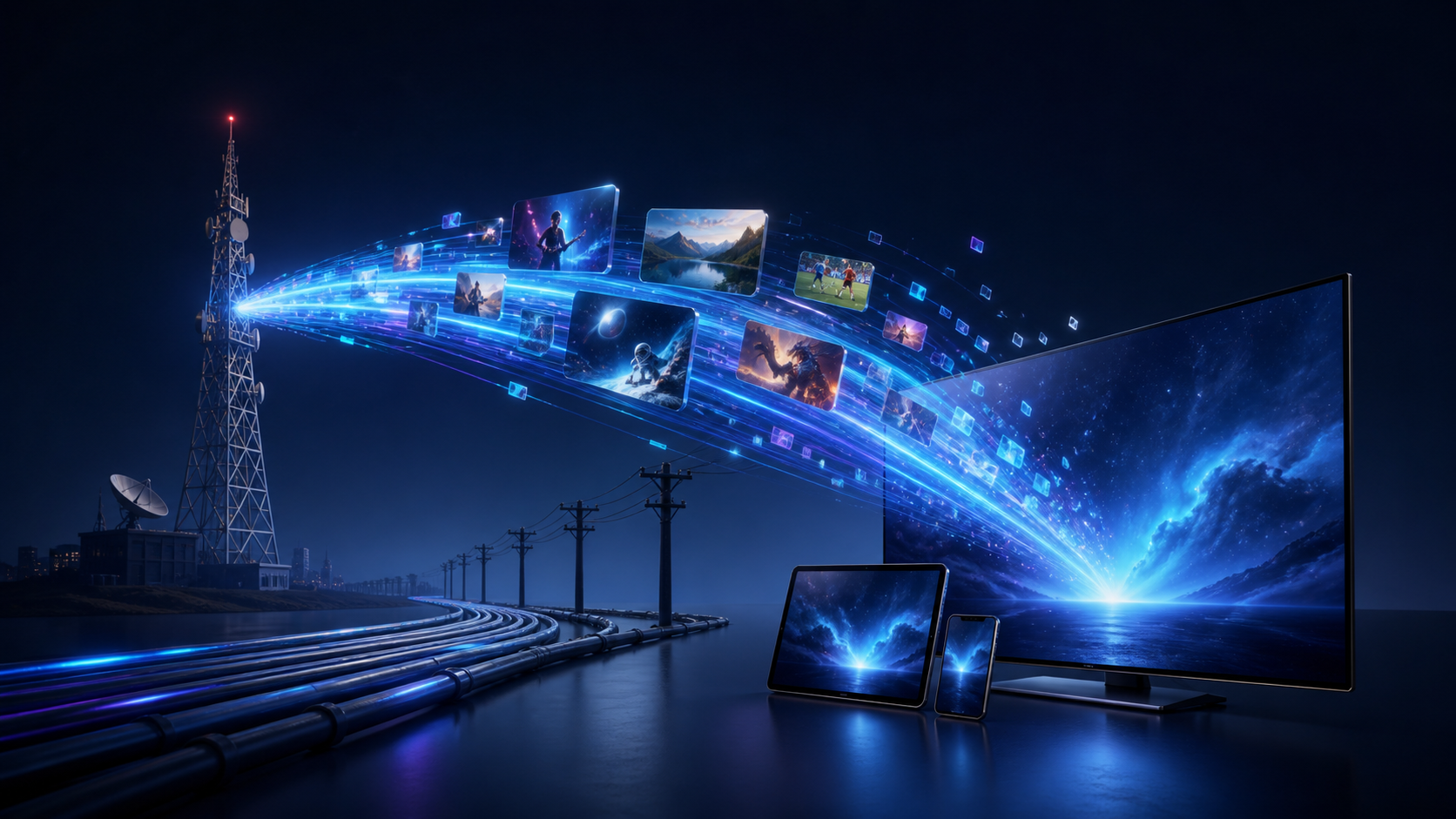
You can open a show on a phone, continue it on a television, and watch without buying a cable package—but the label behind that experience is easy to misunderstand. The full form of OTT is Over-the-Top. It means delivering video, audio, or other media over the public internet, “over the top” of a traditional cable, satellite, or managed television network.
In everyday conversation, OTT usually means an internet streaming service or the technology behind it. Netflix and YouTube are familiar examples, but the category also includes live sports services, broadcaster apps, specialist video libraries, audio platforms, and free ad-supported channels.
Full form of OTT: the direct answer
OTT expands to Over-the-Top. The phrase describes content that reaches a viewer through an internet connection without the internet provider controlling the programming bundle.
The internet service provider still carries the data. What OTT goes “over” is the traditional distribution layer: the cable operator, satellite package, broadcast schedule, or operator-controlled set-top box that once stood between a content owner and its audience.
That distinction explains why OTT is a delivery model, not a genre. An OTT movie is simply a movie distributed through an OTT service. The same infrastructure can carry an on-demand series, a live match, a news channel, a concert, a class, or a religious service.
Why is it called over-the-top?
Traditional pay television usually combines the network and the content package. A cable or satellite operator manages the delivery system, supplies channels, and often provides the receiver in the home.
OTT separates those roles. A broadband or mobile provider supplies connectivity, while an independent media service delivers its own catalogue or live stream through an app or website. Telestream’s OTT explainer draws the same boundary: managed IPTV runs through a private operator network, while OTT travels over internet services and can reach many kinds of connected devices.
This separation gives viewers more choice over three things:
- What they watch: a catalogue, event, channel, or individual title rather than a fixed bundle.
- When they watch: on demand, live, or through a scheduled internet channel.
- Where they watch: a smart TV, streaming stick, phone, tablet, computer, or game console.
It does not mean every OTT service is free, ad-free, global, or available on every device. Those are product and licensing decisions, not part of the acronym.
How an OTT platform works from upload to playback
Pressing Play feels immediate, but several systems cooperate before the first frame appears.
1. Content enters the platform
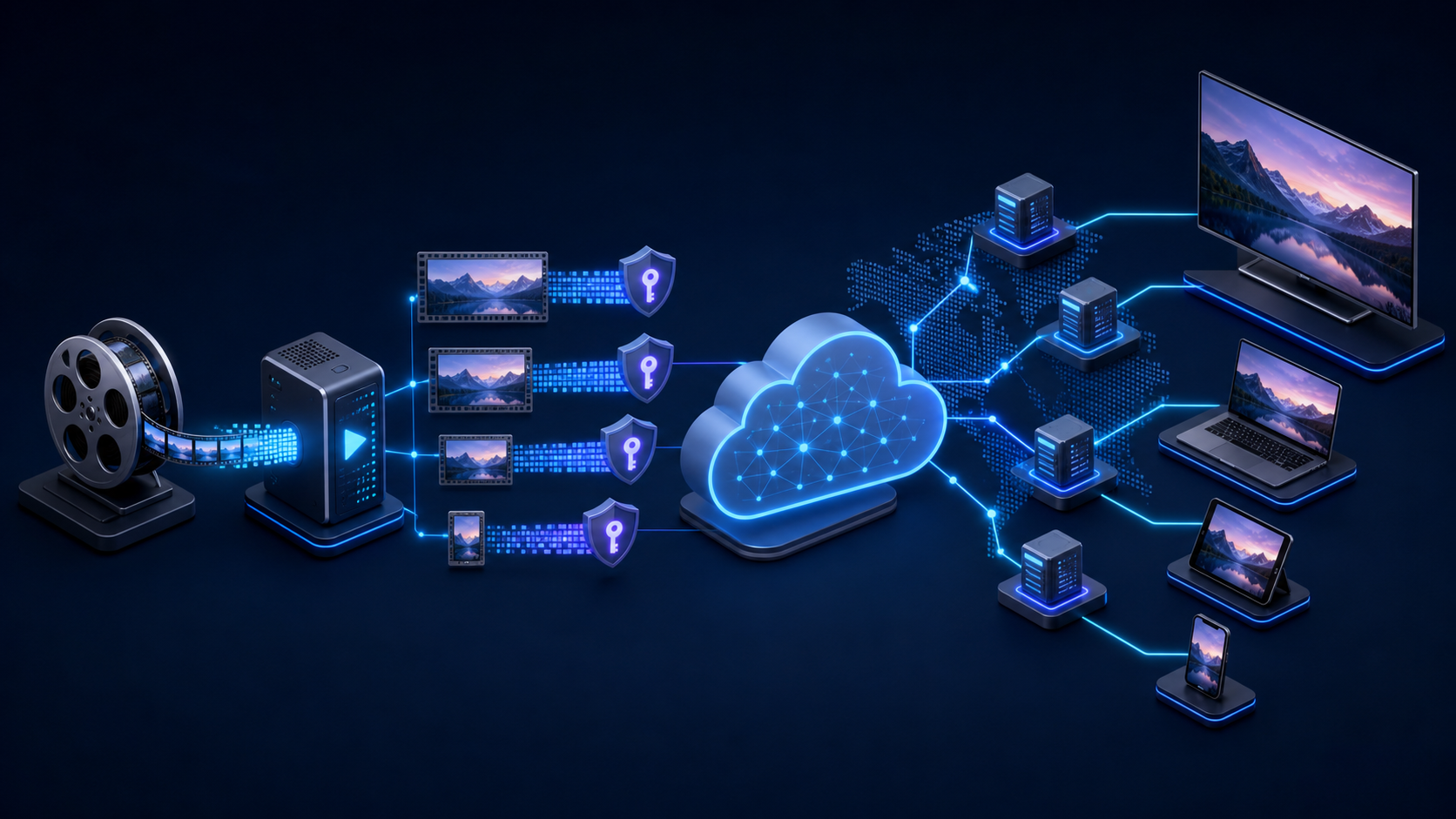
For video on demand, the source may be a finished master file. For live OTT, it may be a camera feed from a studio, stadium, classroom, or venue. Metadata—such as the title, artwork, language, captions, age rating, and access rules—enters a content management system alongside the media.
2. The source is encoded into multiple versions
One large master would perform poorly across every screen and network. An encoder compresses the source and creates several renditions with different resolutions and bitrates. This set is often called an adaptive bitrate ladder.
The player can then request a lighter version on a weak mobile connection and a higher-quality version on fast broadband. Apple describes HLS as adaptive streaming that changes stream quality with network conditions to reduce buffering, while the HLS specification documented in RFC 8216 defines variant streams that clients can switch between. For a deeper technical explanation, see this guide to adaptive bitrate streaming.
3. Packaging makes the stream playable
The encoded outputs are divided into small media segments and described in a playlist or manifest. Common delivery formats include HLS and MPEG-DASH. Instead of downloading an entire movie before playback, the app requests the next segments as they are needed.
4. A CDN moves content closer to viewers
A content delivery network caches or serves media from distributed locations. This reduces the distance each segment must travel and helps an OTT service handle audiences spread across cities or countries. The origin remains the authoritative source, while CDN edge locations absorb much of the playback traffic.
5. The app authenticates the viewer and protects premium media
The service may check a subscription, rental, purchase, entitlement, geography, or device limit before allowing playback. Premium catalogues commonly add digital rights management (DRM). Google describes Widevine as its content protection system for premium media; Apple’s streaming documentation notes that HLS supports encryption and DRM through FairPlay Streaming.
DRM is only one part of secure streaming. Operators also need secure sign-in, protected APIs, controlled playback tokens, sensible session limits, and monitoring for account or stream abuse.
6. The player adapts while you watch
The app reads the manifest, selects a rendition, fills a short buffer, and begins playback. It continues to observe available bandwidth and device performance. If conditions worsen, it can switch to a smaller rendition; if they improve, it can move up again.
That is why video quality can change during the same programme. The platform is balancing picture quality against the greater cost of a stalled stream.
Full form of OTT in TV: OTT vs cable, IPTV, and CTV
Several related terms describe different layers of the viewing experience. Treating them as synonyms creates confusion.
| Term | What it describes | Delivery path | Simple example |
|---|---|---|---|
| OTT | A media delivery model | Public internet to an app or website | Watching an on-demand series in a streaming app |
| Cable or satellite TV | A managed television service and channel package | Operator-controlled cable or satellite network | Watching channels through the provider’s set-top box |
| IPTV | Television delivered with Internet Protocol, commonly through a managed network | Private or operator-controlled IP network | A telecom provider’s television service |
| CTV | A device category: a TV connected to the internet | Varies; often receives OTT apps | A smart TV or TV connected through a streaming device |
The shortest rule is: OTT is how content is delivered; CTV is where some of it is watched. A viewer can consume OTT on a phone, so OTT is not limited to televisions. A connected TV can also show broadcast, cable, console, or locally stored media, so not everything on a CTV is OTT.
OTT and live streaming are not opposites either. OTT can be live or on demand. “Live streaming” describes the timing of the content; “OTT” describes the internet-based route to the audience.
What counts as OTT content?
OTT content extends beyond films and episodic television. Common formats include:
- on-demand movies, series, documentaries, and short-form video;
- live sports, news, worship, concerts, webinars, and classes;
- always-on internet channels, including FAST channels;
- music, podcasts, and internet radio;
- communications services delivered over an internet connection.
The broad definition includes audio and communications, although media teams often use OTT as shorthand for video. Adjust’s OTT glossary similarly describes streamed content across internet-connected devices and distinguishes video, audio, and communication examples.
An OTT device does not have to be a special box. Smart TVs, streaming sticks, phones, tablets, browsers, and consoles can all run OTT clients. The essential requirement is an internet connection plus software capable of requesting and playing the service.
How OTT platforms make money
The full form of OTT tells you how content arrives, not how the business earns revenue. Operators can choose one model or combine several.
| Model | How it works | Best fit |
|---|---|---|
| SVOD | Viewers pay a recurring subscription | Deep catalogues and repeat viewing |
| AVOD | Viewers watch free or lower-priced content with ads | Broad reach and advertising inventory |
| TVOD or EST | Viewers rent or buy individual titles | Premium releases and occasional purchases |
| PPV | Viewers pay for access to a specific live event | Sports, concerts, and special events |
| FAST | Scheduled linear channels stream free with ads | Lean-back viewing and catalogue reuse |
| Hybrid | The service combines subscriptions, ads, transactions, or free tiers | Segmented audiences and multiple revenue goals |
No model is automatically superior. A rights holder should match monetization to content frequency, audience willingness to pay, rights windows, advertising demand, and the cost of acquiring and retaining viewers. A detailed video monetization platform guide can help translate those variables into a commercial choice.
From OTT full form to a real platform: what operators need
Knowing the acronym is enough for a viewer; launching a service requires decisions across product, media engineering, security, data, and operations.
Start with the audience and content promise. A live sports product prioritizes low latency, concurrency, event reliability, and entitlement under sudden demand. An on-demand learning library may care more about search, progress tracking, captions, downloads, and access across inexpensive Android devices.
Then define the operating stack:
- content ingest, metadata, and editorial workflows;
- encoding, packaging, captions, and quality control;
- storage, origin, CDN strategy, and playback analytics;
- identity, payments, entitlements, DRM, and geographic controls;
- apps for the target phones, browsers, smart TVs, and streaming devices;
- monetization, recommendations, support tools, and ongoing release testing.
This is where an experienced engineering partner can be useful. Apexnova builds production-ready OTT platforms across web, mobile, and connected TV, including cloud infrastructure, multi-CDN delivery, DRM, analytics, and SVOD, AVOD, TVOD, FAST, hybrid, or live PPV monetization. Its stated delivery model targets launches in 30 days and draws on work across more than 20 platforms.
Before choosing any vendor or architecture, turn broad claims into acceptance criteria: startup time, rebuffering rate, supported devices, playback failure rate, concurrent viewers, recovery objectives, rights enforcement, and cost per viewing hour. The article on OTT testing shows how to verify those outcomes before release.
Frequently asked questions
Why is Netflix called OTT?
Netflix is called an OTT service because it delivers its catalogue over the internet directly to apps and browsers instead of requiring a traditional cable or satellite television package. The term describes the delivery model, not the company’s content genre or subscription price.
What is OTT on a TV?
OTT on a TV means watching an internet-delivered media service through a smart TV app, streaming stick, game console, or connected set-top device. The television is the viewing device; OTT is the route used to deliver the content.
Is OTT TV free?
OTT can be free or paid. Some services use advertising, some charge a subscription or one-time fee, and others combine free and premium tiers. “Over-the-top” does not specify a price.
What is an OTT movie?
An OTT movie is a film distributed through an internet streaming service. It may be included in a subscription, supported by ads, rented, purchased, or offered as part of a free catalogue.
What is the difference between OTT and streaming?
Streaming is the process of playing media as data arrives instead of waiting for the entire file to download. OTT is a broader delivery model in which a service uses the public internet to reach viewers outside a traditional managed television package. Most modern OTT video is streamed, but the terms emphasize different things.
OTT ka full form kya hai?
OTT ka full form Over-the-Top hai. Iska matlab internet ke through video, audio, ya doosra media seedha viewer tak pahunchana hai, bina traditional cable ya satellite TV package par nirbhar hue.
Conclusion: use the OTT definition to make a better decision
The full form of OTT is Over-the-Top, but the useful idea is direct internet delivery: content owners can reach viewers across devices without owning the access network or fitting inside a traditional channel bundle.
If you are choosing a service, compare its content, price, device support, and playback experience. If you are building one, begin with the audience, rights, monetization, device reach, and measurable streaming-quality targets—then select the architecture that can meet them.