


Secure Streaming: DRM, Access Control, and Anti-Piracy
A paying viewer should be able to press Play immediately. A copied link, stolen account, untrusted device, or pirate restream should not receive the same privilege. Secure streaming is the architecture that keeps those two outcomes separate without turning normal playback into a maze of errors.
That requires more than encrypting video. A production design must connect identity, entitlement, CDN access, content keys, device policy, session limits, watermarking, monitoring, and a tested response path. This guide explains what each control does, where it stops, and how to assemble the right stack for an OTT service.
What is secure streaming?
Secure streaming is the controlled delivery of live or on-demand media so only authorized viewers can request, decrypt, and play it under the rights you define. It combines transport security, short-lived access, digital rights management (DRM), session policy, and anti-piracy operations; no single one of those controls is sufficient by itself.
The important word is controlled. HTTPS protects data while it travels across a network, but it does not decide whether a subscriber owns a title. A signed token can decide whether a request reaches the CDN, but it does not make an already delivered video segment unreadable. DRM can protect decryption keys and enforce playback rules, but it does not prove that the account holder is the person using a valid session.
The browser boundary reflects this division of responsibility. The W3C's current Encrypted Media Extensions specification defines a common API for interacting with content-protection systems, while explicitly leaving authentication and authorization to the application. Secure video streaming therefore has to be designed as a chain of decisions, not purchased as one checkbox.
Start secure streaming with a threat model
Security controls should follow the content, rights agreement, audience, and likely attacker. A free product demo embedded on a marketing page does not need the same protection as a 4K movie premiere or a sold-out live sports event. Applying the maximum stack everywhere adds license calls, integration work, device exceptions, privacy impact, and support burden without necessarily reducing meaningful risk.
Begin by listing the assets and outcomes that matter:
- premium video, audio, subtitles, thumbnails, and manifests;
- content-encryption keys and DRM credentials;
- subscriber identities, entitlements, payments, and watch history;
- geographic, rental-window, device, resolution, and output rules;
- live-event exclusivity and the time available to disrupt a pirate restream;
- playback availability for legitimate viewers.
Then map each abuse case to a control and an acknowledged limit.
| Threat | Primary control | What the control does not solve |
|---|---|---|
| Shared or scraped playback link | Short-lived signed URL or cookie | A valid token copied before expiry may still be replayed unless it is scoped and monitored |
| Direct origin access | Private origin plus CDN-only access | It does not authorize the viewer by itself |
| Segment or key extraction | DRM with protected license exchange | It cannot stop a camera pointed at the display |
| Stolen credentials | Strong authentication, bot controls, risk signals | It cannot distinguish every willing account share from normal household use |
| Concurrent account sharing | Server-side session and device limits | Rigid rules can block legitimate travel or network changes |
| Unauthorized embed or territory | Domain/app allowlist and geo-policy | Referrer and IP signals have gaps and can be manipulated |
| Screen or output capture | Secure decode path, output policy, watermarking | Support varies by device; no control removes the analog hole |
| Pirate redistribution | Forensic watermarking, fingerprinting, monitoring, takedown | It detects and attributes misuse after content escapes |
| Service disruption | Rate limits, WAF, origin shielding, resilient delivery | Availability controls do not protect content rights |
The goal is defense in depth with explicit ownership. A team should be able to say which system denied a request, which system protected the key, which signal identifies leakage, and who can revoke access during an incident.
How DRM protects a secure video stream
DRM encrypts packaged media and releases the information needed to decrypt it only through a licensed playback path. At a simplified level, the player encounters encrypted media, asks its content-decryption component to create a license challenge, sends that challenge through the application's license endpoint, and receives a license only after the service evaluates the request.
A useful license decision can include:
- whether the user is authenticated and entitled to the title;
- whether the rental, subscription, or event window is active;
- the device and DRM security level;
- permitted resolution and offline duration;
- concurrent-stream and device-registration policy;
- output restrictions for an external display;
- whether a risk rule requires denial or reduced quality.
Do not let the client make the authoritative entitlement decision. The app can collect a challenge and present a token, but the trusted backend should resolve the user, title, rights window, and policy before a license is issued. Keep signing keys and provider credentials in a managed secret store, separate production and test environments, rotate credentials, and log decisions without logging content keys.
Why OTT platforms usually need multi-DRM
Device ecosystems do not share one universal content-protection system. Google describes Widevine as its premium-media protection system and documents support across Android, Chrome, Firefox, Edge, Roku, and other platforms, but not Safari or tvOS. Apple FairPlay Streaming protects HLS delivery on Apple platforms, while Microsoft PlayReady supports rights such as expiration, security levels, and output restrictions in its device ecosystem.
That makes the device matrix an architecture input. A typical broad OTT footprint may need Widevine, FairPlay, and PlayReady, plus device-specific testing of the player, codec, packaging mode, security robustness, offline behavior, and external-output rules. Do not infer support from an operating-system name alone; browser, app runtime, television model, and device certification can change the available path.
Common Encryption can reduce duplicated packaging by allowing compatible DRM systems to reference commonly encrypted media. It does not eliminate DRM-specific license messages, certificates, client integration, or conformance testing. Packaging strategy must be proven against the actual devices and rights requirements, especially for 4K, HDR, offline playback, and long-lived television fleets.
What DRM does—and does not—prevent
DRM makes a copied encrypted segment useless without a valid license and can keep decryption inside a protected client path. It can also enforce business rules such as expiry, persistence, security level, and output policy. That is materially stronger than hiding a media URL or protecting a clear encryption key with an easily replayed request.
DRM is not a guarantee that video can never be captured. Device capabilities differ, software paths may receive lower privileges, compromised clients exist, and any visible picture can be recorded with an external camera. The right objective is to raise the cost of extraction, constrain quality on weaker paths, and make valuable leakage discoverable and attributable.
DRM also introduces privacy responsibilities. The W3C EME specification treats persistent data and identifiers as potentially sensitive and describes safeguards such as per-origin values and user-clearing controls. Minimize persistent identifiers, document retention, restrict access to DRM telemetry, and involve privacy review before turning device identity into a broad tracking system.
Secure streaming access control at the CDN edge
DRM protects encrypted media; access control decides whether a request should reach the manifest, segments, or license service. Use both for premium content.
A clean playback sequence looks like this:
- The viewer authenticates with the application.
- The backend verifies the title entitlement, rights window, territory, account state, and concurrent-session policy.
- The backend creates a short-lived playback authorization scoped to the intended resource and action.
- The CDN validates that authorization before serving the manifest and media objects.
- The player acquires a DRM license through a separately authorized request.
- Session heartbeats and playback telemetry allow the service to refresh, expire, or revoke access.
Signed URLs, signed cookies, and token scope
Signed playback authorization proves that a trusted issuer approved a request with defined constraints. Useful claims can include an expiry, content path, session ID, user or device pseudonym, territory, maximum resolution, and token type. Keep the claim set small, validate issuer and audience, and never put a signing secret in a web, mobile, or TV client.
For segmented video, choose the delivery mechanism deliberately. Amazon's CloudFront guidance on signed URLs and cookies recommends signed cookies when a viewer needs multiple restricted files, using HLS video as an example, and signed URLs for individual files or clients that do not support cookies. Other CDNs expose different token models, so test how manifest requests, nested playlists, audio, subtitles, and media segments inherit authorization.
Token duration is a product decision as well as a security setting. A five-minute expiry is safer on paper but fails if a television cannot refresh in the background or a two-hour live event crosses the boundary mid-session. Prefer short authorization with a tested server-side refresh flow, a small clock-skew allowance, revocation capability, and clear player behavior when refresh fails.
Avoid over-binding tokens to volatile signals. A mobile viewer can change IP addresses during a normal handoff, and a household can legitimately share a public address. Bind only where the threat justifies the support cost, and make the denial reason observable to your service without exposing exploitable detail to the client.
Protect the origin, not just the viewer URL
A secure CDN URL is ineffective if the same media remains public at object storage or the origin hostname. Make the origin private, permit delivery only through the approved CDN or service identity, separate ingest from playback, block directory listing, and prevent unsigned alternate hostnames from serving the assets.
Use TLS across viewer-to-edge and edge-to-origin connections. Apple's current HLS authoring specification requires TLS 1.2 or later for its authoring profile and recommends that media-segment URLs not remain completely static. TLS protects data in transit; it should sit underneath entitlement, token, and DRM controls rather than being treated as their replacement.
Account, session, territory, and embed rules
The login surface is part of streaming security because a perfectly protected stream can still be watched through a stolen account. Use MFA or passkeys where appropriate, breached-password defenses, anomaly detection, and separate rate limits for the account and source. OWASP's current bot-management guidance specifically recommends independent per-username and per-IP buckets for login endpoints so distributed credential stuffing does not slip through a single combined key.
Track active playback sessions on the server. Heartbeats can update last-seen time; a timeout can clear abandoned sessions after crashes or power loss; a deliberate session-end event can release capacity faster. Show viewers their registered devices and provide a safe way to sign out others. This turns a blunt concurrent-stream limit into an understandable account control.
Geo-blocking and domain or app allowlists enforce distribution rules but remain supporting signals. IP location can be obscured by VPNs, referrer headers can be absent, and native apps do not behave like browser embeds. Define what happens to missing or contradictory signals, test travel and cellular use cases, and combine territory enforcement with entitlement and short-lived access.
Anti-piracy beyond DRM
Prevention ends at the display. Anti-piracy operations begin before launch and continue after playback.
Use watermarking for attribution
A forensic watermark embeds a session-specific signal that can survive ordinary transformations and help trace an illicit copy. A visible overlay containing a masked account or session identifier can deter casual capture, but it is easier to crop or obscure and should not be described as equivalent to forensic watermarking. The Streaming Video Technology Alliance's watermarking implementation resource treats watermarking as a distinct technology for securing online video against theft.
Decide the detection objective before implementation: subscriber attribution, source-device attribution, distributor tracing, or rapid live-event extraction. Document who can resolve a watermark to an identity, retain that mapping only as long as needed, restrict access, and create a review process before suspending an account.
Detect, revoke, and respond
Fingerprinting and monitoring can search public or partner surfaces for redistributed content. Once a candidate stream is found, the response path may include confirming the match, extracting a watermark, revoking a session or device, rotating a live feed or token policy, preserving evidence, and sending a platform or legal takedown request.
Speed matters most for live rights. Define an incident target in minutes, not an abstract promise to “monitor piracy.” Run a rehearsal with the security, operations, rights, support, and legal owners before the high-value event.
For premium UHD or early-window content, translate the rights agreement into testable requirements. MovieLabs says its Enhanced Content Protection specification has been widely implemented and updated in response to evolving threats. Whether or not that specification governs a particular catalog, it models the correct practice: turn protection expectations into an explicit system specification instead of relying on a vendor label.
How to build a secure streaming architecture
Build the smallest stack that addresses the threat model, then verify its boundaries. The following sequence keeps product rules and security mechanisms aligned.
1. Write a playback-security contract
For each content tier, specify:
- supported web, mobile, TV, console, and casting paths;
- authentication strength and entitlement source;
- DRM systems, packaging, license duration, and offline policy;
- permitted resolution by device robustness;
- token scope, duration, refresh, and revocation behavior;
- territory, domain, app, device, and concurrent-session rules;
- watermarking, monitoring, evidence, and incident-response requirements;
- privacy, retention, availability, and customer-support constraints.
Connect that contract to the wider OTT architecture and adaptive bitrate streaming design. Security changes manifests, cache keys, startup requests, offline state, device eligibility, and failure telemetry; it cannot be bolted onto a finished player without affecting playback.
2. Separate the control plane from media delivery
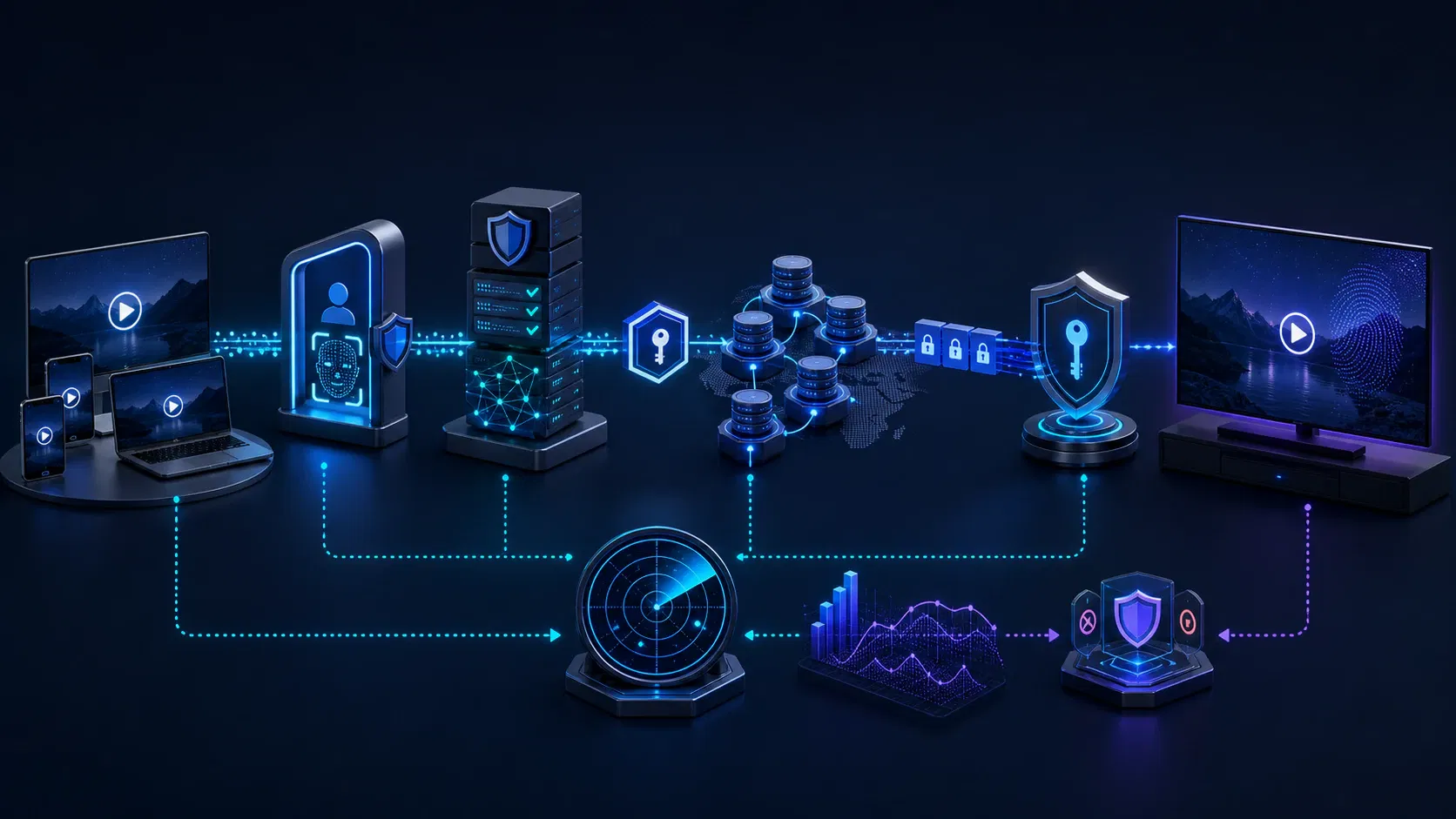
The control plane authenticates the viewer, resolves entitlement, applies policy, creates playback authorization, and brokers licenses. The media plane packages and delivers encrypted manifests and segments through the CDN. Keep the high-volume segment path cacheable while making security decisions through compact, verifiable tokens and controlled license calls.
This separation also limits blast radius. The CDN can reject invalid media requests without sending each segment request to the application origin, while the entitlement service remains authoritative for starting or refreshing a session. Protect both paths with rate limits, observability, least-privilege identities, and independent scaling plans.
At Apexnova, we use this contract to connect multi-DRM player behavior, entitlement APIs, encrypted packaging, CDN policy, and observability across web, mobile, and connected TV. It is most valuable when a team needs to own the platform and diagnose protection failures across vendor boundaries rather than receive a generic “license error.”
3. Package once only when the device evidence supports it
Choose HLS, DASH, CMAF, encryption modes, key rotation, and DRM signaling from the verified device matrix. A shared media package can reduce storage and workflow duplication, but only if every targeted player interprets the combination correctly. Keep representative protected assets for each codec, resolution, audio/subtitle combination, and rights mode.
Do not reuse one content key indefinitely across a large catalog. Define key granularity and rotation from the value and operational needs of the content. Restrict access to the key service, audit administrative actions, back up configuration securely, and rehearse credential rotation without taking active playback offline.
4. Make failure safe and understandable
Decide how the player responds when entitlement, token, license, watermark, or monitoring services are degraded. “Fail open” can violate rights; “fail closed” can cause a widespread playback outage. Content tier, cached licenses, retry budget, geographic rights, and business impact should determine the policy.
Give viewers actionable messages such as subscription required, rental expired, device limit reached, region unavailable, or device unsupported. Keep sensitive detection logic and raw risk scores server-side. In telemetry, preserve a normalized error domain, stage, device, DRM system, request ID, and policy reason so support and engineering can distinguish content denial from an integration defect.
5. Treat security configuration as release-controlled code
Version token policies, DRM provider settings, certificate changes, output rules, device caps, and CDN access controls. Require review for production changes, validate configuration before rollout, use canaries, and retain a tested rollback. Avoid shared production credentials in developer workstations or CI logs.
Inventory certificate and key expirations with accountable owners and alerts. A DRM certificate that expires silently or a signing key rotated on only half the fleet is an availability incident waiting to happen.
Test secure streaming before every launch
A stream playing once on a developer laptop proves almost nothing. Build a test matrix across content tier, account state, device family, browser or app version, DRM system, network, geography, output path, and session condition. Include success and expected denial cases.
Critical tests include:
- authorized playback at every supported resolution and codec;
- expired, malformed, wrong-audience, wrong-path, and revoked tokens;
- direct origin, copied manifest, segment, key, and license requests;
- subscription expiry, rental-window boundaries, refunds, and entitlement changes;
- token refresh during long VOD, live events, pause, seek, and backgrounding;
- concurrent-session cleanup after a crash, power loss, or lost network;
- VPN, proxy, absent-referrer, casting, AirPlay, HDMI, and screen-capture behavior;
- DRM robustness downgrade and unsupported-device handling;
- watermark insertion, extraction, attribution approval, and evidence retention;
- certificate rotation, DRM or entitlement outage, CDN failover, and clock skew.
Run automated protocol and policy tests on every change, then use real devices for secure decode and output behavior. The OTT testing workflow should include weak networks and older television hardware because authorization refresh or license latency can surface as an apparent buffering failure.
Monitor the full playback funnel: entitlement decisions, token issuance and rejection, manifest delivery, license latency and outcome, time to first frame, DRM error, session concurrency, watermark state, and suspicious request patterns. Alert on ratios and cohorts, not just raw totals. A regional increase in license denial or one firmware-specific failure can disappear inside a global success rate.
Common secure streaming mistakes
Relying on an unlisted or hidden URL. A URL in a player or manifest should be assumed discoverable. Enforce authorization at the CDN and license service.
Encrypting HLS while exposing the key. Segment encryption only helps when key delivery is independently protected. For premium rights, use an appropriate DRM path rather than a public or replayable key endpoint.
Shipping one DRM for a multi-device service. Coverage gaps appear as either clear playback or broken playback. Derive multi-DRM scope from the device matrix.
Putting signing secrets in the client. Web and application bundles are not trusted key stores for server authorization. Issue tokens from a protected backend.
Using one long-lived token for an account. Long validity and broad path scope increase replay value. Prefer session-scoped authorization with tested refresh and revocation.
Treating every IP change as fraud. Mobile and household networks change legitimately. Use multiple signals, reasonable policy, and a recovery path.
Claiming DRM makes piracy impossible. That promise obscures the need for watermarking, monitoring, incident response, and device-specific validation.
Collecting device identity without a privacy boundary. Protection data can become tracking data. Minimize, pseudonymize, restrict, and expire it.
Frequently asked questions
What is the difference between signed URLs and DRM?
Signed URLs or cookies control access to delivery: who can request a manifest or media object, for what resource, and for how long. DRM protects encrypted content and its license policy on the playback device. Premium secure streaming commonly uses both.
Does DRM stop screen recording?
DRM can restrict capture and external output on supported, compliant devices, but it cannot guarantee that visible video will never be recorded. Use secure playback paths to reduce capture, then add watermarking and monitoring to deter and trace leakage that prevention cannot stop.
Is HLS secure by default?
No. HLS can run over TLS and supports encrypted delivery, but a publicly accessible manifest, exposed key, or unprotected origin can still make content retrievable. Add entitlement, signed CDN access, protected key or DRM licensing, origin controls, and monitoring according to the threat model.
Which DRM systems does an OTT platform need?
The answer comes from its device matrix and content agreement. Broad services often need Widevine, FairPlay, and PlayReady, but exact requirements vary by browser, native app, television, codec, resolution, offline mode, and output policy.
How do you secure a live stream?
Authenticate and entitle the viewer, issue session-scoped CDN authorization, encrypt the live package with the appropriate DRM, enforce session and territory policy, and monitor for restreams. For valuable events, add forensic watermarking and rehearse rapid detection, attribution, revocation, and takedown before going live.
Can secure streaming prevent account sharing?
It can reduce unauthorized sharing with device registration, concurrent-session rules, risk signals, and short-lived playback authorization. It should not assume every new IP or device is abuse; transparent viewer controls and support-safe recovery are part of an effective policy.
Build secure streaming as a measurable system
The right secure streaming stack is not the one with the longest feature list. It is the one that maps each valuable asset and realistic threat to an owned, testable control while preserving reliable playback for authorized viewers.
Start with the rights and device matrix, separate entitlement from delivery, deploy multi-DRM where the content requires it, constrain CDN access, add attribution and response, and test the failure paths before launch. If those layers currently belong to separate vendors or teams, request a streaming security architecture review to turn them into one operational plan.