

OTT Service Definition: How Streaming Works and What It Includes
If a product brief uses “OTT,” “streaming platform,” and “CTV” as if they mean the same thing, teams can end up comparing the wrong products or omitting an entire layer of the service. A precise OTT service definition gives product, content, and engineering teams a shared starting point.
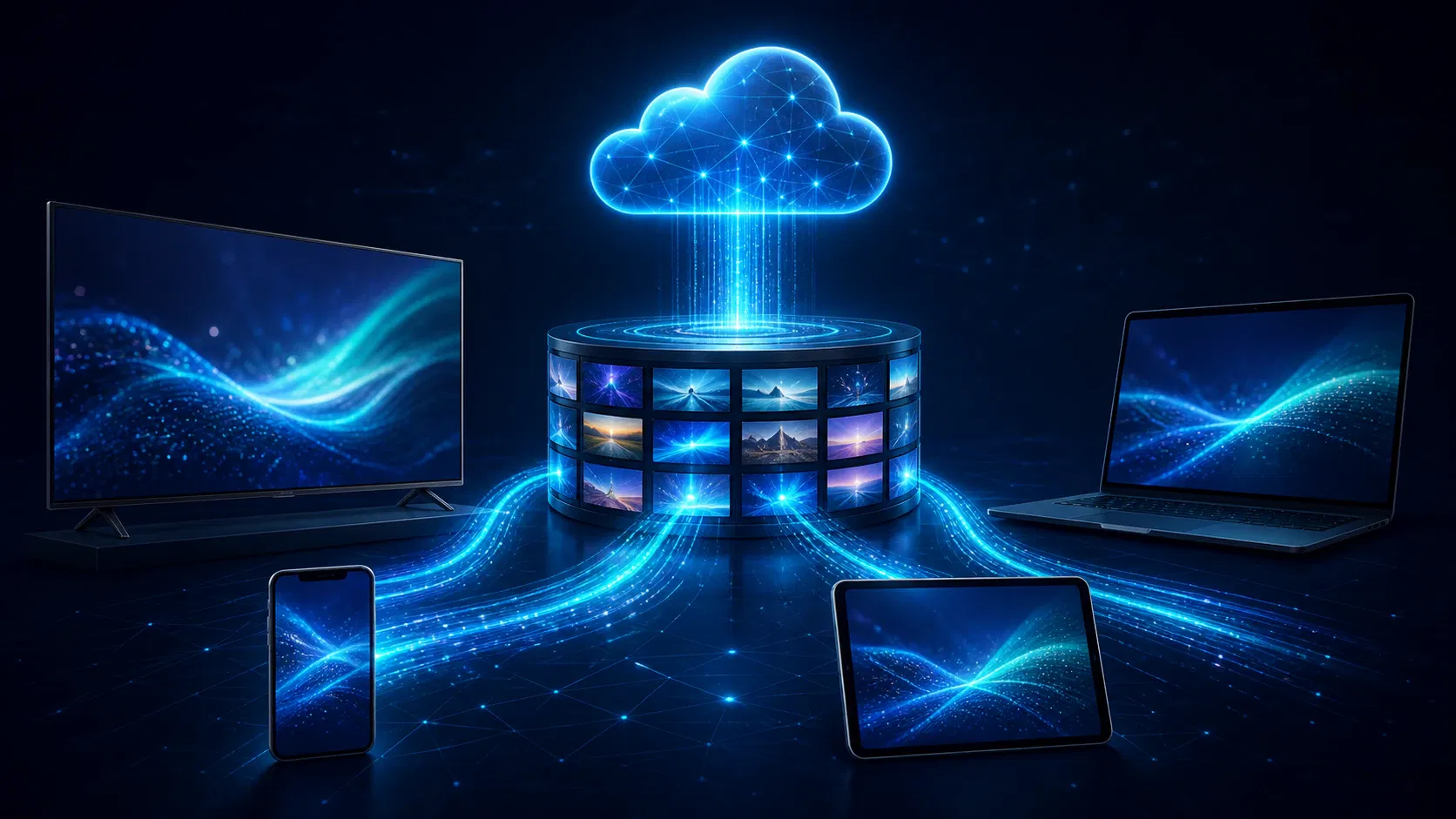
An OTT service delivers video or audio directly to viewers over the public internet instead of relying on a cable, satellite, or broadcast operator to distribute it. OTT stands for “over the top”: the service travels over the viewer’s existing internet connection and reaches a compatible app or browser.
OTT service definition: the short answer
In media, an OTT service is defined by how content reaches the audience, not by the kind of show, the screen, or the payment model. It may deliver an on-demand film, a live match, a scheduled channel, a podcast, or a free clip; what makes it OTT is delivery over the open internet outside a traditional television distribution system.
The IAB UK definition of OTT includes both linear television and video on demand delivered directly over the internet. It also makes an important device distinction: OTT can be accessed on mobile, desktop, consoles, apps, or the web and is not limited to a connected television.
That gives the term four practical boundaries:
- Internet-delivered: the public internet carries the media.
- Direct-to-viewer: the content provider can reach the audience through its own service rather than a cable channel slot.
- App- or browser-based: playback happens on software running on an internet-connected device.
- Independent of one access provider: changing broadband or mobile providers does not inherently require changing the OTT service.
In everyday Indian usage, “OTT” often means a video-streaming app. In broader telecommunications language, OTT can also describe internet-delivered messaging, voice, or audio services. This guide uses the media-industry meaning: consumer video and television delivered online.
How an OTT service works from content to screen
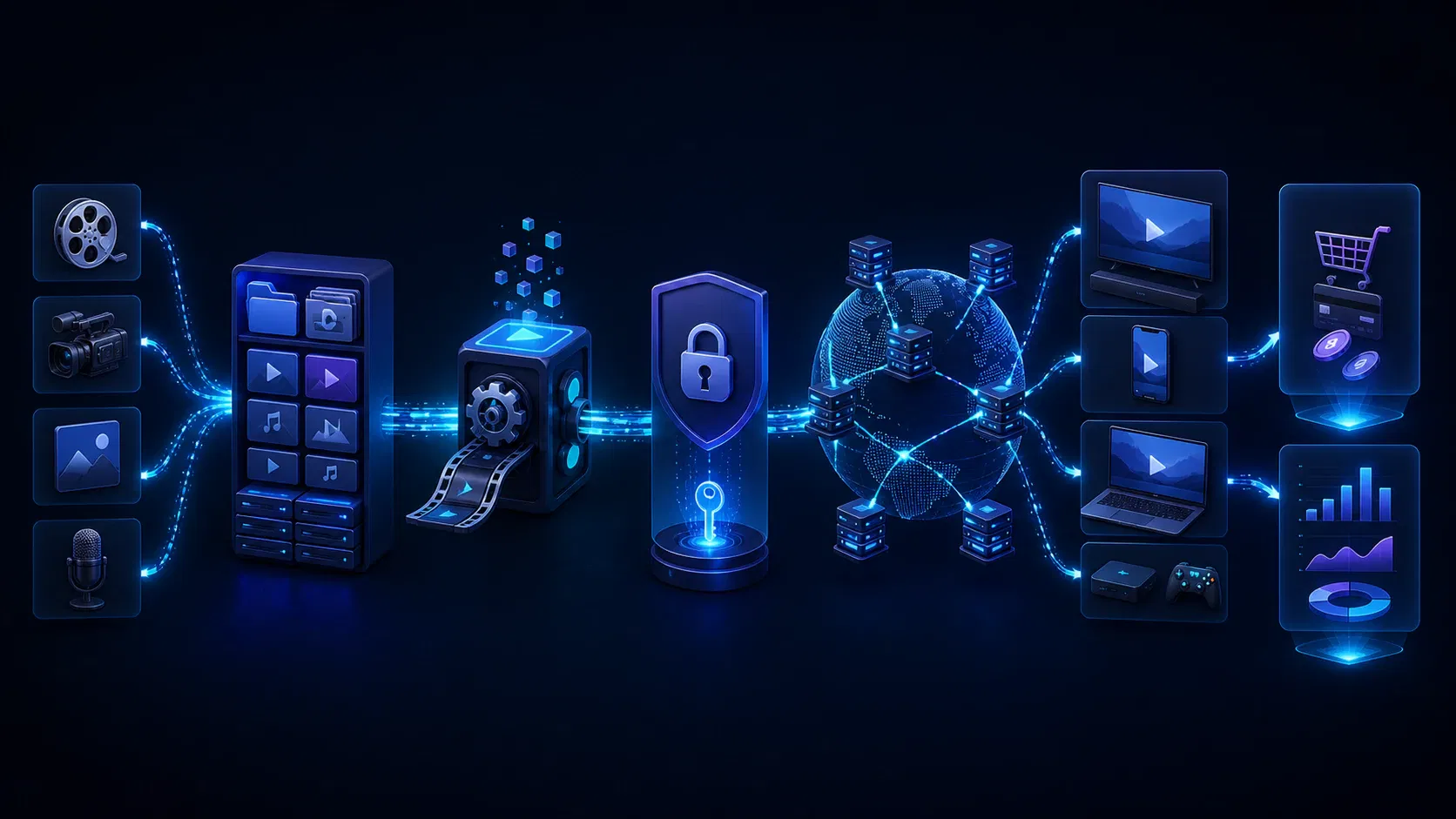
Pressing Play hides a multi-stage delivery system. For on-demand video, the path usually works like this:
- Ingest: A master video file and its metadata enter a content-management workflow.
- Encode: The source becomes several renditions at different resolutions and bitrates.
- Package: The renditions are divided into short media segments, with a manifest that tells a player what is available.
- Protect and authorize: Entitlements, encryption, signed requests, and sometimes digital rights management determine who can watch.
- Distribute: An origin stores the assets while a content delivery network caches them closer to viewers.
- Play: A web, mobile, or TV app requests a manifest and begins fetching segments.
- Measure: Playback analytics record startup time, buffering, errors, quality changes, and engagement.
Amazon’s CloudFront streaming documentation describes the same core packaging model: an encoder creates audio, video, and caption segments plus a manifest, using formats such as HLS, MPEG-DASH, or CMAF. Live OTT follows a similar path, but the encoder, packager, manifests, and segments keep updating while the event is happening.
The player normally receives multiple quality levels. Apple’s HTTP Live Streaming documentation explains that HLS supports alternate streams at different bitrates and lets the client switch in response to bandwidth changes. This is adaptive bitrate streaming: a slow connection may receive a smaller rendition while a stable connection receives a sharper one.
A CDN helps the same service reach many regions without sending every segment request to one origin. But “uses a CDN” is not a complete quality strategy. Encoding choices, cache behavior, player logic, device performance, and real network conditions all affect whether playback starts quickly and continues without interruption.
OTT service definition in practice: service, platform, app, and device
The vocabulary becomes easier when each term answers a different question.
| Term | What it means | Example question |
|---|---|---|
| OTT service | The audience-facing media offering | What can viewers watch and under what access rules? |
| OTT platform | The technology and operations stack behind that service | How will content be managed, delivered, protected, monetized, and measured? |
| OTT app | A client application for one device family | How will viewers browse and play content on Android TV? |
| OTT content | The live or on-demand media offered through the service | Which films, lessons, matches, or channels are available? |
| OTT device | Hardware capable of running or displaying the service | Is the viewer using a phone, smart TV, console, or streaming stick? |
| Connected TV (CTV) | A television screen connected to the internet directly or through another device | Where is the viewer watching? |
An OTT platform definition is therefore broader than “video hosting.” A working platform can include a video CMS, encoding and packaging, an origin and CDN, identity, subscriptions, payments, advertising, entitlements, DRM, applications, search, recommendations, customer support, and analytics. A business may build these components, buy them as a managed product, or combine both approaches.
One service can have several apps, and one app can expose several content formats. Likewise, a CTV device can display OTT video, but OTT viewing also happens on phones and browsers. Nielsen’s OTT, CTV, and streaming guide frames streaming as the broad delivery activity, OTT as internet distribution across devices, and CTV as television-screen viewing.
OTT compared with streaming, IPTV, VOD, and cable
These labels overlap, but they are not interchangeable.
| Concept | What it describes | Network or viewing constraint |
|---|---|---|
| Streaming | Media begins playing while data continues to arrive | Can occur across many delivery models |
| OTT | Direct media delivery over the public internet | Depends on an internet connection and compatible client |
| IPTV | Television delivered over a provider-managed IP network | Commonly tied to the operator’s network and equipment |
| VOD | Content available whenever the viewer chooses | Can be delivered through OTT, IPTV, or another system |
| CTV | Viewing internet-delivered content on a television screen | Describes the screen/device context |
| Cable or satellite TV | Traditional operator-controlled television distribution | Usually uses a managed channel package and receiver |
The shortest distinction is: streaming is an activity, OTT is a distribution model, VOD is an access pattern, and CTV is a viewing environment. IPTV also uses internet protocol, but normally runs on a managed network controlled by the provider; OTT traverses the open internet.
These categories can stack. Watching an on-demand program in an OTT app on a smart TV is simultaneously streaming, VOD, OTT, and CTV viewing. Watching a live OTT sports channel on a phone is streaming and OTT, but not CTV and not VOD.
Downloads do not invalidate the service’s OTT identity either. A subscription app may let an authorized viewer save a title temporarily for offline playback. The service is still OTT even though that specific viewing session does not stream continuously.
Types of OTT services and revenue models
An OTT services definition should not assume that every product looks like a subscription film library. Common models include:
- SVOD (subscription video on demand): viewers pay a recurring fee for access to a catalog.
- AVOD (advertising-based video on demand): viewers watch on-demand content funded wholly or partly by ads.
- TVOD (transactional video on demand): viewers rent or buy individual titles or events.
- FAST (free ad-supported streaming television): scheduled, channel-like programming is streamed free with advertising.
- Live OTT: sports, news, worship, classes, conferences, or entertainment are delivered as they happen.
- Hybrid: subscriptions, advertising, transactions, free sampling, or premium tiers coexist in one service.
The Nielsen terminology guide separately defines SVOD, AVOD, TVOD, FAST, and virtual channel bundles, which is useful because the distribution method does not dictate the commercial model. A service can change its pricing or add an ad-supported tier without ceasing to be OTT.
The better model depends on audience behavior, content rights, willingness to pay, release windows, advertising demand, and the cost to acquire and serve each viewer. The technology must then enforce that model: subscriptions need billing and entitlements, advertising needs decisioning and insertion, transactions need purchase rights, and regional catalogs need availability rules.
What an OTT service needs beyond a video player
A player proves that a stream can open. A service must also remain usable, secure, measurable, and commercially operable across its intended devices.
Start with these layers:
- Content operations: metadata, artwork, seasons, live schedules, rights windows, localization, captions, and publishing approvals.
- Media processing: repeatable encoding, audio and subtitle handling, packaging, quality checks, and live workflow resilience.
- Delivery: origin capacity, CDN design, adaptive bitrate ladders, regional performance, and failure handling.
- Identity and rights: sign-in, profiles, entitlements, geo-restrictions, concurrent-stream limits, and device management.
- Content protection: encryption, secure tokens, and DRM where licensing requires it. Google describes Widevine as a premium-media protection system built on standards including Encrypted Media Extensions and Common Encryption.
- Applications: consistent discovery and playback across web, mobile, smart TV, connected TV, and any required consoles.
- Monetization: subscriptions, payments, advertising, transactions, taxes, refunds, and revenue reporting.
- Observability: audience analytics plus playback quality-of-experience data that can separate content, CDN, player, DRM, and device failures.
For teams deciding whether that operating stack belongs in-house, Apexnova connects application engineering with encoding, multi-CDN delivery, DRM, monetization, and playback analytics. That engagement is most relevant when a service must work across web, mobile, and connected TV without fragmenting ownership across unrelated vendors.
Treat the device matrix as a product decision, not a last-mile porting task. A browser, iPhone, budget Android phone, Roku device, Fire TV, and several generations of smart TV can differ in codec, DRM, memory, input, app-store, and lifecycle constraints. “Available everywhere” needs a maintained list of supported combinations and a test plan for each one.
A practical OTT service evaluation checklist
Before choosing a platform or writing an architecture plan, answer these questions:
- Which audience and geographic markets must the service reach first?
- Is the content on demand, live, scheduled, or a mixture?
- Which web, mobile, and television devices are launch requirements?
- Which codecs, captions, audio tracks, accessibility features, and DRM systems do content rights require?
- Will access be free, subscription-based, ad-supported, transactional, or hybrid?
- Who owns customer identity, payment data, viewing data, and content metadata?
- What are the targets for startup time, buffering, availability, live latency, and support response?
- How will the team test real devices and detect regressions after release?
- Which components create meaningful product differentiation, and which can be bought without creating lock-in?
- What happens when an encoder, origin, CDN, payment provider, DRM service, or app-store release fails?
This checklist also clarifies whether you need simple hosting or an OTT platform. If the product only embeds a few public videos on a website, hosting and a lightweight player may be enough. If it sells access, publishes a managed catalog, supports television apps, or operates live channels, the wider OTT stack becomes relevant.
Frequently asked questions
What does OTT stand for?
OTT is the abbreviation for “over the top.” In media, the phrase means content travels over the public internet to an app or browser instead of being distributed through a traditional cable, satellite, or broadcast television operator.
Is Netflix an OTT service?
Yes. Netflix is an OTT service because it delivers its catalog to internet-connected devices rather than requiring a cable or satellite television package. Netflix itself describes the product as a subscription-based streaming service.
What is the difference between OTT and streaming?
Streaming is the process of playing media while data is still being delivered. OTT is the distribution model in which a service reaches viewers over the public internet, so most OTT viewing uses streaming, but the terms answer different questions.
What is the difference between OTT and IPTV?
OTT uses the open internet and normally works independently of the viewer’s internet provider. IPTV usually delivers television over a managed, private IP network controlled by a telecom or service operator, often with operator-provided equipment.
Do I need a smart TV to use an OTT service?
No. OTT services can run in web browsers and apps on phones, tablets, computers, consoles, streaming sticks, set-top devices, and smart TVs. A television is only one possible screen.
How do OTT services make money?
They commonly earn revenue through subscriptions, advertising, one-time rentals or purchases, pay-per-view events, sponsorships, or a hybrid of these models. The delivery remains OTT regardless of which monetization model is used.
Use the definition to choose the right scope
The useful OTT service definition is not “an app like Netflix.” It is a direct internet distribution model supported by content operations, media processing, delivery, security, apps, monetization, and measurement.
For an early concept, define the audience, content format, device matrix, rights, and revenue model before comparing vendors or estimating a build. If those answers expose dependencies across playback, infrastructure, DRM, billing, and TV applications, request an OTT architecture review and turn them into one testable service scope.